


Hot-Water Circulation When Pipes From Boiler Pass Under The Floor
Description
This section is from the book "Plumbing Problems", by The Sanitary Engineer. Also available from Amazon: Plumbing Problems, or Questions, Answers and Descriptions Relating to House Drainage and Plumbing.
Hot-Water Circulation When Pipes From Boiler Pass Under The Floor
Q. I inclose drawing of boiler, pipes, and tank. I saw in the Sanitary Engineer of April 19, 1883, a plan for circulating, which I mark Figure 109. I have tried the plan, but it will not work. I then cut off the return hot-water pipe or circulating pipe, marked c, which ran to the bottom of boiler, and connected it to the circulating-pipe of stove and boiler, as by dotted lines, and it still will not work. The pipe can't be run on kitchen-ceiling nor over ceiling on floor. Evidently we must run through floor to cellar-ceiling, and up in partition to tank and bathroom. Can you inform me how to make a circulation work without changing the whole line of pipe? If you can give me any information concerning the circulation it will oblige me very much.
A. Any circulation which has to drop after leaving the boiler is a thing of doubt, as there are so many circumstances which may affect the flow besides the actual direction of the pipe. When the pipe which has to convey the water away from the boiler has to take a downward course, or the pipe returning to it again takes an upward one, they separately and collectively preponderate against the force which naturally tends to assist the circulation. In your case, in b, from the boiler to the under side of the floor, the water is the hottest in the circulation, and would naturally rise, whereas it must go down to accomplish what you want. But in c, for the same perpendicular height, it is the coldest, as it is the end of the circulation, and would naturally fall where it is forced to ascend to accomplish what you desire. Thus, in these two pipes, from the boiler to the under side of the floor, you have a preponderance against you. In the pipe b, where it rises in the house again, you have a hot pipe, but not as hot as where it runs in the wrong direction at the boiler, and in juxtaposition to it you have the return-pipe c colder than it, though not very much so, and warmer than the pipe c where it rises. These pipes at this point tend in the right direction, but the difference of weight of water between them is not sufficient to overcome the difference which works against them in their course in the vertical position near the boiler.
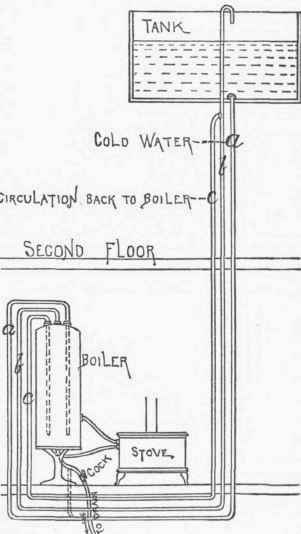
Figure 109.
If you clothe a flow or hot pipe where it ascends, and a return or cold pipe where it also ascends, and all level pipes, it will assist a circulation, as by that means you prevent a great loss of heat at these parts, and keep the column of water nearly the same temperature and density throughout its length, allowing it to cool only where cooling will tend to quicken the circulation by increasing the density - namely, where flow-pipe or return-pipes fall, but notably the latter. In your case, if b and c, where they run upward, could be extended indefinitely, you presumably would reach a point where the circulation would go on, and which Mr. Armstrong must have exceeded in his case, or his job in the Young Ladies' Seminary at Northfield, Mass., would not have worked. There may be influences at work, also, in his case, assisting him, such as a large quantity of cooling surface in his return-pipe compared to the bulk of water it will hold, or its being run in a position where the influence of cold draughts or cold pipes affects it. The method of entering the boiler at the bottom with the return-pipe is better than carrying it down inside in a tube.
We do not recommend this method of getting circulation, and no one should attempt it unless it was an impossibility to run the pipes any other way. Hood, in his treatise on warming, etc., says: "In Figure no, B represents the boiler; and the effective or direct motion is in this case caused by the water in the coil and pipe c d being so much heavier than in the boiler and the pipe B a that it overcomes the retrograde motion which is produced by all the other parts of the apparatus. Thus the water in g h being heavier than that in i k, and that in e f (below the dotted line) being lighter than that in l m, has in both cases a tendency to retrogression. * * * The motive power, therefore, entirely depends upon the quantity of heat given off by the coil; for the water must be cooled down many degrees in order to give it sufficient preponderance over the water in B a to cause a circulation."
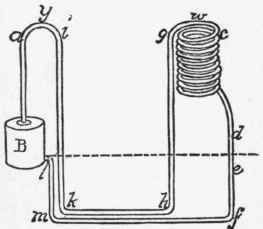
Figure 110.
Continue to:


My Books

