


Emptying A Trap By Capillary Attraction
Description
This section is from the book "Plumbing Problems", by The Sanitary Engineer. Also available from Amazon: Plumbing Problems, or Questions, Answers and Descriptions Relating to House Drainage and Plumbing.
Emptying A Trap By Capillary Attraction
Q. I was requested a few days ago to investigate the cause of a terrible stench, similar to that found in a sewer, which filled the bath-room (which also contained a water-closet) almost to suffocation, during the early hours only of each morning, and until the water-closet had been used or the bell-pull lifted. The cause for this terrible stench was found to be a most peculiar one indeed - viz., a large 4-inch P-trap being syphoned by capillary attraction.
The entire plumbing-work was carefully examined, but no leak or other defect was visible. Yet the trap under the water-closet was found to contain very little, if any, water for several consecutive mornings. Then a series of the usual but most severe trials or attempts were made to syphon this trap (there is a similar bath-room above this one, and all using the same soil-pipe), all of which failed.
Then the water-closet, etc., was removed, and the following was found - viz.: The trap was found to be a hand-made, soldered, side-seam one, made of sheet-lead. In soldering the seams some of the hot metal had been permitted to protrude beyond the inner side of the trap, and thus formed a projecting "peg," on which a large cloth had caught in attempting to pass. As the closet necessitated the use of a considerable quantity of water, the effect was to attempt to carry the cloth out of the trap, but the actual result was to firmly retain one portion of the cloth at the lowest point (nearly) of the trap, and carry, in a continuous line, the remaining portion up and out into the soil-pipe, thus completely syphoning the water from the trap during the night hours, when the water would not be replaced at short intervals. A similar circumstance was found in the trap of a kitchen-sink almost two years since. However, in this case the trap had first caught some shreds of cloth on the rough edges of the trap-screw, the result being almost identical with the above. I send you herewith a sketch of the first described trap, which you are at liberty to use in such manner as you deem proper.
A. The trap described above was an old-fashioned one, such as is not made nowadays. Yet the imperfection seems to have served a good purpose in this case in drawing attention to the cloth in the trap. If it had been washed through it would have been very likely to make a dam at some other point less accessible than this one, and render it necessary to cut the pipe open to get it out. If the water-closet had been a simple hopper with accessible trap there would have been no need to remove it, for any one could have reached the cloth in a moment.
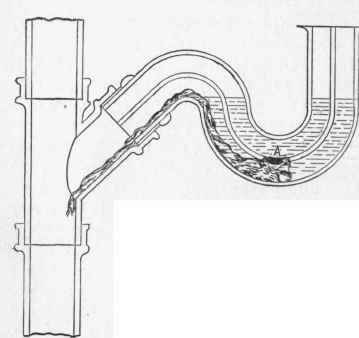
Figure 54.
Moral - Avoid complicated fixtures, and preserve all textile fabrics for paper stock instead of putting them down the drains.
We believe that a few months ago a New York plumber had his attention directed to this same capillary action, and made several experiments upon it, which satisfied him that, under some circumstances, it could and did cause the loss of seal where other explanations failed to account for it, all of which enforces the moral cited above.
Continue to:


My Books

