


2. Increase of Adipose Tissue
Description
This section is from the book "Part 8.2. Inanition (Fasting) And Fattening Cures - On the Pathology and Therapy of Disorders of Metabolism and Nutrition", by Prof. Dr. Carl von Noorden. Also available from Amazon: Clinical Treatises On The Pathology And Therapy Of Disorders Of Metabolism And Nutrition V8: Inanition And Fattening Cures (1910)
2. Increase of Adipose Tissue
From all that has been said it is clear that to increase the adipose tissue is much simpler and much more certain than to increase the protoplasm. One can force an accumulation of fat by increasing the amount of food that is introduced and that is assimilated above the standard of the maintenance diet. In fact, one is able to predict with almost mathematical accuracy how much fat can be deposited in this way. If we add a definite surplus to the maintenance diet (fattening addition), then a small proportion of the superfluous calories is utilized in the process of digestion and absorption (an average of about 8%); a small part leaves the body without having been utilized at all (unabsorbed material, losses in the feces averaging about
4% of the caloric surplus). Of the large remainder a small amount, averaging at the utmost 10% of the caloric surplus, is stored in the cells in the form of reserve albumen. All the rest is deposited as nitrogen-free material. It is customary to calculate this latter factor as fat, although one must remember that a portion of this surplus is also stored as glycogen. The latter portion, however, is very small, and at the expiration of a few days reaches a maximum that cannot be exceeded, so that from then on the calculation of the stored material as fat corresponds to actual conditions.
As an example the following fattening experiment, that B. Krug performed eighteen years ago under my direction, may be analyzed:
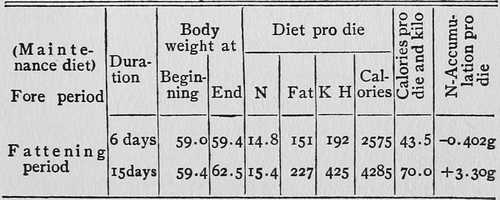
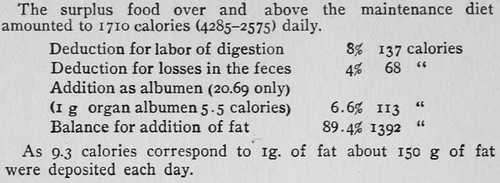
Calculations of this kind can, of course, only be performed in an exact manner if analyses of all the articles of food and of the excreta are made at the same time. In general one must be content with estimates that are sufficiently accurate, however, in practical work.
In determining simply the increase in weight other values must, of course, be introduced than in determining the deposit of albumen or of fat ; for the bulk of the body is increased not only by dry substances but also by water and by inorganic constituents. In a previous paragraph I have given certain figures relative to the latter point that I have gained from an experience extending over many years.
Continue to:


My Books

