


Animal And Vegetable Proteins Compared
Description
This section is from the book "Vitamines - Essential Food Factors", by Benjamin Harrow. Also available from Amazon: Vitamines, Essential Food Factors.
Animal And Vegetable Proteins Compared
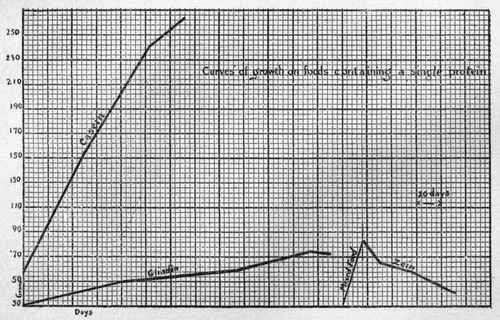
Now turn your attention to chart 2. A diet consisting of the protein casein* (found in milk) which, as you may gather from the table in the Appendix, does not contain the amino-acid glycocoll, caused rats to grow and gain in weight; for notice the incline of the curve marked "casein." Evidently glycocoll is not indispensable. When the protein glia-din (derived from wheat or rye) is substituted for casein, the incline of the curve is nowhere near as sharp. -The increase in weight is very, very gradual. Gliadin, as the table shows, is deficient in the amino-acid lysine, and the failure to gain so rapidly may be due to this deficiency.
The foods other than protein that Drs. Osborne and Mendel used were starch, sugar, lard, agar and inorganic salts. The agar was added "to form an indigestible intestinal 'roughage,' " and the inorganic salts were given either as a mixture of the pure inorganic salts, or in the form of "protein-free milk" - a product representing the milk from which fat and protein have been removed. In their subsequent vitamine studies these investigators made frequent use of this "protein-free milk."
* And, of course, fat, carbohydrate, etc. Please remember that in all the examples here given, the one constituent of the diet that varies is the protein; the other constituents are not changed during such experiments, though they are always added in proportions that experience has taught to be beneficial.
Figure 2. - Amino-Acids and Growth
Showing typical curves of growth of rats maintained on diets containing a single protein. On the casein food (devoid of glycocoll) satisfactory growth is obtained; on the gliadin food (deficient in lysine) little more than maintenance of body weight is possible; on the zein food (devoid of glycocoll, lysine and tryptophane) even maintenance of body weight is impossible.
Osborne and Mendel: J. A. M. A., 1915.
In answer to the criticism that "protein-free milk" is not free from nitrogen compounds, and "therefore makes a comparison of the biological value of different proteins" difficult, Prof. Mendel writes: ". . . It is true that protein-free milk which we used in our earlier experiments contained a certain modicum of nitrogenous matter - a fact which we ourselves pointed out, It is not unlikely that this may have altered the numerical values in the comparisons which we made earlier between the different proteins. In recent years we have no longer used this product. In fact at the present time whenever it is desired to compare protein values we employ a yeast concentrate which gives no biuret reaction [the 'biuret' test is one used to detect proteins]. I believe that the fundamental conceptions regarding the importance of certain amino-acids is unaltered by any of the comments which have been made."
Now notice the interesting situation that arises when zein (derived from maize) becomes the sole source of protein. At first the rats under examination were given a mixed food containing several different proteins, and the animals thrived splendidly. Then after about two weeks the diet was so changed as to replace the mixed proteins with the single protein zein. See how the curve suddenly swerves. It actually goes down-hill. This down-hill slope of course indicates that the animals are losing weight and are on the decline; for remember that we are not dealing with rats that have reached maturity and that are merely too fat, but young rats in the growing stage. If rats in the growing stage lose weight, particularly if the loss continues over many weeks, then something is surely the matter - just as under similar conditions all would not be well with an infant.
Zein is devoid of the amino-acids glycocoll, lysine and tryptophane. The experiments with the milk protein, casein, have proved that glycocoll is not essential; for though casein contains no glycocoll, the animals thrived. Where lysine alone is deficient in the protein molecule there is more or less maintenance; that is, neither a decided increase nor decrease in weight (see the curve marked glia-din); hence the decided downward slope of the curve in the case of zein would lead to the belief that the indications of rapid decline are probably due to the absence of the amino-acid tryptophane (and perhaps also cystin. See later experiments).
The three experiments just described are extremely suggestive, for they point to the indispensa-bility of the amino-acids lysine and tryptophane. The indications are that no matter how many calories a diet yields, no matter how well the diet is distributed among the foodstuffs, no matter how much protein is given, if the protein part of the diet is deficient in the amino-acids lysine and tryptophane, life is impossible.
To prove this still further, Drs. Osborne and Mendel fed rats with a diet in which the protein consisted of zein only. Note the loss in weight
(chart 3, the first portion of curve B). After several weeks the amino-acids lysine and tryptophane were added to the diet. See how the curve immediately shoots upwards. When tryptophane alone is added to the zein the rats neither gain nor lose in weight (chart 3, first part of curve A); upon the further addition of lysine a gain in weight is noted.
Figure 3. - Amino-Acids and Growth
Showing the effect of the amino-acids tryptophane and lysine to zein which fails to yield them. With zein alone there is nutritive decline. The addition of tryptophane permits maintenance but not growth. The addition of tryptophane and lysine enables the animals to make considerable growth.
Osborne and Mendel: J. A. M. A., 1915.
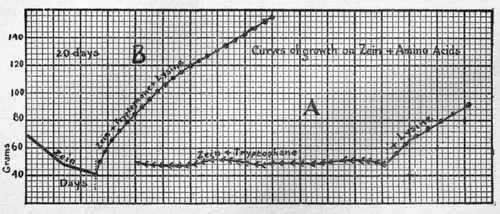
Figure 4. - Amino-Acids and Growth
Showing the favorable effect on growth by supplementing a protein (zein) incapable of maintaining animals when it is the sole protein furnished in the diet with a more "perfect" protein (lactalbu-min). The proportion of the lactalbumin used - 4.5 per cent - was of itself insufficient to promote growth well. It evidently furnished the amino-acid groups lacking in the zein.
Osborne and Mendel: J. A. M. A., 1915.
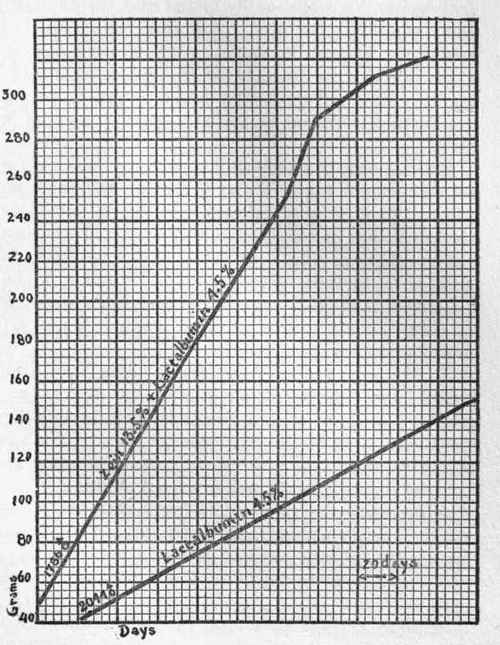
Enough now has been said regarding these charts so that charts 4 and 5 and 6 become self-explanatory. Chart 4 is of interest because it points to the advantage of a diet consisting of mixed proteins rather than a single protein; and our diets do happen to include mixed proteins. Charts 5 and 6 emphasize the importance of appreciable amounts of certain amino-acids, such as cystine (chart 5) and lysine (chart 6).
So far only a few of the amino-acids have been tested; but this is not surprising, for the experimental details of such a research often become bewildering even to the professional man. What is glibly dismissed in a sentence or two in some report, often represents weeks of painstaking labor. But the study of even these few amino-acids has made it evident that henceforth instead of speaking of the protein content of foods, we shall have to discuss them in terms of their amino-acid content.
So long as man eats food in variety and abundance, the fear of malnutrition is slight. Without really knowing the precise content of his food, he manages to get what he needs. But the days of abundance for most of us are fast coming to an end. In certain portions of the hemisphere even mere subsistence is beset with great difficulty. If in the place of semi-guesswork we can substitute exact knowledge; if we can tell the people, Take such and such foods because they contain such and such proteins, which in turn are rich in such and such amino-acids essential to life, then we have contributed very definitely to the welfare of mankind.
Continue to:


My Books

