


42. The Nomenclature Of The Vitamins
Description
This section is from the book "The Newer Knowledge Of Nutrition", by Elmer Verner McCollum. Also available from Amazon: The Newer Knowledge of Nutrition: The Use of Food for the Preservation of Vitality and Health.
42. The Nomenclature Of The Vitamins
The nomenclature of these recently discovered nutritive complexes is more or less in a state of confusion. Stepp (12), who is entitled to the credit of having first established the indispensability of certain alcohol-ether soluble substances in the diet, regarded them as lipins. Funk (19) designated a hypothetical group of protective substances of unknown nature "vitamines." Hopkins (9) after discovering the remarkable growth-promoting effects of small additions of milk to a diet of purified food-stuffs, termed them "accessory" food substances.
There is much reason to believe that Stepp's view that the substances under discussion are lipins is erroneous. They are associated with the lipins under the conditions under which he worked. The term "vitamine" seems to bestow an importance upon these substances paramount to that of other indispensable substances. Such an assumption is obviously unwarranted. There is no evidence as yet that any of them are amines, and indeed there are strong reasons for believing that one at least, that associated with certain fats, does not contain nitrogen. The term amine has a definite significance in organic chemistry, and it seems reasonable to insist that its use should be reserved for compounds containing an amino group. The term "accessory" food-stuffs is the least desirable of all, for it uses the term "accessory" in a sense exactly the opposite to its well established meaning, that of an agent acting in a subordinate way to a principal agent. There can obviously be no room for differentiation on a basis of importance among a series of indispensable food complexes which includes several amino-acids, nine inorganic elements, a utilizable carbohydrate, and two or more unidentified factors. The term "accessory" would be rightly used to designate the condiments, such as the various spices, which add to the acceptability of foods.
When it was established that there are two unidentified factors necessary in the nutrition of the rat; that one was soluble in fats and not in water, and the other never associated with fats, but easily dissolved out of natural foods by water or dilute alcohol, it became necessary to differentiate between them by names which would characterize them. For the reasons stated, none of the terms in use seemed desirable, and it seemed to McCollum and Kennedy (24) advisable to employ provisionally algebraic terms, using a prefix designating characteristic solubility. They proposed the terms fat-soluble A for the factor carried by certain fats, and water-soluble B for the factor which relieves the paralysis in polyneuritic animals. These terms have found widespread acceptance, but the terms introduced by Stepp, Funk and Hopkins, are still used by many, and frequently in ludicrous combinations, such as fat-soluble A vitamin; water-soluble B accessory. The lack of appreciation of fitness, and even of consideration of definition of well-established terms, which is exhibited by certain writers of this branch of literature is truly amazing.
Upon the establishment of the existence of an anti-scorbutic substance Drummond (25) designated it water-soluble C. He has recently (26) suggested that the spelling of vitamine, be changed to vitamin, and this term be adopted to designate the entire group of chemically uncharacterized dietary essentials. This would be in accord with the nomenclature of the hormones and of the alkaloids, and indicates nothing of their chemical natures. This seems to be a satisfactory nomenclature to adopt.
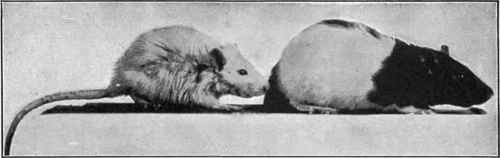
Fig. 5. - The rations of these two rats from weaning time were exactly alike except in the character of the fat which they contained. The one on the left was given 5 per cent of sunflower seed oil. The one on the right was given 1.5 per cent of butter fat. Butter fat, egg yolk fats and the leaves of plants contain a dietary essential, the chemical nature of which is still unknown, which is necessary for growth or the maintenance of health. This substance is known as fat-soluble A, and is not found in any fats or oils of vegetable origin. A lack of this substance in the diet causes the development of a peculiar eye disease known as xerophthalmia. The animals were the same age when photographed.
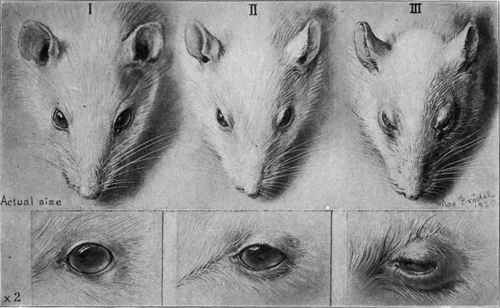
Fig. 6. - Illustrates the appearance of the exterior of the eyes as ophthalmia of dietary origin develops. On the left is shown the normal eye of the rat. In the center is shown the puffiness around the eyes which denotes that ophthalmia is about to appear. On the right the extreme edema of the eyelids is shown. When the latter condition is reached the cornea usually ulcerates and a bloody exudate seals the lids shut. The eyes become filled with leucocytes. The introduction of a fat containing fat-soluble A leads, in the earlier stages, to prompt recovery from this condition.
Continue to:


My Books

