


400. One May Have A Surprising Variety Of Food And Still Have A Faulty Diet
Description
This section is from the book "The Newer Knowledge Of Nutrition", by Elmer Verner McCollum. Also available from Amazon: The Newer Knowledge of Nutrition: The Use of Food for the Preservation of Vitality and Health.
400. One May Have A Surprising Variety Of Food And Still Have A Faulty Diet
The most surprising generalization which is warranted by exact nutrition studies, is that even a diet composed of cereal grains, legume seeds, tubers, fleshy roots, fruits and muscle cuts of meat, irrespective of the proportions in which the components are represented, the variety which it affords, or the chemical composition as shown by even the most searching analysis by chemical methods, will fail to support satisfactory growth in a young rat. It will further fail to maintain satisfactory health and vitality in an adult which has been reared on a diet which is of high quality until it has completed its growth, and is later transferred to its experimental diet. Such a diet may contain any or all of a list of foods including wheat, maize, rolled oats, barley, rye, pea, bean, soy bean, potato, turnip, radish, beet, steak, ham, roast, etc., or any other seed, tuber, root, and muscle meat, and still fail signally to maintain the vitality of a rat. Muscle meats, as has already been stated, enhance such a mixture only with respect to protein and phosphorus, among the factors in which it is deficient. When such meats are included in the above list, the deficiencies of the diet will be limited to calcium, sodium, chlorin and fat-soluble A. In the above discussion we have limited ourselves to the nutrition of the rat. This species, as has already been pointed out, does not require the anti-scorbutic substance in its diet. In order to make such a food supply as we are now discussing, complete for human nutrition, it would be necessary to include a certain part of the fruit in the raw condition. Raw potato and other root vegetables would also serve this purpose well, whereas the seeds of the cereals or legumes, or muscle meats, are of very little value for this purpose.
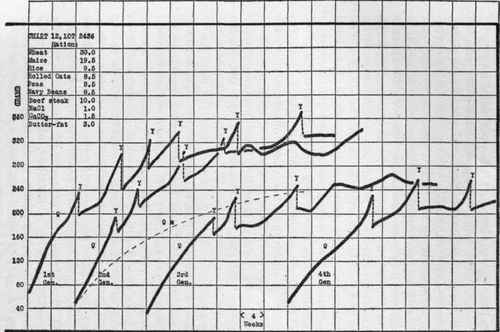
Chart 12. - This chart shows how good growth and high fertility may be secured in rats on a monotonous diet consisting of cereal grains, legume seeds and beefsteak supplemented with calcium, sodium and chlorine and with a source of fat-soluble A. If the inorganic additions are omitted the animals on this diet would be entirely unable to grow. If the butter fat were omitted they would be very inferior, and succeeding generations would be of low vitality. This would also tend markedly to reduce the fertility. If the beefsteak was omitted and no other supplementary source of protein was added in its place the animals would again be stunted, especially in the second generation. The omission of a supplementary source of protein would effect in a marked manner the capacity to produce and rear young. With the diet as tabulated, however, we have a complete food mixture and the family took it without any variation through successive generations without any striking deterioration in vitality.
Continue to:


My Books

