


285. Hemeralopia And Nyctalopia Possibly Associated With Vitamin Deficiency
Description
This section is from the book "The Newer Knowledge Of Nutrition", by Elmer Verner McCollum. Also available from Amazon: The Newer Knowledge of Nutrition: The Use of Food for the Preservation of Vitality and Health.
285. Hemeralopia And Nyctalopia Possibly Associated With Vitamin Deficiency
It is of interest in this connection to call attention to another widespread condition which seems related to a deficiency of fat-soluble A in the diet of man. Hemeralopia, or inability to see by subdued light, is common in several parts of the world, and has been frequently referred to faulty nutrition. Thus Krienes (24) attributed certain cases of the disease to malnutrition. De Gouvea (25) gave a resume of the literature of the subject up to 1883, and described many cases of hemeralopia among the negro slaves who worked on the coffee plantations of San Paulo, Brazil. They were restricted to a diet of beans, pork fat and maize meal. Slaves on other plantations who were better fed did not suffer from the disease. Little (26) mentioned the prevalence of night blindness (nyctalopia, often inaccurately called hemeralopia) among the people of Newfoundland. He also stated that the diet was sufficiently poor to make beri-beri and scurvy a common occurrence. I am informed by Dr. Grenfell that night-blindness is common in Labrador. Dr. Appleton, in a private communication also informs me that she has seen many cases of this eye disease in Newfoundland and Labrador. The diet of the inhabitants of these regions consists almost exclusively of bread made from bolted wheat flour, canned meats, fish, molasses, tea and small amounts of raisins.
The diet of these regions is of a character which one would expect to be dangerously low in its content of fat-soluble A as well as deficient in other respects. It is essentially a diet derived from the endosperm of wheat, muscle tissue of beef, pork and fish, and molasses. The last article of food, after its drastic treatment in the manufacture of sugar, would not be expected to have any appreciable value as a source of any of the unidentified dietary factors. Such a diet is actually so poor in the anti-neuritic substance that beri-beri is of frequent occurrence, and is likewise so poor in the anti-scorbutic factor as to make scurvy common. Judging from the known dietary properties of muscle meats, there is every reason to believe that the diet is also deficient in fat-soluble A. The regular use of cod livers as an adjuvant to the diet in these places is advisable, since this would prevent both beri-beri and scurvy, and perhaps also night-blindness.
Dr. Ann Young, who has had experience as a medical missionary in India, has informed me that night-blindness is common in the vicinity of Calcutta (27). The popular remedy for the condition consists in poulticing the eyes with an exudate of fresh goat's liver and in including liver in the food. I have also been informed from several sources that the value of liver for the cure of night-blindness has been appreciated in Japan from very early times. It has already been pointed out that the glandular organs of animals are good sources of fat-soluble A. It is not to be wondered at, if our surmise is correct, that night-blindness in certain parts of the world is in reality due to specific starvation for fat-soluble A. That it should occur in parts of India where the people subsist to a great extent on a diet derived from muscle meats and from those parts of the plants functionating as storage tissues is to be expected from our present knowledge of nutrition. Several types of faults in such diets would tend to predispose to susceptibility to lack of fat-soluble A. In Japan where there is no dairy industry, the supply of fat-soluble A would depend largely upon the extent to which leafy vegetables are ingested. Certain edible roots have been shown to contain moderate amounts of this factor, but the amounts of such succulent foods as would ordinarily be eaten by man would scarcely suffice to meet the requirements of the body. The encouragement of the dairy industry in these countries, or the importation of liberal amounts of dried or canned milk, and their wider use in the diet, together with the utilization as adjuvants to the diet of fish livers and other glandular organs of animals, and of eggs, would go far toward the elimination of this disease, which, provisionally, may be regarded as a specific syndrome of dietary origin.
From early times records have come down to us showing that epidemics of dropsy have occurred during famines caused by drought or war. In the descriptions of this disorder, it has been noted that hemeralopia frequently preceded the development of the edema. It is said that night-blindness is endemic in Russia during the Lenten Fasts. Corneal ulcers and xerosis of the conjunctiva have sometimes been noted, among those who suffered from edema due to faulty nutrition, and ophthalmologists have repeatedly referred these eye changes to poor nourishment. These eye troubles in man result from conditions so complicated that it is not possible without further evidence, to attribute all of them to specific starvation for fat-soluble A. There is, nevertheless, a strong presumption that xerophthalmia or keratomal-acia and night-blindness (hemeralopia, nyctalopia) not infrequently occur as manifestations of a deficiency of this dietary factor.
This conclusion is supported by the frequent occurrence in the literature of ophthalmology of expressions of the belief that malnutrition may bring about the condition of defective vision known as hemeralopia. Illustrations are found in the association of eye diseases with pellagra by Rampoldi (24), in the view of Saweljew, published in 1892, that night-blindness results from fat hunger (24); in the report of Roussanow (24) as early as 1885, that cod liver oil is an unfailing remedy for hemeralopia, and in the description of "springtime catarrh" and its associated conjunctivitis by Vetsch (24). These observations suggest that a diet derived too largely from cereal products, tubers and other foods having similar deficiencies, induce lowering of vitality, which becomes manifested, among other ways, in faulty vision.
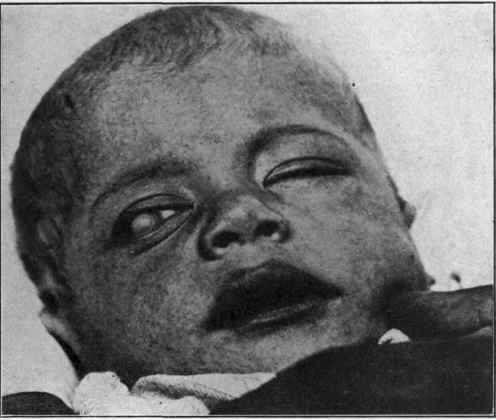
Fig. 11. - Illustrates a baby observed and treated by Dr. C. E. Bloch of Copenhagen. The child was suffering from severe xerophthalmia due to being confined too largely to a diet of separator skim milk supplemented with cereals. The right eye is filled with leucocytes and presents a yellow appearance. The left eye is swollen shut. The right eye was affected with a corneal ulcer. The sight of the right eye was lost.
Continue to:


My Books

