


The Therapeutic Uselessness And Social Mischief Of Hypnotism. Part 6
Description
This section is from the book "Hypnotism, Mesmerism And The New Witchcraft", by Ernest Hart. Also available from Amazon: Hypnotism, Mesmerism, and the New Witchcraft.
The Therapeutic Uselessness And Social Mischief Of Hypnotism. Part 6
Dr. Luys l recognises frankly that a great variety of physical methods suffice to produce the condition of artificial sleep - the presentation of a shining object in front of the eyes, the vibrations of a tuning fork, the ticking of a watch, the sound of a horn, a mere word of command, and, when the subject is sufficiently trained, the mere holding of the finger before the eye. To save himself trouble he has had constructed a framework of small mirrors, rotated by a clockwork movement, before which the subjects for experiment are placed, and as they gaze at it they fell into various attitudes of slumber, fascination, catalepsy, hysteric hallucination, or whatever else one may please to call it. Fig. 12 (copied from a photograph in a volume of Dr. Luys's lectures) shows the effect of the compound mirror on a number of cataleptic subjects after gazing at it. This mechanical hypnotisation might, it would be supposed, have relieved the physician and those who surround him of some of the superstitions with which his practice is loaded, but it has by no means had that effect.
The first series of phenomena presented to me were illustrative, and supposed to be demonstrative, of the extreme sensitiveness of the hypnotised patient and highly trained subject to magnetic currents however feeble, to residual magnetic impressions, to magnetic effluvia, to the perception of coloured luminous atmospheres radiating from and playing around the poles of a magnet or the anodes of a faradic machine, and to flames and effluvia of like character proceeding from the features, the fingers and the hands of the human subject.
1 Lecons Cliniques sur les Principauw.phenomenes de l'Hypnotisme, par J. Luys. Paris: George Carre, 1890.
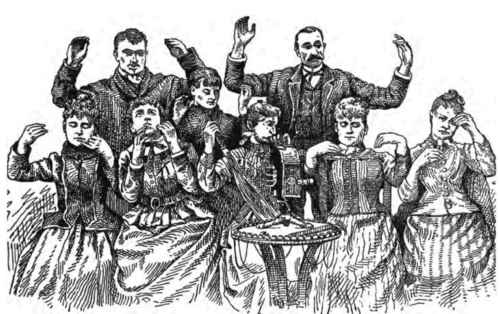
Fig. 12. - Group of eight persons under the influence of a rotatory mirror apparatus (after Luys).
The subject presented to demonstrate these phenomena was the man Mervel, who indeed played a great part in many of the subsequent demonstrations - a sad and unhappy being, extremely pathological in his neurotic aptitudes and infirmities, an undoubted hypnotic and hysteric, but with all the cunning so often superadded to this condition and commonly playing a large partin the clinical picture derived from such performances. I may as well at once give a few outlines of his clinical history, as he told it to me. He came into the wards on November 25, 1891; his present illness dated from June 22, when he had fallen from the first floor under an attack of fright when carrying a case weighing 120 lbs; Three days afterwards he had an attack of lethargy, lasting from eight to twelve hours. He was very well up in the nomenclature of his own case, as indeed are most of these people, He told me he was the victim of heredity, that his father had died of apoplexy, his mother was very nervous, and his sister, when 19 years old, had suffered from attacks of hysterical lethargy. He himself had walked in his sleep while a boy, and was 'born a somnambulist.' Since he had been in the wards he had been treated by prolonged hot baths and lengthened sittings of induced sleep.
At one time he said he could not be made to eat, but he had been made to eat 'by suggestion,' and now had a very good appetite. He was still subject to attacks of lethargy and unconsciousness, and had on the previous morning been picked up in the courtyard where he had fallen senseless, and also to fits of somnambulism; he was sleepless, depressed,' haggard and altogether a miserable personality. Having put him to sleep, or what looked like hypnotic lethargy, almost instantaneously, by holding two fingers before his eyes, and having rapidly brought him into the lucid stage of somnambulism with the eyelids open, Dr. Luys took into his hand a bar magnet and handed it to the hypnotised Mervel. 'What do you see,' he said, ' from that pole?' Presently Mervel's features, which up to that moment had been expressive only of stupor, became animated and smiling, he caressed the end of the magnet with both hands. ' Ah,' he said with delight, and like a child playing with some beautiful new toy,'see the blue flames; it's blue, the flames are playing about, it is the colour of the sky - the colour of heaven.' Then the bar was reversed, and the opposite end was shown. ' Ah,' he said, ' that's red.' His features contracted, his brows were knit, his face was expressive of horror and fright. 'Take it away,' he said, 'it's red, red; I don't like it, it hurts me.'
Instead of taking it away, however, it was pointed at him. He rose from his seat and moved rapidly away from it backwards, and nearly fell in his retreat to the end of the room. To restore his equanimity the reverse pole was again presented to him. Once more he instantly changed his expression. His features were lighted up with pleasure. ' Ah, c'est bleu;' and he followed the magnet to his seat and fell back into the chair, caressing the magnet as though with extreme delight. These phenomena, Dr. Luys explained to me, were constant, and were related to the attractive and repulsive effects of the north and south poles of the magnet respectively, and to the coloured flames which highly sensitive sub-jects in the somnambulistic state saw emanating from them.
This proceeding was varied in different forms. Thus on another occasion Dr. Luys took out of his pocket two photographed papers mounted on cardboard and contained in envelopes. One of these, he explained, had been placed in front of a magnet, and the surface of the magnetic pole had been slowly photographed on to it, the other had been simply exposed to the light; both presented a tolerably uniform and fairly similar blackened surface, but with easily-recognisable differences of coloration. When one of these was presented to the patient he again became ecstatically delighted. 'Ah,' he said, ' it's blue, light blue, the beautiful flames are playing on the surface.' This, it seems, was the magnetic photograph. Then the other was presented to him. He looked at it with a vacuous, indifferent, and uninterested expression. ' Ah,' he said,' it's dark, it's grey, I don't see anything,' This was the unmag-netised photograph. Again he was shown a photograph of Dr. Luys himself, which he examined with great interest. ' Yes,' he said,' it is full of lights and colours, there are red flames issuing from the right eye and from the cheek and mouth and ears on one side of the face, and from the other come blue flames, all blue,' 'That,' said Dr. Luys, 'is how he sees me, and, strange to say, the same magnetic flames are seen by him on my photograph.
Continue to:


My Books

