


History Of Hypnotism
Description
This section is from the book "Practical Lessons In Hypnotism", by Wm. Wesley Cook. Also available from Amazon: Practical Lessons In Hypnotism.
History Of Hypnotism
The germ of the science of hypnotism was recognized by the ancient Greeks and Romans, who derived their knowledge of it from the early Egyptians. There is also evidence that the Chinese practiced the art thousands of years ago. In fact, the exercise of hypnotic power seems to have been one of the intuitive accomplishments of mankind; for in various forms it is practiced by the untutored savage in all parts of the world. We may even go further and declare hypnotic power to be an attribute of all living creatures. Reptiles fascinate their victims; animals are all more or less awed by their superiors and in turn exercise power over their inferiors; male birds fascinate their mates, and even fishes are known to excite fear in their kind.
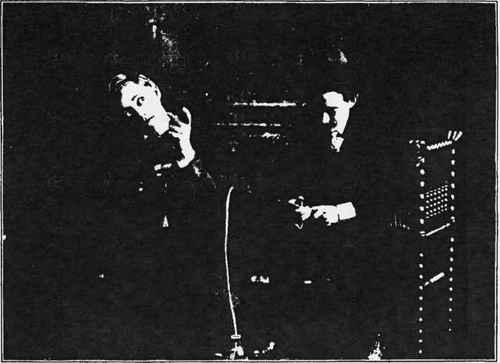
The hypnotist has impressed it upon the subject with the broom that he is Col. Roosevelt hunting mountain lions. The other subject thinks he is Col. Bryan out fishing.
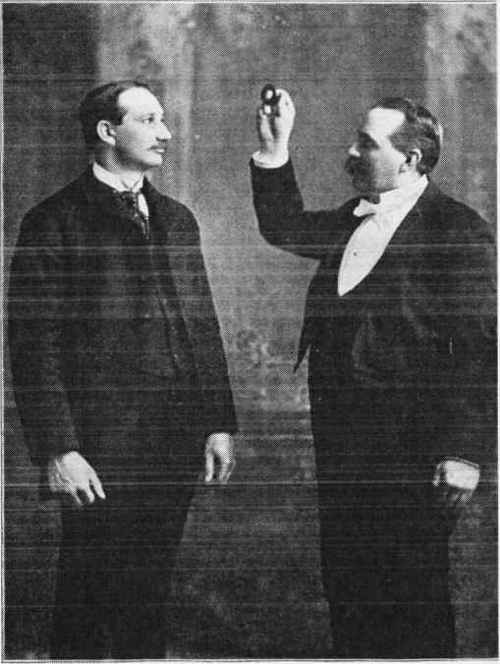
Using the disk to rivet the attention. The first step in producing hypnosis.
Bereft of its traditions, the history of hypnotism commences with the discoveries and experiments of Dr. Friedrich Anton Mesmer, who was born near Constance, Switzerland, May 23rd, 1734. He received his medical degree from the University of Vienna, and in his graduating thesis he introduced his theory of animal magnetism. This theory was that throughout the universe there was a power similar to the magnetic power of "loadstone," that exercised a peculiar influence over the human body. To this power he gave the name of "animal magnetism/' and declared it could be excited by the personal contact of human beings under certain circumstances. He first published an account of his discoveries in 1775, enshrouding them in secrecy concerning his methods. The publication created great excitement and when he shortly afterward went to Paris, in 1778, generous donations of money were given him by his admirers and those interested in his theories. The government made him a proposition to give him an annuity of $4,000 a year and provide him a fully equipped hospital free of expense if he would impart his secret method to three persons to be named by the authorities.
He refused to accept the proposition, and continued to practice his art for the cure of disease with great success and to teach his methods to large numbers of pupils. In this way he derived a large income for several years, when in 1785 the government appointed a commission, including Bailly, Lavoisier and Benjamin Franklin, to investigate his methods. This committee made a very unfavorable report, which destroyed Mesmer's popularity and caused him to lose his practice and pupils. He returned to Switzerland, where he died March 5th, 1815.
The Marquis Armond De Puysegur
One of Mesmer's most enthusiastic scholars was the French Marquis Armond De Puysegur. He greatly improved upon Mesmer's methods and discovered the manner of producing the somnambulistic state, in which he was enabled to cure various diseases without causing the violent hysterical demonstrations that frequently followed Mesmer's performances. His discoveries, however, as well as those of Mesmer, were apparently forgotten until Du Patel and De Foissac, Parisian physicians, applied them in their practice (1820-1830).
Baird And Curtis
The scientific career of hypnotism started in 1841, under the impulse given it by Dr. James Baird, of Manchester, England, who met with such great success with it in his practice that other physicians and investigators followed his example. It was Dr. Baird who gave to the science the name of Hypnotism.
In America, the first physician of prominence to investigate and employ hypnotic power as an aid in the treatment of disease was Dr. Alva Curtis, whose book on "Medical Science," published in 1846, contains a section on "Neurology and Animal Magnetism," which gives full and explicit directions for using this power in medical practice. The position he then assigned to it was that of one of the harmless methods of aiding natural efforts toward restoring health. He bereft it of all sensationalism and treated it in a purely scientific manner.
Charcot And Bernheim
In the '70's, Dr. Charcot, of Paris, became an enthusiastic hypnotist, and employed hypnotic suggestions with great success in the treatment of large numbers of patients in his hospital at La Salpetriere. His prominence as a physician led many others to follow his example. About the same time, Dr. H. Bernheim, Professor in the Faculty of Medicine, in Nancy, commenced his arduous investigations and experiments that have rendered his name famous in the field of hypnotic science.
In later years, many physicians and scientists of renown have added their labors to those of the investigators mentioned, and at the present time the science has become so universally recognized that departments of "suggestive therapeutics" are established in the leading medical colleges; and what was formerly regarded as one of the tricks of charlatans is now established as a useful and dignified science.
Continue to:


My Books

