


Animal Hypnotism
Description
This section is from the book "Hypnotism And Hypnotic Suggestion", by E. Virgil Neal, Charles S. Clark. Also available from Amazon: Hypnotism And Hypnotic Suggestion.
Animal Hypnotism
Whether there is in animals a state which may properly be called hypnosis is a disputed question. Opinions on the subject range between two extremes; on one hand Czermak,1 a careful investigator of the phenomenon, holds that many animals may be brought into a condition essentially like the hypnotic state of man; or the other Verworn, the author of the most important recent work on the subject, believes that there is only a superficial similarity in the states. He therefore calls his book2 "The so-called Hypnosis of Animals."
But so far as our present consideration of the peculiar and interesting abnormal state in which many animals may easily be placed is concerned it matters little whether it be identical with human hypnosis or entirely unlike it, for it is to an examination of the nature and symptoms of the condition, rather than its relationships, that we shall turn after a brief review of the history of the subject.
It is commonly known that fowls, frogs and various other animals may be made inactive for long intervals by holding them firmly in one position for a short time. After an animal which has been thus held is released, it frequently remains almost motionless for a period varying from a few seconds to several hours; it then, in most cases, jumps up suddenly, as if startled in sleep. It is this state of immobility in animals to which the name hypnosis has been applied by some authors.
Over two hundred and fifty years ago Daniel Schmenter, a professor at the University of Altdorff, stated in one of his works a hen could be kept quiet for long periods by holding it on a table, across which a string or chalk line was drawn in line with the animal's eyes. Ten years later, in 1646, a Jesuit priest, Athanasius Kircher, gave the first scientific account of this peculiar experiment, and offered an interesting explanation of the phenomenon. Schwenter had thought the inactivity to be due to fear, a kind of paralysis, but Kircher believed the hen saw the. line and imagined it was tied.
1. At the end of this article a list of the most important works on Animal Hypnotism may be found.
2 "Die sogenannte Hypnose der Thiere." phenomenon. Schwenter had thought the inactivity to be due to fear, a kind of paralysis, but Kircher believed the hen saw the. line and imagined it was tied.
From Kircher's time until 1872 nothing seems to have been done toward the scientific investigation of Animal Hypnotism. Then Czermak, a prominent German psycho-physiologist, repeated Kircher's experiments with crayfish, hens, and several other birds. Since 1872 William Preyer, the eminent physiologist and psychologist, and Emil Heubel, formerly a docent at the University of Kiew, have carefully studied the hypnotic state of frogs. Another investigator, Danilewsky, has given attention to the phenomenon in various reptiles, and Professor Max Ver-worn, of the University of Jena, one of the foremost of German physiologists, has recently observed guinea pigs, frogs, and snakes.
Thus far we learn from various sources that the peculiar quiescent condition may be produced in the monkey, horse, wolf, guinea pig, rabbit, squirrel, mouse, dog, cat, duck, goose, swan, turkey, goldfinch, siskin, canary, robin, parrot, pigeon, dove, alligator, crocodile, lizard, snake, frog, toad, triton, crayfish, cuttlefish, and crab. There are probably hundreds of other animals whose susceptibility has not been discovered.
For a more detailed study of the symptoms of the so-called hypnotic state of animals two or three animals may be taken as types. The crayfish, hen and frog, since they are all favorable subjects for these experiments, have been most studied and will serve our purpose well.
Hypnosis in the crayfish, which has been taken as a representative of invertebrate animals, has been known for a long time. Formerly the process was called "magnetization", and "passes" were used to induce the state. Stroking an animal from tail to head brought on the quiescent period, while "passes" in the opposite direction served, it was supposed, to remove the spell. The strange effect was said to be due to the passage of a magnetic fluid from the body of the hypnotizer to the animal influenced. Recent investigation has proved that "passes" are quite unnecessary for the induction of hypnosis, so that to-day "Animal Magnetism" is one of the curious myths of science.
To bring a crayfish into hypnosis it is only necessary to place it in a stable position and hold it there firmly so as to prevent, as far as possible, movements of the body and limbs, until the animal ceases its efforts to escape. This may take anywhere from ten seconds to as many minutes; in certain cases even this period is insufficient. In an article on the crayfish in the American Journal of Physiology for April, 1900, Dr. Dearborn states that the length of time required for the hypnotization of an individual varies from day to day. At one time half a minute of restraint may be followed by a quiescent interval of ten minutes, at another several minutes may have no perceptible effect. After the hand or other restraining object is taken away, the animal may remain in position a few seconds or several hours. This period is as variable as the time necessary for the induction of the state.
Of the many positions in which crayfish have been made to remain by this simple method, perhaps the oddest are "standing on the head" and "hanging by the tail or abdomen." It is easy to stand the animal upright with its weight resting on its head, appendages and large claws. If one be held in this extremely unnatural position for a few moments, it will remain so after the operator's hands have been removed.
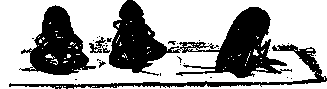
Frequently an animal will hold this posture for five or tea minutes. Similarly when suspended by the tail, the crayfish, after a few struggles, becomes quiet and remains thus for a long time. These are only a few instances of the strange positions in which crayfish have been kept; there are many others just as interesting so far as the nature of the hypnotic condition itself is concerned.
Continue to:


My Books

