


III. Treatment Of Scoliosis. Part 8
Description
This section is from the book "Massage And Medical Gymnastics", by Emil A. G. Kleen. Also available from Amazon: Massage and medical gymnastics.
III. Treatment Of Scoliosis. Part 8
L4. Pelvis-carrying-forward or -backward. - The apparatus consists of a chair gliding over a frame which stands on the floor. This frame can be adjusted on a slope forward or backward by the insertion of a block under the short end. The patient, seated in the chair, grasps a support placed at shoulder height. In moving forward the anterior part of the frame is raised and the patient draws himself up the incline, at the same time holding the arms stretched and rounding the back as much as possible. This exercise is used when there is lordosis. In the movement backward the back of the frame is raised, and the patient pushes himself backward, at the same time hollowing the back as much as possible. This exercise is used in flat back and lumbar kyphosis. Both exercises are difficult to perform accurately; the apparatus is therefore little used.
L5. Pelvis-side-tilting. - This apparatus consists of a stool which moves round a sagittal axis. Balance is maintained by a pendulum with a heavy weight attached to the seat. The patient sits fixed by a strap over the thighs, and by a pair of side supports projecting under the arms and fixed to the footboard. The movement is performed by the patient tilting the pelvis and sitting board down towards the side required. The exercise has a corrective effect by the lateral flexion which thus arises in the lumbar region, and by the asymmetric muscle action required for the movement.
L6. Back-raising (Fig. 177). - The apparatus has a round cushion placed horizontally at the height of the head with a mechanism attached, which in turn is connected to a lever with a movable weight. The patient sits directly under the cushion, his head placed at such a height that it just touches when he is sitting with a very round back. The patient then straightens himself, pushing up the cushion as high as he can, and then returns to the starting position. The exercise strengthens all the extensor muscles of the spine.
L7. Lumbar-flexion (Fig. 178). - The patient lies prone on the apparatus (as in L2 Forward-lying Holding); the elbows are supported on the front plinth with the upper arm vertical. Transversely across the lumbar region between the iliac crests and the lower border of the thorax a hard rectangular cushion is placed, attached, by means of a strap passing under the patient's abdomen towards the ground, to the free end of a weight lever. The position is taken by the patient holding his spine passively arched downward, as in a lordosis position. The patient then arches his spine upward (backward) as far as possible, like a cat, without moving the shoulders and hips, and then resumes the starting position. This movement has a direct effect in counteracting lordosis by strengthening those muscles which correct it.
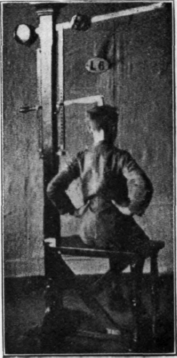
Fig. 177.
After this description of Dr. Zander's apparatus used for the treatment of scoliosis we may suitably end the chapter with examples of diagrams representing different types of scoliosis and the exercises suitable for their treatment arranged as an ordinary gymnastic prescription.
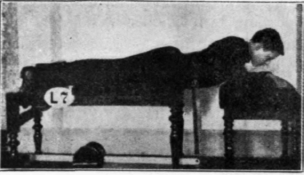
Fig. 178.
Anna. | ||
Kl. | Right 122, 45°. | |
L3. | Right No. 10 | B 54 - 17 |
R 46 - 15o | ||
K5. | Right 45; Left 25 (st.); A2. No. 3 Left out; Left over. | |
K3. | 17; Rack cushion R. c. 10; Chest cushion L20; Scale 148; No. 20. |
L2. | Half-right-side-lying Holding. |
Running Back-hacking (Gl). | |
Kl. | As above. | ||
L3. | " " | ||
L1. | Right | 50 . 50 | Right down; |
45 | |||
Left stretch. | |||
E6. | Right. |
C6. | Right or L2 Lcft-side-lying Head-side-bending. |
K5 and A2. As above. | |
Kl. L6. J5. | No. 8. Height 82. |
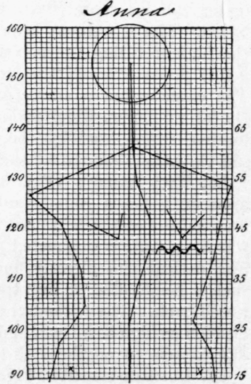
Fig. 179.
Elisabeth. | |
Kl. | Left 120, 45°. |
C6. | Left No. |
A3. | Left No. 6 + A2; Right No. 4. |
K3. | 17; Back cushion Left c. 8; Chest cushion 0; Scale 144, No. 20. | |
L3. | Left No. 10 | B 52 - 15 |
L 43 - 12o | ||
Running Back-hacking. | ||
K2. | Left 100 + | 12 | ; Slope 20°. |
12 | |||
L2. | Right-side-lying Left side-bending. | ||
K5. | Right 48 (st.); Left 35. A2 No. 4 Right-shoulder-raising. | ||
Kl. | |||
L3. | |||
Ll. | Left | 50 . 50 | Hip-drawing. |
45 | |||
E6. | Left. | |
L6. | No. 8. | Height 82. |
J5. |
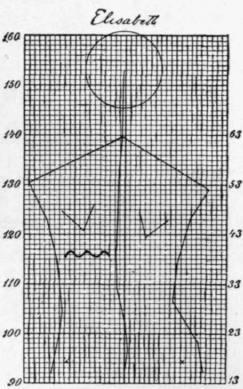
Fig. 180.
Gurli. | ||
Kl. | Right 119, 45°. | |
L3. | Right No. 8 | B 55 - 14 |
H 48 - 11o | ||
K5. | Right 45; Left 34; A2 No. 3; Left out; Left over. | |
K3. | 20; Back cushion Right c. 8; Chest cushion Left 16; Angle 144; No. 18. |
L3. | |
(Running Back-hacking.) | |
K2. | Left 95 + | 10 | ||
12' | ||||
L2. | Half-right-side-ly. Holding. | |||
Ll. | Right | 50 . 50 | Right down, | |
45 | ||||
Left stretch. Left Side-press. 32. | ||||
K3. 30; Back cushion Left c. 8; Chest cushion 0; Angle 134; No. 20. | ||||
C5. | N5. | |||
K5. | + A2. | |||
(E6. | Right. |
L3. | |
(J5. |
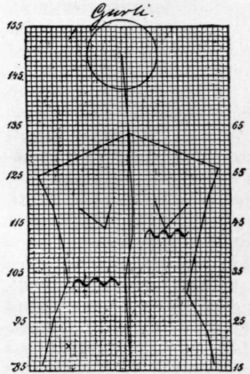
Fig. 181.
Continue to:


My Books

