


Stage 5: Increase of Passive Movement and Commencement of Complete Massage. The Use Of Massage And Early Movements In Recent Fractures
Description
This section is from the book "Lectures On The Use Of Massage", by William H. Bennett. Also available from Amazon: Lectures On The Use Of Massage.
Stage 5: Increase of Passive Movement and Commencement of Complete Massage. The Use Of Massage And Early Movements In Recent Fractures
Stage 5: Increase of Passive Movement and commencement of Complete Massage. - The back-splint is now dispensed with, the fracture being fixed by means of side-splints straight or with foot-piece (Cline's). These having been removed, the limb is laid on the bed or couch, and complete ordinary massage is applied for fifteen minutes. Unless the union is very firm, the fracture is then fixed by two short splints, or, better, by a poroplastic or leather splint. Passive movements of the ankle and knee are then made in the manner shown in the figure. The flexion at the knee not only prevents stiffness of that joint, but allows more free internal massage by relaxing the calf muscles. The date of commencement may be at any time after the fourteenth day, according to the state of the union.
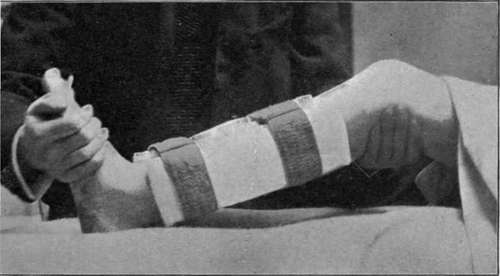
Fig. 6. - Massage in Recent Fracture of the Leg
There is one injury in which the effect of the use of this plan from the beginning is most remarkable - viz. intracapsular fracture of the neck of the thighbone. So far as massage of the part is concerned in a fracture of that kind it cannot be commenced too early. If it is started a few minutes after the injury it is not too soon. In such cases, as you well know, the pain is sometimes very acute, and the spasm is often almost continuous, the patient complaining bitterly of the jumping of the limb and the intense discomfort caused by the spasm. The suffering resulting from the spasm can be removed very rapidly by smooth rubbing of the sort I have described. In such a fracture it is unnecessary to trouble too much about adjustment of the fragments. Excepting cases of impaction, or occasionally when the operation of screwing the fragments together has been immediately adopted, bony union, as you know, rarely occurs, and the indication therefore is to obtain as useful a limb as possible, although there may be no bony union of the fracture. The object in view should be to get a movable and painless limb with the muscles as strong as possible. No splints should be used. Splints in such cases tend to the production of bed-sores and promote the wasting of muscles. They do no good, and they render the patient most uncomfortable. Therefore let these cases be treated by smooth rubbing at once and passive movement in 24 hours. A masseuse, or any intelligent person with a moderately soft touch, can give more comfort in a case of this kind than all the narcotics and anaesthetics in the pharmacopoeia. In a day or two let passive movement be commenced. Have no anxiety about the union,your main objects being to give comfort and prevent muscle-waste: upon the prevention of muscle-waste the ultimate utility of the limb will for the most part depend. The worst thing that can happen in cases of this kind is wasting of the muscles, which can be obviated by intelligent massage and movements. This, then, is the treatment under ordinary circumstances which I strongly commend to your notice in such cases. The use of a splint should be altogether avoided, smooth massage should be commenced at once, passive movement should follow quickly, flexion and extension should be effected by lifting the knee from the bed in the way I show you (fig. 6), and rotation movements should be the last to be practised. For the first three or four days let passive flexion and extension be made as often as possible ; no pain occurs if the limb has been previously rubbed smoothly and gently. In a week or two rotation may be used. At the end of a week voluntary movements should be encouraged as much as possible. Under no circumstances should any passive movement whatever be employed until the neighbourhood of the injury has been subjected to a good smooth rubbing. You may use liniments or not, as you please, but it is the rubbing which does the good.
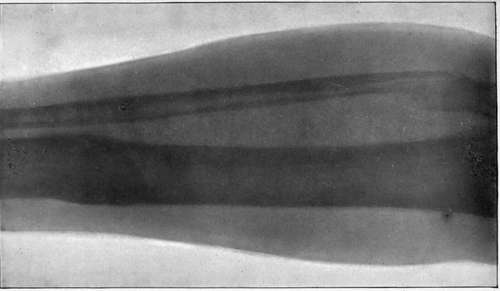
Plate I. Diagram showing the condition of an ordinary fracture of the tibia and fibula five weeks after the injury, in a case treated by the method of massage and early movements.
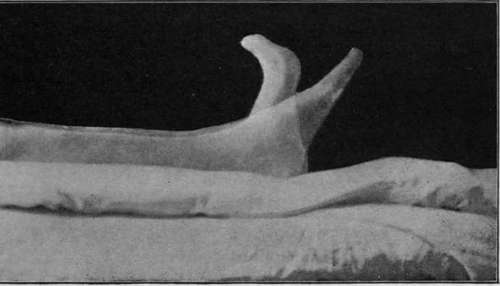
Fig. 7. - Massage in recent Fracture OF the Leg
Showing the amount of voluntary movement at the ankle in a severe case of Pott's fracture two weeks and three days after the injury. When the patient was admitted, immediately after the accident, the foot was displaced completely outward, the transverse horizontal plane of the sole being vertical. The use of all splints was discontinued in the third week.
Continue to:


My Books

