


A Plan For The Embellishment Of The Shrubbery Borders In London Parks. Continued
Description
This section is from the book "The Wild Garden", by W. Robinson. Also available from Amazon: William Robinson: The Wild Gardener.
A Plan For The Embellishment Of The Shrubbery Borders In London Parks. Continued
An essential thing is to abolish utterly the old dotting principle of the mixed border, as always ugly and always bad from a cultural point of view. Instead of sticking a number of things in one place, with many labels, and graduating them from the back to the front, so as to secure the stiffest imaginable kind of arrangement, the true way is to have in each space wide colonies or groups of one kind, or more than one kind. Here is a little bay, for example, with the turf running into it, a handsome holly feathered to the turf forming one promontory, and a spreading evergreen barberry, with its fine leaves also touching the ground, forming the other. As the turf passes in between those two it begins to be colonised with little groups of the pheasant's-eye Narcissus, and soon in the grass is changed into a waving meadow of these fair flowers and their long grayish leaves. They carry the eye in among the other shrubs, and perhaps carry it to some other colony of a totally different plant behind - an early and beautiful boragewort, say, with its bright blue flowers, also in a spreading colony. Some might say, Your flowers of narcissi only last a certain time; how are you going to replace them? The answer is, that they occupy, and beautifully embellish, a place that before was wholly naked, and worse than naked, and in this position we contend that our narcissi should be seen in all their stages of bud and bloom and decay without being hurried out of the world as soon as their fair bloom is over, as they are on the border or in the greenhouse. They are worth growing if we only secure this one beautiful aspect of vegetation where before all was worse than lost. We also secure plenty of cut flowers without troubling the ordinary resources of the garden.
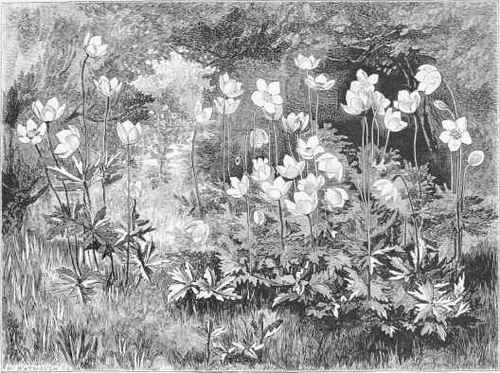
Colony of the Snowdrop-Anemone in Shrubbery not dug. Anemone taking the place of weeds or bare earth.
We might then pass on to another, of the German iris, occupying not only a patch, but a whole clump ; for these enormous London parks of ours have acres and acres on every side of this greasy dug earth which ought to sparkle with flowers; and, therefore, a very fine plant might be seen to a large extent. And how much better for the gardener or cultivator to have to deal with one in one place than be tormented with a hundred little "dots" of flowers - alpine, rock, wood, copse, or meadow plants - all mixed up in that usually wretched soup called the "mixed border"! No plants that require staking ought to be used in the way we are speaking of. Day lilies, for example, are good plants. In some bold opening what a fine effect we could get by having a spreading colony of these therein; scores of plants might be named, that want no sticking, for such places. Each plant having a sufficient space and forming its own colony, there is much less doubt in case of alterations as to what should be done. In fact, in the case of an intelligent cultivator, there should be no doubt. Observe the advantage of this plan. Instead of seeing the same plants everywhere, we should pass on from narcissi to iris, from iris to bluebell, and thus meet with a different kind of vegetation in each part of the park or garden, instead of the eternal monotony of privet and long dreary line of "golden-feather" everywhere. The same kind of variety, as suggested for the flowers, should be seen among the shrubs. The sad planter's mixture - privet, laurel, etc. - taking all the colour and all the life and charm out of the shrubbery, should be avoided; so, too, the oppressive botanical business, with everything labelled, and plants classified out of doors as they are in an herbarium. They should be put where they would look well and grow best. Well carried out, such a system would involve labour, and, above all things, taste at first; but it would eventually resolve itself into the judicious removal of interloping weeds. The labour that is now given to dig and mutilate once a year and keep clean at other times of the year would easily, on the plan proposed, suffice for a much larger area. More intelligence would certainly be required. Any ignorant man can dig around and mutilate a shrub and chop up a white lily if he meets it! But any person taught to distinguish between our coarse native weeds and the beautiful plants we want to establish, passing round now and then, would keep all safe.
On a large scale, in the London parks, such a plan would, be impossible to carry out without a nursery garden; that is to say, the things wanted should be in such abundance, that making the features of the kind we suggest would be easy to the superintendent. The acres and acres of black surface should themselves afford here and there a little ground where the many hardy plants adapted for this kind of gardening might be placed and increased. This, supposing that a real want of the public gardens of London - a large and well-managed nursery in the pure air - is never carried out: the wastefulness of buying everything they want - even the commonest things - is a costly drawback to our London public gardens. At the very least we should have 100 acres of nursery gardens for the planting and replanting of the London parks. So, too, there ought to be intelligent labour to carry out this artistic planting; and with the now-awakened taste for some variety in the garden, one cannot doubt that a few years will give us a race of intelligent young men, who know a little of the plants that grow in northern countries, and whose mental vision is not begun and ended by the ribbon border.
The treatment of the margin of the shrubbery is a very important point here. At present it is stiff - the shrubs cut in or the trees cut in, and an unsightly border running straight along, perhaps with a tile edging. Well, the right way is to have a broken margin, to let the shrubs run in and out themselves, and let them form the margin; let them come to the ground in fact, nut stiffly, and here and there growing right outside the ordinary boundary, in a little group. Throw away altogether the crowded masses of starved privet and pruned laurel, and let the turf pass right under a group of fine trees where such are found. This turf itself might be dotted in spring with snowdrops and early flowers; nothing, in fact, would be easier than for any intelligent person, who knew and cared for trees and shrubs, to change the monotonous wall of shrubbery into the most delightful of open-air gardens ; abounding in beautiful life, from the red tassels on the topmost maples to flowers in the grass for children.
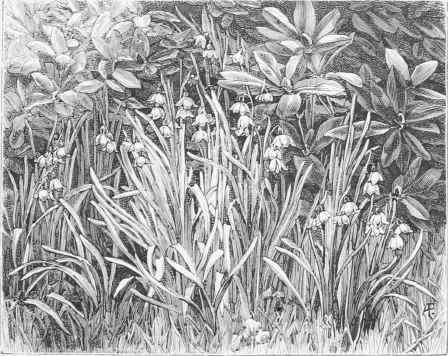
Colony of the Summer Snowflake, on margin of shrubbery.
Continue to:


My Books

