


E. Hedges for Bleak Exposures
Description
This section is from the book "The Complete Garden", by Albert D. Taylor. Also available from Amazon: The Complete Garden.
E. Hedges for Bleak Exposures
These plants are hardy as far north as the Canadian northwest and will survive under extreme exposure. This group has been subdivided in order more clearly to differentiate between plants which should be used for their different characteristics under different exposures.
a. Late foliage:
Syringa vulgaris (not variety alba) Common Lilac b. Close shearing:
Berberis thunbergi Thunberg's Japanese Barberry
Caragana arborescens
Siberian Pea Shrub Caragana microphylla
Dahurian Pea Shrub
Elaeagnus angustifolia
Russian Olive Rhamnus cathartica
Common Buckthorn Shepherdia argentea
Buffalo Berry
Shepherdia canadensis (on lime) Canadian Buffalo Berry c. Unsheared low hedges:
Berberis thunbergi Thunberg's Japanese Barberry
Spiraea vanhouttei Van Houtte's Bridal Wreath d. Fruiting hedges:
Berberis thunbergi
Thunberg's Japanese Barberry Crataegus (in variety)
Thorn Hippophae rhamnoides
Sea Buckthorn Rhamnus cathartica
Common Buckthorn
Rosa (in variety) Native Rose
Rosa rugosa Japanese Rose
Shepherdia argentea Buffalo Berry
Shepherdia canadensis (on lime) Canadian Buffalo Berry
Symphoricarpos (in variety) Snowberry e. Shady places:
Acer saccharinum Silver Maple
Crataegus monogyna English Hawthorn
Lonicera xylosteum Fly Bush Honeysuckle
Philadelphus coronarius Common Mock Orange
Spiraea vanhouttei Van Houtte's Bridal Wreath
Symphoricarpos racemosus Snowberry
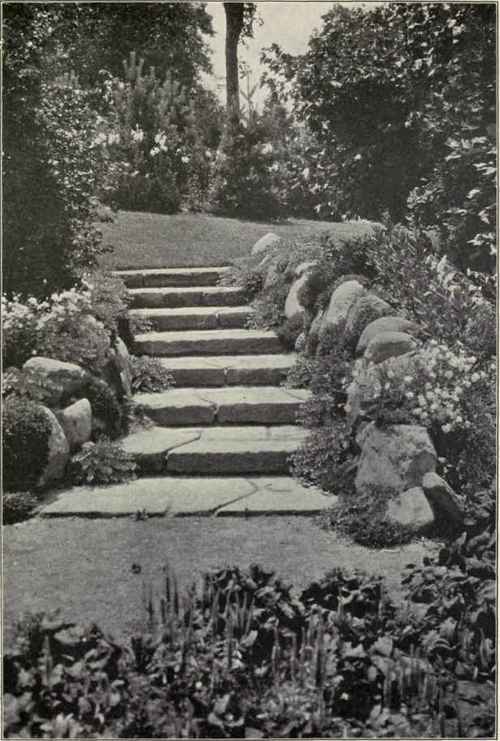
Plate XX. An effective combination of stone work and of plantings in an informal lawn. Varieties of stonecrop, moss pinks and Scotch pinks lend charm to an otherwise uninteresting mass of stone. (See plate LIII, page 334, for lily planting shown in background of this picture.) (See page 139)
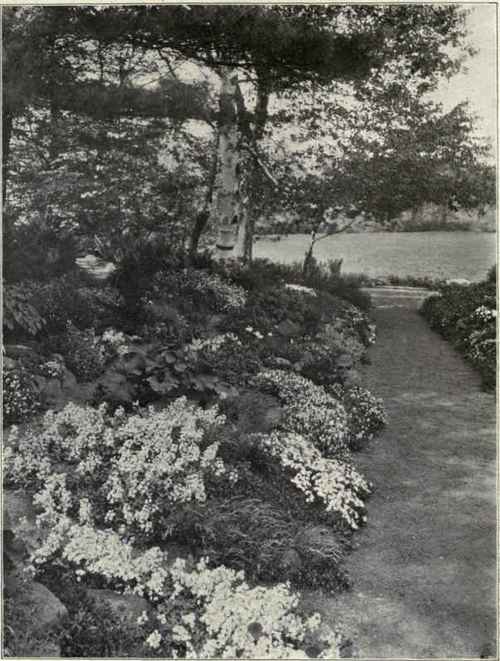
Plate XXI. An uninteresting rocky slope often can be turned into an attractive landscape feature through the careful selection and planting of plants adapted to light, sandy soils. This slope is covered with a grouping of hardy pinks, evergreen candy-tuft, saxifrage and tufted pansy. (See page 139)
Continue to:


My Books

