


Propagation
Description
This section is from the "Ornamental Gardening In Florida" book, by Charles Torrey Simpson. Also see Amazon: Ornamental Gardening In Florida.
Propagation
If one has any considerable amount of planting to do it will be almost absolutely necessary to build some kind of a propagating house or even more than one. Such buildings should be placed where they will be well sheltered from winds, and especially the northwest wind. They should have sunshine the greater part of the day. Posts can be set in the ground, their tops being a little over six feet high, and on these a horizontal strip can be nailed at the top and bottom. On these strips vertical pieces of 1 x 3 should be nailed, leaving about an inch and a half space between them, or the north and west sides may be boarded up close or all sides if thought best. Pieces of 2 x 4 may be nailed across the top about six feet apart and supported by other posts and on these a flat roof of 1 x 3 slats should be nailed. These slats may have spaces left between them anywhere from an inch and a half to two inches wide. Part of this roof may be laid closer than the rest if necessary and if considerable shade is required for any purpose the slats over that part may be laid with one-inch spaces or even less. There will need to be a door, and one must have a well inside, or if outside as close to the door as possible. This is the cheapest, simplest form of slat house and may be built from ten feet square to a large size, either of rough material or dressed stuff and painted. Shelves on which to sow seeds or plant cuttings can be built along one or more sides of the structure at a height of three to three and a half feet above the ground and from two to three feet wide. A rim should be made along the inside of the shelving and two or three inches of sand or earth placed on the shelves. One may, however, be quite successful rooting cuttings or raising seedlings in the ground without having shelves.
A much more ornamental and permanent structure can be built with concrete walls and a span roof, the ridge of which had better run north and south. The side walls of such a building can be four and a half feet high, and the end walls may be the same height with the upper part of wood or the whole may be concrete. If the walls are tight and fertilizer sacks are hung from the fronts of the shelves the space enclosed will be found to be a fine place in summer to root large Croton and other cuttings with nearly all their leaves, as it can be kept dark and close with such degree of moisture as is needed. Such large cuttings make fine plants almost at once.
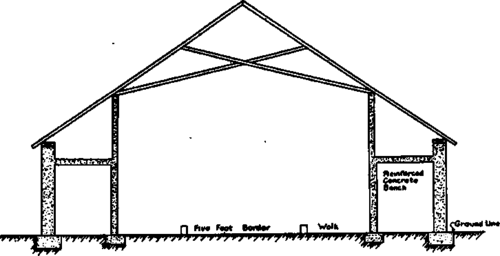
Plan For A Simple Plant House.
End elevation, showing how a substantial building for use in Florida can be put up at small expense. It may be covered with glass or slats. (Fig. 5)
On the south side of the slat house, or in any well-sheltered spot nearby, it is an excellent plan to have a glass covered frame, even if of only a single sash. In this, if it is exposed to the sun and well covered on cold nights, many very tender things can be kept through the winter that would perish out of doors or in an ordinary slat house. Such things as the Dieffenbachias, He-migraphis and the Fittonias are sometimes killed by cold when there is no actual frost. Cuttings of many tropical plants - not all - can be rooted in such a frame in winter if it is handled rightly, and seeds of the more tender things can be started. Where a large collection of plants is to be propagated and cultivated a glass-covered house is very convenient and almost necessary.
It may be made in the simplest form by sinking in the ground, say a couple of feet, a pit the size of the future structure. Then lengthwise through the middle of it a trench about three feet wide is to be excavated a couple of feet deeper. The building may be a span roof and run north and south, or a lean-to and run east and west facing the south. A concrete wall six inches thick is built facing both sides of the trench, leaving a passageway two feet wide the length of the pit. This should be carried up at intervals of perhaps six feet in the form of posts to support side benches and the roof. It is best to make the benches of reinforced concrete, since nothing below the surface of the ground can then decay. The roof can be made of sashes which should be hinged above and lifted below for ventilation. It needs a door in one end and steps to descend to it. If one of the benches or a part of it is screened off in front with fertilizer sacks during cold weather and one or more lamps or a small oil stove is put in and lighted a fine bottom heat may be kept up, furnishing ideal conditions for rooting cuttings, starting seeds, or for small or delicate plants. There should be a pipe or some kind of a ventilator leading from this space out to the open air. Such a building may be ten feet wide over all. Of course one can build a regular glass house with hot water pipes if he wishes.
It is always well to keep in such a place one or more extra plants of rare, tender things. If one cannot have any kind of a propagating house he can put in cuttings or sow seeds in flats or shallow boxes, either in the house or a sheltered, partly shaded place. It is almost absolutely necessary that such a propagating arrangement should be protected from all wind.
Continue to:


My Books

