


El Espirito Santo
Description
This section is from "The Horticulturist, And Journal Of Rural Art And Rural Taste", by P. Barry, A. J. Downing, J. Jay Smith, Peter B. Mead, F. W. Woodward, Henry T. Williams. Also available from Amazon: Horticulturist and Journal of Rural Art and Rural Taste.
El Espirito Santo
IN 1826, Henry Barnard, Esq., then residing in Truxillo, Peru, sent to Richard Harrison, Esq., of Liverpool, England, the bulb of a remarkable cparasitical, orchidacious plant, which he had found in the neighborhood of Panama, where it was looked upon with much consideration, and known as El Espirito Santo - the Holy Spirit; but which had never been seen in the conservatories of Europe. The bulb was properly cared for, and soon began to put forth leaves, but leaves only, until 1831, when it shot up its first flower stem, which sprang from the base of the bulb, while its leaves grew from the summit.
It was not until the blossom appeared that the significance of its local name was apparent. When the flower had fully opened, a most singular and beautiful appearance was presented. The fructifying column in the center of the flower, with its surmounting anther and the projecting glands of pollen-masses were observed to present a striking resemblance to a dove - the emblem of the third person in the Holy Trinity. Hence the name, El Espirito Santo - the Holy Spirit - was reverentially applied by the native residents, from the same religious feeling which had prompted the name of the " passion flower."
The form of a dove assumed by the parte of this flower, as described above, are remarkably true to nature. The breast, the extended wings, the head and beak, and even two purle dots for the eyes, are all distinctly shown, and almost as true to nature as the art of man can depict them.
Owing to the great heat required by this plant, and its peculiarly delicate construction, it has been found very difficult to cultivate it, artificially, away from its native region, which is comprised within the central portion of the torrid zone of the Western Continent.
Some two or three years since, as Mr. Shuman, the chief florist at Woodward's Gardens was crossing the Isthmus of Panama, he took the opportunity to make a collection of some of the most characteristic tropical plants obtainable in that locality, and among others was a specimen of the Espirito Santo, which still occupies the portion of the native wood upon which it was found - for it is a semi-parasitical plant. Under the excellent care and management of Mr. Shuman, with the very superior facilities furnished by Mr. Woodward, the proprietor of the gardens for the cultivation of tropical plants, this specimen, after continuing in vigorous growth for two years, threw up its first flower stem which was duly covered with a most gorgeous show of flowers. It subsequently bloomed a second time, last fall.
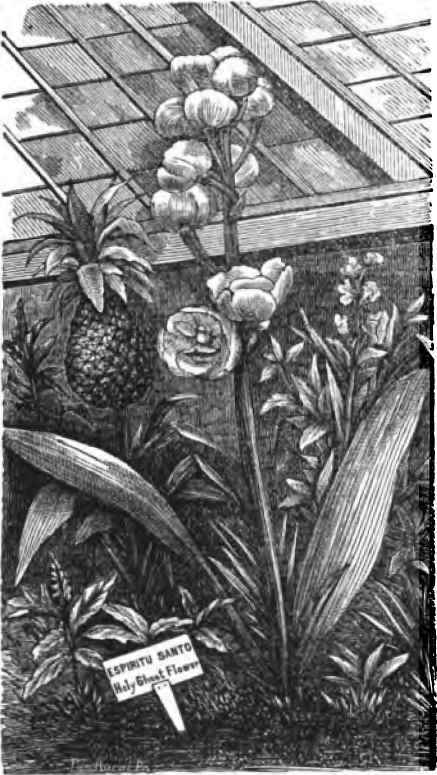
Espirito Santo - Holy Spirit Flower.
Both the flowers and leaves, with the distinctive dove representation within the center of one of the flowers is shown in tho accompanying illustration, which has been engraved from a photograph taken of the same while at the height of its show. The bulb, from the tops of which the leaves grow and from the base of which the flower stem springs, is not shown; but the leaves, flowers and upper portion of the flower stalk is distinctly shown.
Five leaves spring from each bulb, from twenty to thirty inches in length, by five or six in breadth - lanceolate in form. The flower stem grows from three to four feet in height, bearing upon its summit a spike of globose, fleshy, yellowish-white flowers, yielding a very peculiar and delicate perfume.
The flowering of this plant attracted much attention and a large number of visitors to the garden last season. It is expected that it will flower again this season. A carefully prepared representation of the flower was made in wax, at the time, by Mrs. A. 0. Cook, of 304 Mason street, which may be seen in a small vase just to the left of the front entrance to the rotunda museum. Copies of the same have also been made, and are in possession of several persons in the city. In its native clime (Central America), this plant blooms just at the commencement of the rainy season, and, of course, just after its annual period of rest. The flowers hold on about one month. It is now known to botanists as Peresteria alata, and is figured in vol. 5 (new series), of Curtis' Botanical Magazine (No. of Engraving 3,115). The plant belongs to the order of Orchidacea, a class of plants of wide distribution, occupying in some of its varieties almost every portion of the earth from the equator to almost the extreme northern and southern limits of the poles. It is only, however, as we approach the equator that the varieties of this plant assume peculiar or beautiful forms.
There, owing to the peculiar condition of the column, the anther containing the pollen, and the often remarkable development of some one or more of the inner leaves or petals into unusual forms, the flowers frequently take the most singular and sometimes beautiful or fantastic forms. An insect, or a spider, a butterfly, etc., sometimes a bird, as in the peristeria alata, not unfrequently a reptile, and sometimes a helmet with visor closed or raised, and often other singular and most beautiful forms are seen.
Sometimes there is a peculiar sensibility connected with the flower, which makes it a most effective insect trap, so hinged that it immediately entraps and holds fast any insect which may alight upon it, when its size is sufficient to enclose such intruder. . The particular specimen at Woodward's and which is herewith figured, is a pseudo-bulbous epiphyte plant - having the appearance of a bulb, but not a real bulb, and growing upon other plants but not penetrating their substance, nor absorbing their juices, as is the case with a real parasite. This variety is also sometimes found growing upon rocks or upon the earth, generally choosing dry, hilly localities. It grows well artificially in turfy peat or rotten wood. It is thus kept at Woodward's, where it is seen in a rustic hanging-basket. S.
San Francisco, Cal.
Continue to:


My Books

