


Remarks (4)
Description
This section is from "The Horticulturist, And Journal Of Rural Art And Rural Taste", by P. Barry, A. J. Downing, J. Jay Smith, Peter B. Mead, F. W. Woodward, Henry T. Williams. Also available from Amazon: Horticulturist and Journal of Rural Art and Rural Taste.
Remarks (4)
Dr. Hull's record of his careful experiments with special manures for the strawberry, deserves the attention of cultivators. We may add, for the information of those who know nothing of the soil, that it is naturally a heavy, and rather poor clayey loam, on a gravelly subsoil - by no means calculated by its fertility and friability, to favor the cultivator of delicate fruits; and notwithstanding this, the crop obtained by Dr. Hull's various modes of culture, has been surprisingly large. The beds of most varieties on a very large strawberry patch, were literally loaded with the finest fruit.
The nice cultivator will find a good deal in our correspondent's detail of experiments to stimulate him to make extended experiments; but the practical results jot general use, which we deduce from the foregoing article, and our observation of the strawberries themselves, are these. 1st. The best preparation for strawberry beds is to have the soil well trenched and manured with stable manure, mixed with a liberal supply of leached ashes - that substance supplying both potash and soda in sufficient quantities, (fresh ashes has more lime and far less potash - the latter being largely added by the soap boilers.) 2d. The finest and most delicate of the Pine Strawberries - which usually fail in this climate, may be grown perfectly by the aid of a good mulching of fresh tan-bark. 3d. Tan-liquor diluted adds to the flavor of strawberries - but we are confident that when fresh tan is applied in the autumn as a covering to the beds, sufficient tannic acid finds its way into the soil by means of the rains, to answer this purpose.
Notwithstanding - as a straw berry crop is always greatly increased in size and quantity by watering the plants, it is better to water them with tan-liquor, one part to one hundred.
A great deal has been said and written by our horticultural friends at the west, about the absolute worthlessness of all the large Pine Strawberries of Europe, such as British Queen, Keen's' Seedling, etc., - which bear mostly what are called staminate blossoms, as being barren, and never yielding more than half a crop in the United States; and their place has been in a good degree supplied with varieties of the scarlet, (native strawberries, such as the Hudson, Iowa, Willey, Ac. - bearing pistillate blossoms, and producing enormous crops with little care, in this climate.
And as most persons have found it difficult, from the greater heat of our climate burning up the plants, to cultivate the pine strawberries, and easy to cultivate the Scarlets, the latter have pretty nearly supplanted the former in our gardens. Yet, in Europe, where both grow equally well, no one thinks for a moment, of comparing the flavor of the two, and we never saw Scarlet strawberries served at a good table in Europe - but always Pines. For our own part, we consider (comparatively) the Hudson strawberries, with which our markets are mostly filled, poor sour things, only fit for preserving - and such fruits as Willey, Columbus, Iowa, Neck Pine, (no pine at all,) and most of the other heavy bearers that, as we understand, fill the great strawberry market of Cincinnati, are no better.* They are when compared to fine flavored pine strawberries, what a soar cooking apple is to the finest Newtown pippin - or the acid Malagatune peaches that fill New York markets to delicious Rareripes - or poor Teneriffe to the best pale Sherry. But so long as we were denied by our climate the satisfaction of cultivating any others, we were forced, of course, to be contented with sour Scarlets.
Dr. Hull's great success with the British Queen, the most productive and delicious of the Pine strawberries (a fruit to be found at every private table and good hotel in the north of Europe, averaging three to four inches in circumference,) has been so remarkable, and the reason for it is so simple that we predict from it a revolution in strawberry culture; and this result has been had too in the face of a very dry and exposed site - where this same strawberry invariably pushes up in summer if cultivated in the common way. And the whole secret of his success in growing this and the other most delicious pine strawberries - such a Goliath - Schiller, Myatt's Eliza, etc. is nothing more than to make the soil rich and keep the beds cool in summer and warm in winter by a mulching of two or three inches of fresh tan-bark.
The adjoining cut is an accurate representation of British Queen Strawberries, taken from Dr. Hull's beds, and not selected but chosen of the average large size. The flavor was higher, and the color richer and darker than any specimens that we saw in England in 1850 - though fruit nearly twice this size is by means unusual there. In our own garden we had nearly as good results with less care, and this season, in order to satisfy ourselves that these sorts hitherto considered too delicate for our hot climate, were really rendered hardy by the tan mulching, we planted two beds, - mulched one and left the other bare, in the usual way. It is now mid-summer - the mulched bed is very luxuriant and healthy; the unmulched shows the usual half-burned and starved appearance, common to the European Pines in this climate.
As we know our friend Mr. Longworth, of Cincinnati, is the sworn foe of the staminates or Pine strawberries - afflicted with utter want of faith in their power of giving a crop, and the staunch friend of the pistillate Scarlets, knowing them to bear abundantly, we requested our neighbor Dr. Hull to set apart some average hills or patches in his beds of British Queen, and keep an account of their product for the benefit of such skeptics.
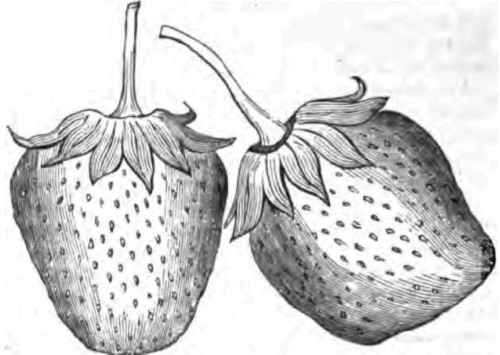
British Queen Strawberries from Dr.Hull's beds.
* Hovey's Seedling and Burr's New Pine, are exceptions - not scarlets - but apparently a crate between Scarlett and Pines - by for the beet strawberries for this climate in general cultivation - but not equal in flavor to the true Pines.
The result was an average of 164 berries to each hill of 20 inches square - a result, considering the large size of the fruit, that we think will satisfy even our Cincinnati friends.
We predict an increased cultivation for the high flavored pine strawberries, and hope for an abundant - particularly by amateurs of many of the Scarlet sorts. Market grow* ers who can command pood soil and plenty of tan-bark, will find one bushel of British Queens or Goliaths will command more in the market than three bushels of Hudsons. Their firmness renders them well adapted to carriage. We close this long article with a note of Dr. Hull's, relating to his cultivation of this variety, which will commend itself to amateurs. Ed.
Continue to:


My Books

