


Pruning And Management Of The Peach-Tree (2). Continued
Description
This section is from "The Horticulturist, And Journal Of Rural Art And Rural Taste", by P. Barry, A. J. Downing, J. Jay Smith, Peter B. Mead, F. W. Woodward, Henry T. Williams. Also available from Amazon: Horticulturist and Journal of Rural Art and Rural Taste.
Pruning And Management Of The Peach-Tree (2). Continued
156. These means may be greatly assisted by disbudding, pinching, summer-pruning, and even by defoliation; and these operations may be employed separately or combined, according to the age and growth of the tree.
157. The results of the first year's growth are not always such as have been supposed. Often the vegetation is languid, and the shoots are neither so long, nor so thick, as to enable us to originate the first lower secondary branch. If such be the case, its formation must be deferred till the following year; and the two main branches are pruned to eyes properlv situated for their prolongation. At the second winter-pruning, whatever may be the length of their leading shoots, they must still be cut down to the stated height of fifteen inches and three quarters, each of them to two eyes chosen as aforesaid - one for the prolongation of the main branch, and the other for forming the first secondary branch. I have shown at c (fig. 7,) the point at which the pruning must be made in this case, which causes no other inconvenience than that of retarding the formation of the lower secondary branches for one year.
158. Second Pruning
Third year of Planting. Fig. 8 represents the state of the tree after the second year's growth. The two main branches, a, a, have increased in length; so also have the two first secondary branches, b, b. All the shoots and laterals which have grown on the sides of these four branches are pruned to two or three eyes; then the main branch a is pruned at about thirty-one inches and a half from the insertion of the secondary branch b, after having ascertained that there are eyes properly situated at a like height on the other branch a, in order that a symmetry as perfect as possible may exist between the two wings of the tree. This interval of thirty-one inches and a half affords facility in nailing the fruit-branches formed along the secondary branches, and allows a free play of air and light The main branches a and a are pruned at c, each on a wood-bud, a, situated on the upper side; and having a second eye, b, situated on the under side, which is to become the second lower secondary branch. If there should not be a wood-bud properly situated for a leader, there is no objection to choosing one in front; but then, when it pushes, and as it proceeds in growth, it must be nailed so as to make it gradually take the right direction, because it has a tendency to grow outward.
The two branches b, b, are then both pruned to the same length, about thirty-one inches and a half, in order that, when the four arms are nailed, the points of the branches on each wing may nearly touch a perpendicular line supposed to be drawn from the base of the wall to the coping. This would be the case if the tree, represented by fig. 8, where the cuts on the leading branches are seen at c c, were nailed; because the ultimate depression of the main branches would make the two points on each wing nearly touch the same vertical line.
150. Very often in trees of this age the vigor is such that nearly all the eyes on the leading shoot break forth; so that, at the time of pruning, laterals only are found on the shoot, especially at the height to which it ought to be shortened. In such a case, choice is made of a lateral situated on the upper side, with another immediately below it on the under side; and after having cut the principal shoot, the two laterals are pruned each on a wood-bud suitable for prolonging them according to their respective-destinations. They are then regulated by nailing. The pruning of the main and secondary branches may also be effected either on a latent eye followed by a lateral - that is, having a lateral immediately below - or on a lateral followed by a wood-bud, according as they are found at the point where the amputation should take place. Disbudding and pinching are still employed according as they are needed.
160. Third Pruning
Fourth year of planting. The tree is unnailed, and shows the results of the third year's growth. I begin by examining the comparative state of each wing, so as to act accordingly. Supposing no unfavorable accident has occurred to the tree, I cut down all that are solely wood-shoots to two or three eves, according to their strength. All the fruit-branches that were pruned the preceding year are cut back to the lowest shoot, or to the successional nearest to the principal branch; and this successionai is itself shortened to two or three eyes, according to its strength when it has no flowers; and when it has flowers it is pruned to the first wood-bud above the flower-buds. The laterals that it may be thought proper to preserve on the leading shoots of the principal branches must be pruned in the same way, and they are thus treated at every subsequent pruning. This done, we proceed to prune the three branches a, b, C, (fig. 11,) on each wing, commencing with the uppermost.
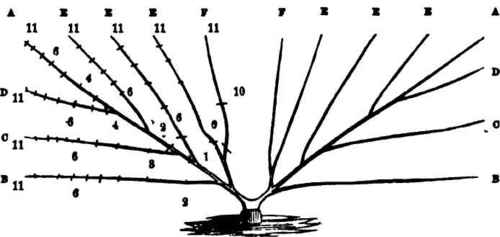
Fig. 11.
161. The two main branches, a, a, are pruned thirty-one inches and a half higher up than at the preceding pruning, and on an eye situated on the upper side, and which eye becomes the leading shoot On the under side there must be an eye at the origin of d, which is intended to form the third lower secondary branch. After having thus operated on the two main branches, the two secondary ones, c and o, which must now undergo their first pruning, are next attended to. They are pruned at about thirty-one inches and a half from their base, on a bud situated as much as possible in front; the shoot from it afterwards receives its proper direction by nailing. The branches b and b are next pruned for the second time, and on a bud also placed in front, and thirty-one inches and a half higher up than the preceding pruning. It is necessary to remark, that, in order properly to constitute the lower secondary branches, they must be so pruned that their extremities exceed the perpendicular line supposed to be drawn where the end of the main branch touches when the latter is temporarily bent down with the hand. This excess of length should be greatest for the lowest secondary, and diminish to the highest.
I should add, that, when a secondary branch is to be formed, it is always important to make the pruning, on the main branch, exactly at the proper point, where the eye immediately below it, which is to produce the secondary branch, may be placed at the proper distance for giving an equal space between the lower branches.
162. Immediately after the pruning is finished, the main branches are brought to a proper position, by bringing down each wing equally, so that the secondary branches may take a right direction. The requisite nailing of all branches is then completed at the upper part of the tree; for that part has always a tendency to make the strongest growth, and which tendency it is well to counteract by the greater or less amount of constraint that can be imposed by this operation. About the same time, the first disbudding takes place, and is followed by the pinching of all the over-luxuriant young shoots; and it is generally necessary, for the reasons above stated, to commence likewise these operations on the upper part of the tree. In short, we disbud when needful, and especially two of the shoots from triple buds on the upper sides of the branches; and all suppressions are made that the flow of the sap may render necessary for regulating and completing the intentions of the operations of winter-pruning.
164. Fourth Pruning
Fifth year of planting. In our cultures at Montreuil, owing to the height the tree has attained, and the lowness of the walls, the formation of the lower secondary branches is now complete; but when the walls are high, a fourth lower secondary may be formed at this pruning, proceeding in the same way as for the other three which compose the frame-work of our trees. I will not treat further on this fourth branch, which seldom exists in our gardens, as I only wish to make known my own practice in conducting the square-trained Peach tree.
165. Fig. 11 (a, b, o, d,) represents the principal branches of the tree at this stage. After having examined, from top to bottom, the shoots and fruit-branches along the principal ones, and having pruned them as was done in the previous year, the pruning of the wood-branches is next to be considered.
166. The main branch, a, is brought down to the point it should occupy after nailing, in order to judge better where each secondary branch should extend. The branch a is now pruned for the fourth time, the branch d for the first time, the branch o for the second time, and the branch b for the third time; each of them to its proper relative height. As the formation of a secondary branch is no longer required, the branch a is pruned to a bud situated either on the upper or under side, or in front of the branch, according as it may happen to be at the most suitable distance.
167. Sometimes I do not find eyes on the principal branches sufficiently well placed at the winter-pruning. In that case I leave a portion of the shoot beyond the eye intended to produce the leading shoot, when that eye is situated lower down than the one on the corresponding branch, in order that after nailing no difference may be perceived. When the eye above which I have left this piece of branch begins to grow, I cut back to it, and I attend to the growth of the two relative extremities in order that they may become of equal length.
168. After having trained and winter-nailed the tree, lowering at the same time its four branches towards the position which they should finally occupy, vegetation soon commences; and during its course we must disbud, pinch, nail, disbud a second time, and use summer-pruning, according as these operations are required; performing all with the view to the equal distribution of sap. Particular care must be taken at the summer-pruning, to cut off all the snags, wherever they are found; because healing over is more readily effected at that than at any other period.
Continue to:


My Books

