


Architectural Ornaments
Description
This section is from "The Horticulturist, And Journal Of Rural Art And Rural Taste", by P. Barry, A. J. Downing, J. Jay Smith, Peter B. Mead, F. W. Woodward, Henry T. Williams. Also available from Amazon: Horticulturist and Journal of Rural Art and Rural Taste.
Architectural Ornaments
"Whoever travels over our country will notice some strange freaks in the way of ornaments to buildings. People seem tired of the old tasteless style, and for want of knowledge and good taste, and not from want of disposition to do the right thing, pile on the ornaments, without the least taste or propriety.
The following article from Repton's Landscape Gardening, contains some valuable hints. It makes a fine addition to our chapter last month, from the same source; on "Architecture - Styles and Changes":
Or Ornaments
The English language does not admit of a distinction between those ornaments which comprehend utility, and those which are merely ornamental, or, rather, enrichments; thus, columns may be called architectural ornaments, but the sculptured foliage of the capitals are decorations and enrichments. In the progress of sculpture, we may trace it as an imitative art; from its origin, in the rude misshapen blocks of granite in Egypt, to its perfection, in the works of Greece, which are selected or combined forms of beauty, ideal forms, surpassing those of nature. We may, afterward, trace its decline, in the labored exactness of imitation, as in Chinese figures, where individual nature is so closely copied, that even color and motion are added to complete the resemblance.
"Much has been said, of late, concerning the study of nature in all works of art; but, if the most exact imitations of nature were the criterion of perfection, the man who paints a panorama, or even a scene at the theatres, would rank higher than Claude or Poussin. In that early stage of painting in England, when the exhibitions were first opened, they were crowded with portraits in colored wax, artificial flowers and fruits, and boards painted to deceive and surprise by the exactness of their resemblance; but they never excited admiration like the marble of Wilton, the wood carved by Gibbon, or the animated canvas of Reynolds. Mr. Burks observes, that 'it is the duty of a true artist to put a generous deception on the spectators;' but in too close an imitation of nature, he commits an absolute fraud, and becomes ridiculous, by the attempt to perform impossibilities. If it is the mark of a low imagination to aim at the vastness of nature, an endeavor to copy the minutiae of nature is not less a proof of inexperience and bad taste, since both are equally inimitable.
'si la Nature est grande dans les grandes choses, Elle est tres grande dans les petites.'
[If Nature is great in great things, she is very great in little ones].
The model furnishes hints, not portraits; yet such is the love of exact imitation in common minds, that copies are made from copies, without end.
"For this reason, houses are built to resemble castles, and abbeys, and Grecian or Roman temples, forgetting their uses, and overlooking the general forms of each, while their minutest detail of enrichment is copied and misapplied. In works of art we can only use the forms of nature, not the exactness. Thus, in furniture, if we introduce the head or the foot of an animal, it may be graceful; but if we cover it with hair, or feathers, it becomes ridiculous. And in the parts taken from the vegetable kingdom, to enrich the ornaments of architecture, imitation goes no further than the general forms, since we scarcely know the individual plant; although some writers have mentioned the Reed, the Acanthus, and the Lotus.
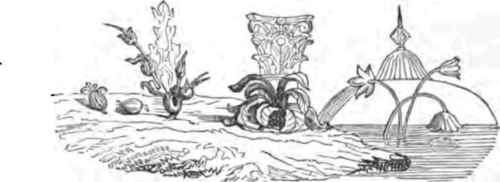
Imaginary sketch, to shew the forms of enrichment In Gothic architecture from the bud; Grecian from the leaf; and Indian from the flower.
"It is a curious circumstance, that the general forms of enrichments may be thus classed: The Gothic are derived from the bud, or germ; the Grecian from the leaf; and the Indian from the flower; a singular coincidence, which seems to mark that these three styles are, and ought to be, kept perfectly distinct.
Continue to:


My Books

