


The Connexion Of The House With The Grounds. Part 5
Description
This section is from the book "The Villa Gardener", by J. C. Loudon. Also available from Amazon: The Villa Gardener.
The Connexion Of The House With The Grounds. Part 5
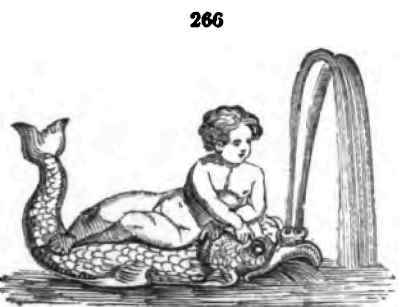
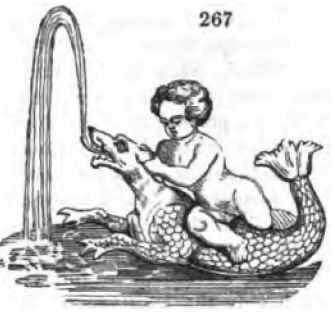
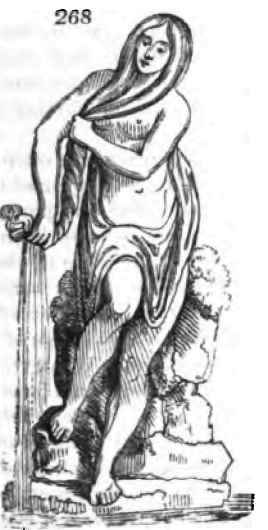
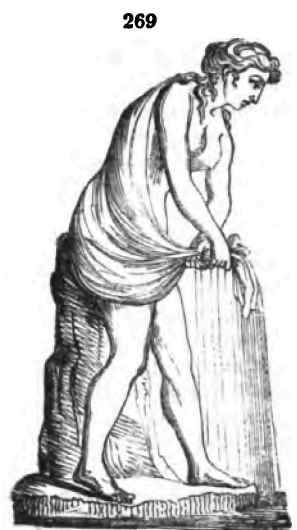
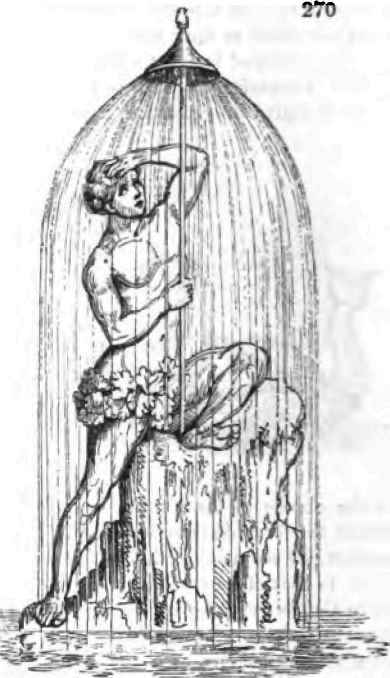
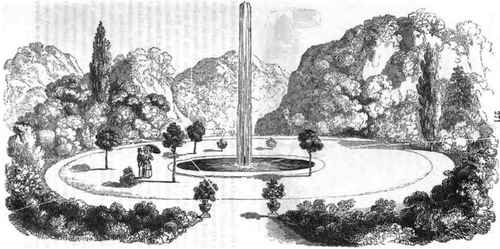
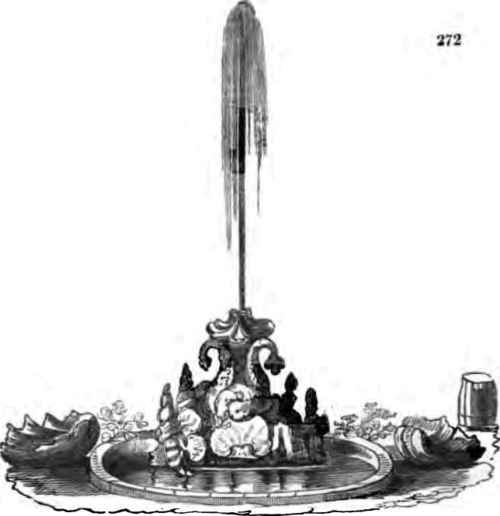
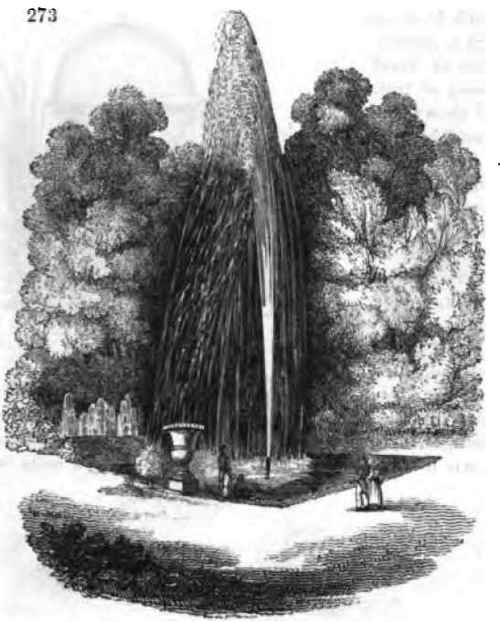
475. Fountains, as matters of taste, like every other object by which the fancy is called into exercise, admit of a great variety of designs. Our guide in the choice of these must he principally the character of the scenery in which the fountain is to be placed. In a Dutch, French, or other architectural garden, we see no objection to figures of animals spouting water (see figs. 266., 267), to that of a nymph wringing her robe (fig. 269.), or her hair (fig. 270.); or to Caus's very elegant design (fig. 271.). In an English garden, however, where the scenery around is not so decidedly artificial, a simple jet from a rock, or a group of shells, as in the wood at White Knights (tee fig. 272.); or from the centre of a basin, as at St Cloud (fig. 273.); or in the design by W. Mason, Esq. (fig. 271.). In this last design, the tube from which the jet issues is to be considered as proceeding from a roast of rock, just seen above the water. Fig. 274. is a view of a piece of rock and shell-work, with fountains, which may suit a grotto; fig. 275. represents a globe; and figs. 276. and 277. are fountains combined with rock-work. These kinds of fountain end their accompaniments have no pretensions to be considered as artistical; but we have given the designs, as they may suit various situations where eco-nomy is an object, and where an amateur would find pleasure in erecting a fountain for himself, with only the assistance of his gardener.
There are various kinds of architectural fountains which are, also, from their simplicity, suitable for pleasure-ground scenery in the modern style; such as candelabra, tripods, columns, vases, etc. Some- times, also, instead of a jet, the character of the scene in which the fountain is to be placed may render a drooping, or cascade, fountain more appropriate; for, by this description of fountain, grandeur of effect can be produced with a much smaller quantity of water, and with much less height of reservoir, than in the case of upright jets. Most of the artificial-stone manufacturers and plumbers have a great variety of designs for fountains; and the hydraulic ram may be obtained from Messrs. Bramah, Piccadilly, or a common forcing-pump may be used.
476. Flower-gardens differ from those beds of flowers which are often scattered on the lawn, in front of a house (so as to constitute a foreground to the distant scenery), by forming a whole of themselves. For this purpose, a flower-garden is, or should be, always surrounded by some sort of boundary, or inclosure, to separate it from the general scenery of the place to which it belongs. This boundary may be variously formed: it may be a border of shrubs; a fence of trellis work, either as an espalier or as an arcade; a conservative wall; a walk covered with trelliswork; a clipped hedge of some kind of evergreen, or an undipped hedge of various shrubs. Whatever kind of boundary is adopted, it is essentially necessary that it should not be so high as to exclude the sun from the area of the garden, or to prevent the free circulation of air round the plants. What the suitable height of the boundary fence may be, to insure the admission of sun and air, depends on the extent of the garden, the elevation or depression of its surface, and its aspect; and, if it be of any other form than a circle or a square, whether its longest diameter is in the direction of east and west, or of north and south.
A case can hardly occur in which a flower-garden should be surrounded by trees: though, in very exposed places, these may be introduced on the north, north-east, and north-west sides; but this should be at the distance of at least three times their height from the boundary fence of the garden. Nothing contributes more to the beauty of flowers than abundance of solar light, and the free circulation round them of air. Even if trees are planted only on the north side, but so near as to exclude the free action of reflected light from that side, the flowers will be weak and drawn towards the sun. All near fences have a tendency to produce this kind of etiolation, as any one may observe in the case of plants growing on the south-side of a common hedge; and this etiolation is directly the reverse of that bushy, tufted, or spreading appearance, which always accompanies vigorous growth in open airy situations, The outline of the flower-garden should always be such, as that on the first view of the interior some general form may be recognised in the area; for example, it may approach to a circle, to a broad or narrow oval, to a square, to a parallelogram, or to a triangle.
A long narrow strip, either crooked or straight, would not be satisfactory to the eye; nor would a space, broad in some places and narrow in others, here straight and there crooked, afford the spectator half so great a degree of satisfaction, as he would experience if he recognised some known and definite figure. Whether the boundary line be regular or irregular is a matter of no consequence, with reference to this end; provided there be ample length and breadth included by the outline, to throw the interior into tome definite shape, when seen in perspective.
Continue to:


My Books

