


278. Sculpture In Gardens
Description
This section is from the book "The Villa Gardener", by J. C. Loudon. Also available from Amazon: The Villa Gardener.
278. Sculpture In Gardens
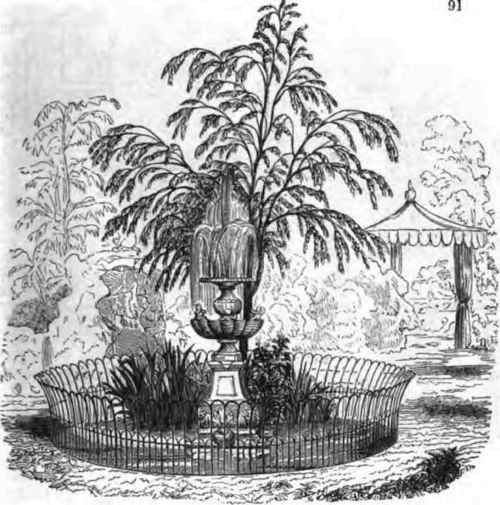
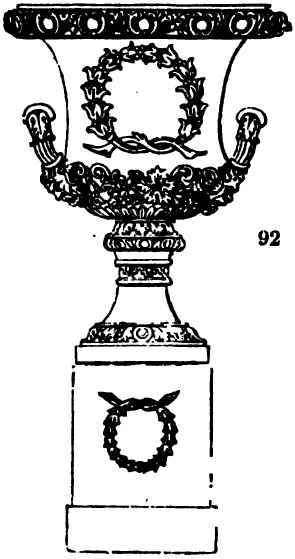
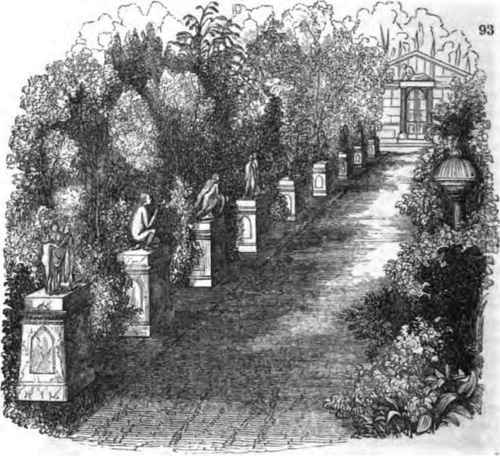
Whoever understands the phrase "unity of expression," and can examine any scene presented to him by the test of its being or not being, "a harmonious whole," will be able to determine what is right and what is wrong in the disposition of sculptural ornaments in gardens. All architectural objects and statuary, being ponderous and intended for great duration, should be placed on bases obviously secure and durable. A vase or a statue should never be set down on grass, or on dug ground, without a decided pedestal, resting, or appearing to rest, on a secure foundation; and it should never be set on anything less obviously durable than masonry. Where such objects form the predominating features in a scene, they should always be connected with some kind of building, such as a parapet or terrace-wall, or even a stone border to a walk, a bed, or a pond; and, in default of these, even a paved walk between a row of statues, the pedestals standing on a flagstone, projected from the pavement into the adjoining turf or dug ground (see fig. 93.), will tend to preserve unity of expression.
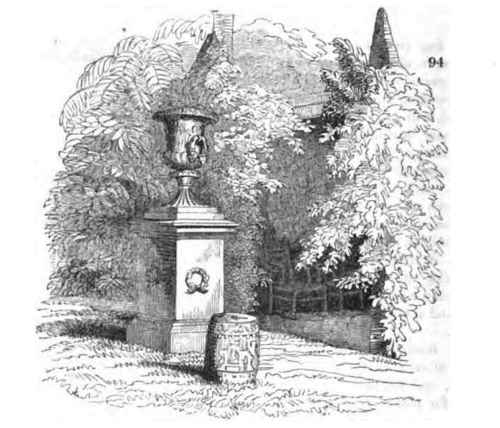
Even an area of gravel projected from a gravel walk, and extending an inch or two all round the pedestal, will have a tendency to maintain the secure architectural character which ought always to accompany architectural and sculptural objects. Rootwork, rustic baskets, and other temporary objects or structures of this kind, should seldom or never be introduced in the same scene with vases, statues, or other ornaments of worked stone. A striking example of the bad effect of mixing styles may be seen in fig, 94., in which a rustic summer-house, a classical vase, and a Chinese seat are all placed together.
279. Rockwork, or a collection of fragments of rock, stones, flints, vitrified bricks, scoriae, and similar objects, to serve as a nidus for plants, is allowable in particular situations; but no description of garden ornament, unless, perhaps, we except rustic work of the kind mentioned in the preceding paragraph, is more frequently misplaced and mismanaged. Collections of stones should never be heaped up about the roots of trees, at the base of walls, or against a mansion, hot-houses, etc.; nor should accumulations of fragments of stone ever be piled up on a level surface of turf, without some preparation or accompaniment indicating that they might have been there naturally. Two of the most remarkable pieces of rockwork in England, are that at the Hoole, near Chester, constructed from the designs, and under the immediate inspection, of Lady Broogbton, and that at Elvaston Castle, the seat of the Earl of Harrington. There is also a rock garden at Blenheim, one at Chatsworth on a most magnificent scale, one at Redleaf, and one in front of the magnificent botanical conservatory at Syon. The rockwork at Redleaf, near Tunbridge (of which views will be given in an after part of this work), is an excellent example of the best mode of improving a country naturally rocky.
At the Hoole (a series of views of which will also be given in a subsequent part of this work), there is a direct imitation of the glaciers of Switzerland, with a level valley between; and on this valley the mountain scenery projects and retires, forming a great variety of prominences, recesses, and sinuosities, aided by scattered fragments of rock, of different dimensions, and by shrubs and herbaceous plants. At Syon, no particular description of rocky scenery is imitated, and the scene can only be described as a ridge formed by piling up huge masses of stone, of different kinds; but the base of this ridge is so well united with the turf, and the whole of the ridge is so disguised by trees, shrubs, and plants, that the want of natural character scarcely ever occurs to the mind. Where the base of the ridge joins the level ground, there are at first seen here and there some slight protuberances of turf, each of which seems to indicate that there is a stone below, and quite near the surface. A little farther apart, portions of the stones seem to have burst through some of the protuberances; and here and there the upper parts of some stones appear quite bare.
Near these, are blocks of stones raised in great part above the surface, and occasionally some entirely so; and, farther on, the grouping becomes conspicuous, and two or three stones are seen piled on one another. To groups of different sizes, so formed, is joined the great ridge, rising to the height of upwards of 50 ft.; and, on climbing up its sides, they are found to be varied by natural-looking paths among the stones, and a profusion of curious little rock plants, unseen from below. At Elvaston Castle, the rockwork is placed on the banks of a long winding lake, and is constructed on a most magnificent scale. The masses of rock appear scattered in a natural manner through the valley, sometimes rising into steep precipices intersected by winding walks, which lead the visitor easily, and almost imperceptibly, to the summit. At Blenheim the object is to ornament rocky scars on the face of a steep bank, and consequently there is no difficulty in forming ledges and niches for the plants, as there is abundance of stone of the same kind as the bank in the vicinity. There is nothing particular in the disposition of the stones; but the stairs which pass obliquely through the scars, and cement them together, are very well managed.
Each part has a separate nidus, with appropriate soil; and the stones are covered with mosses and lichens, which, by the richness of their colouring, produce a very striking effect. 280. Petition of rockwork. Rockwork or stones, so disposed as to convey the idea that they form a part of, or protrude from below, the foundation of a building, produce the expression of stability and propriety; but, when they are heaped up on the surface of the ground against the walls, the idea of incongruity is excited, by seeing that which ought to be the foundation, and consequently under the building, piled up against it, and above the surface of the ground. Not only are the ideas of propriety and stability thus totally destroyed, but those of disorder and insecurity are produced. Neither, as we have observed in a preceding page, should roots, decayed trunks, stumps, or branches of trees, ever be mixed up with stones, on account of their obvious incongruity in point of durability. Each of these kinds of materials ought to be kept by itself; and thus we might have receptacles for plants formed entirely of decayed wood in one place; in another, of fragments of rock; in a third, of land-stones or of flints; and, in others, of vitrified bricks, of scoriae, of pieces of hewn stone, of fragments of sculpture, of shells, of corals, of spars, of petrifactions, etc.
When there is nothing in the nature of the surface that indicates the presence of rock or stone in the soil, and when it is determined, at all events, to have some rockwork, one of the three following modes may be adopted to render it natural: viz., the rockwork may be built on a level surface; an excavation may be made to imitate an old stone quarry; or a walk may be carried through rocks.
Continue to:


My Books

