


How Do You Increase Your Plants?
Description
This section is from the book "The American Garden Vol. XI", by L. H. Bailey. Also available from Amazon: American Horticultural Society A to Z Encyclopedia of Garden Plants.
How Do You Increase Your Plants?
THE amateur is often perplexed as to how to propagate plants in ways that are at once simple and successful. Fig. 1 shows perhaps the simplest way of increasing plants, but it is of use only for a certain class, as the rex begonia, gloxinia, sempervivum, gesnera and echeveria. To get several plants, cut the leaf with a sharp knife at a, b, c, etc., and each piece will root and form a plant. These pieces can be placed in sand as directed for other cuttings, or they may be laid on sandy soil in a moist, shady place, as on the soil of plants occupying large pots, weighted with a little sand.
Layering, as in Fig. 2, is a favorite way of propagating clematis, wistarias, honeysuckles, tecomas, grapes, passion flowers, etc., and differs from propagation by cuttings in that the layers are attached to the parent plant until roots are formed, a is the main plant, b the portion above the surface, and c the part covered with soil, from which the roots emerge. Some bushy plants, like the hibiscus, quince, cercis, (Judas tree), Paradise apple, etc., instead of being bent down and buried, merely have earth hilled up to cover the lower parts of the branches, and this being kept moist, roots will start from them, when they can be divided and planted singly.
A variation from ordinary layering is shown in Fig. 3 where the plant is too tall for bending over, so a pot is broken in two and the pieces are placed around the stem, then tied together, a support arranged, and the pot firmly filled with soil, which must not be allowed to get dry. After the plant is well rooted the stem is cut below the roots and the new plant is grown on in a new pot.
Fig. 4 shows another mode of layering for low branches of trees or shrubs. As shown at a, a long cut is made on the lower side of the limb, and when the latter is bent in the ground and pinned down, the cut parts and aids the formation of roots. A piece of wood may also be inserted to prevent the parts from growing together, as they might, instead of rooting. The same method is shown at b, except that instead of a tongue being cut on the limb, a ring of bark several inches wide is removed, and then the limb is pegged down.
Fig. 1.
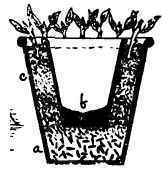
Fig. 6.
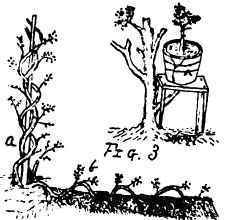
Fig. 2.
Fig. 5 represents several cuttings placed in the sand ready for rooting, a is a cutting of the oleander, b of the carnation, and c of a geranium. For making cut-tings, the wood should be in a proper condition, and as a general rule, this is the case when it will break off clean when bent. It is important to observe this, otherw ise failure often results, t h e wood being either too soft or too hard.
Fig. 6 shows a simple and at the same time one of the best contrivances for rooting cuttings that might fail in an ordinary cutting bed. A pot, 7 or 8 inches in diameter or smaller, is partly filled with broken pots, a, coarse soil, etc., and then a 4-inch pot with the hole closed with clay, b, is set in the center, and the sides, c, are filled with sand. This can be placed on the back of the stove for bottom heat, and the inner pot be kept filled with water. It may also be used for sowing seed, by using sandy soil instead of pure sand. Certain success in starting Cobea standens may be assured by using such a pot, and setting the seeds in edgeways and right end up.
Fig. 7 illustrates the way of preparing a common box for rooting even quite difficult subjects, like double petunias, double primroses, pansies and others. A box, a, 3 or 4 inches high is taken, and for use in the house a watertight lining (painted tin or gal va n i z e d iron) is fitted inside; and between this lining and the sides and ends, enough space is left to allow glass, b, to be inserted and held firmly in place. The glass should come about 10 inches above the box. When the latter is filled with sand, it should be set on the back of the kitchen stove, if quite light, or over a hot-air register or on the-steam radiator, kept properly watered and covered with glass. No better propagator can be desired. Once a day the cover may be raised for a short time for ventilation, and as the moisture does not evaporate very rapidly, but little water is required ; but one should be sure that the bottom of the sand does not dry out from the heat while the top remains wet.
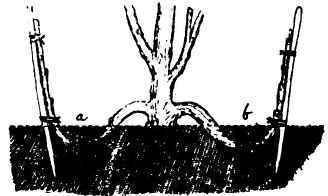
Fig. 4.
Fig. 5.
An interesting way of increasing one's stock of choice dahlias and paeonies is by root-grafting. Young shoots of the desired varieties are inserted into the neck of a fleshy root of a common sort, by cutting out along the upper end of the root a triangular section, large enough to admit the shoot when pared to such a shape that the outside of the root and of the shoot are exactly even; they are then planted, a band having been placed around to keep them in place until they have fully united by new growth.
An old-fashioned plan that may be quite useful to the window gardener who, having but a few plants, might desire something still more convenient than these mentioned, is simply to take an old soup plate half or three-quarters full of clean sand, and nearly fill it with water. Rain water is preferable, though not essential, there being but little if any difference in the growth of the plants whichever is used. Cuttings can be taken from all of the ordinary house plants, such as geraniums, including the ivy-leaved section, fuchsias, coleus, tradescantias, verbenas, begonias - both the flowering and the foliage class - abutilons, carnations, chrysanthemums, lantanas, roses and salvias. They should be rather short, and stuck into the sand on the plate so that about one inch is below the surface of the water, which should be renewed as it evaporates. For the first week they should be shaded during the sunniest part of the day if in the window, and when uncovered should be lightly sprinkled at short intervals. The proper place, however, for this miniature propagating case is where it can receive some bottom heat, especially during the winter season, and there should be light enough to keep the leaves from losing their color.
With this care, which any one can easily give, nearly every cutting will root, and if potted into good soil, all will make fine plants. Hard-wooded plants, like the oleander, may be readily made to root by placing mature shoots in bottles kept filled with water. Many of the finest flowers are easily raised from seeds; but often the seed is so small that it is difficult to provide suitable conditions for its germination. By following this method I have obtained uniform success, and others may be equally fortunate : A shallow box or dish of any sort or size can be used. First in importance is drainage, and for this, broken pots or somewhat coarse coal clinkers from the stove are the best materials. The box is so filled with these that there is space for only about an inch of soil on top, and in arranging this, the coarsest parts should be next to the drainage stuff, and the soil on top should be as fine as possible, so that the minute roots are able to take hold of the nourishment in the soil as soon as they emerge from the seed. The best covering for almost all kinds of seeds is thoroughly dried moss which has been rubbed in the hands or through a fine sieve until it has been made as fine as the soil, and then scattered over the seeds in a layer not thicker than a sixteenth of an inch.
The first watering after the seed has been sown is a delicate operation, and is best managed by laying a piece of newspaper over the top of the box and pressing it down evenly upon the soil. It should be so large that the edges will come up somewhat higher than the edge of the box, and water poured into the depression will gradually soak through the paper and evenly moisten the seeds and soil beneath. As soon as the seeds show signs of sprouting the paper can be removed, but great care must be taken that the plantlets are not allowed to become dry at this critical period. As a rule, seedlings should be transplanted as soon as they can be handled, for a sort of fungus often kills them in the seed box; and their progress is much more rapid for the early transplanting. Hortus.
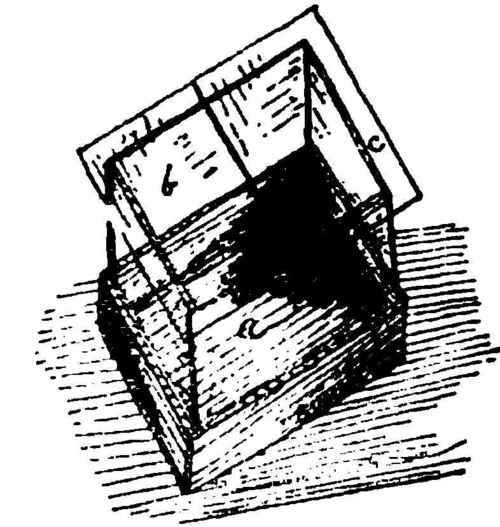
Fig. 7.
Continue to:


My Books

