


The Organs Of Digestion
Description
This section is from the book "Food Facts For The Home-Maker", by Lucile Stimson Harvey. Also available from Amazon: Food facts for the home-maker.
The Organs Of Digestion
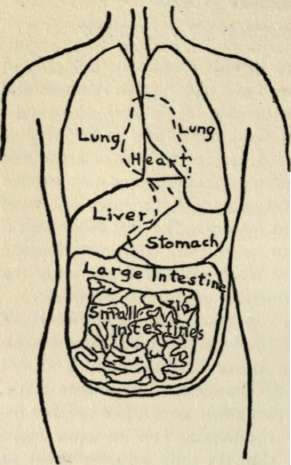
The organs that accomplish this work in the body include the following: the mouth, the stomach, the small intestine, and the large intestine. These are arranged as we see them on the accompanying figure. This shows also the lungs, the heart, and the liver, all of which play an important part in the whole process of the utilization of food. The lungs are the source of supply for the oxygen which enters into combination with the food in the process of combustion, and the liver acts as a storehouse for the food as it is taken up by the blood from the intestines before it is scattered to the various tissues throughout the body. In considering these Mouth organs and the part each plays in digestion, we shall begin with the mouth. Here the action is largely physical or mechanical. The teeth grind the food, and the saliva flowing constantly from the glands into the mouth supplies the liquid to dissolve the ground-up food, or at least soften it so that the other juices can dissolve it. Here in the saliva we have the first one of a group of interesting chemical compounds that are provided by nature to cause chemical changes. Their action is somewhat similar to the action of the molds and yeasts. Those micro-organisms, however, are called "organized ferments," because they themselves grow, and in the process of growing secrete substances which cause chemical changes in the surrounding food material. The substances in the body which serve such a very important function in the process of digestion are called "unorganized ferments," because they simply cause chemical changes without changing themselves. Their scientific name is "enzyme," and in order to explain them, the simile is often used of the lock and key, each key fitting one peculiar lock and one only, so that each enzyme can cause one chemical change for one particular food, and if it does not have a chance to work, the food goes unchanged or undigested. This fact shows the great importance of proper mastication of food. The saliva must become thoroughly mixed with the food substance in order that the enzyme which it contains may act upon starch, converting it into sugar. This action continues while the food passes down the throat into the stomach and there continues for a time while the food is more or less stratified.
A process of combustion
In the stomach among the substances present in the gastric juice is free hydrochloric acid which ultimately stops the action of the saliva on starch. If then the starch is not acted upon by the saliva, it passes unchanged through the stomach into the small intestine which gives it an opportunity to become fermented. The gastric juice contains enzymes as well as hydrochloric acid. The most important of these is pepsin which acts on protein material, breaking it down into two simpler forms. Rennin, another enzyme, is also present in the gastric juice; this has the effect of curdling milk; a singular action because the aim of all digestion is to put food into soluble form, whereas the curdling of milk is solidifying the protein material that is already in liquid form. These solid proteins are re-dissolved by the aid of the pepsin in the gastric juices. The juices of the stomach have little effect on fats except to put some into emulsified form. The acid present in the stomach also dissolves the cell walls that surround fat globules, making it possible for the juices of the intestines to act upon the fat.
Action in the stomach
Up to this point the processes of digestion are largely preparatory. Certain of the simpler protein compounds and some mineral matter are directly used by the body from the stomach, being taken up by the blood through the walls of the stomach. The largest proportion of the food, however, passes on to the small intestine. Here the great work of digestion goes on. The food itself is pushed along by muscular action, entirely involuntary. In fact all of the process of digestion is involuntary after the food leaves the mouth. In the small intestine we have three distinct secretions, each containing important enzymes. The first of these is the secretion from the pancreatic gland. This contains enzymes which complete the change of starch to sugar; break up fats and reduce protein substances to their simplest forms.
From the walls of the intestines we have the second of the secretions. This contains enzymes which act upon each of the distinct, complex sugars, reducing them to simpler forms.
The third of these intestinal secretions is the bile, which makes the conditions for all of these changes more favorable, helping especially in the digestion of fats. All of these secretions are alkaline and neutralize the acid carried in from the stomach.
Action in small intestine
There are no digestive enzymes present in the large intestine. The mechanical motion of this intestine, however, works the food back and forth, forcing it back into the small intestine to insure as complete digestion as possible. The waste that is left is then eliminated from the body. The movements of this tract should be normal. If they are too rapid the patient suffers with diarrhea. If they are too sluggish a condition of constipation results. Hence bulky foods such as fruits and green vegetables, and acid foods, as oranges, lemons, and tomatoes, are desirable in the diet because they have an exciting effect on the action of the intestines.
Continue to:


My Books

