


Cuts Of Beef
Description
This section is from the book "Food Facts For The Home-Maker", by Lucile Stimson Harvey. Also available from Amazon: Food facts for the home-maker.
Cuts Of Beef
There is some confusion throughout the country in purchasing beef because of the various ways in which it is cut in different localities. After the slaughter of the animal the beef carcass is always split lengthwise down the backbone into two "sides." These are hung by the hind legs, and the beef is shipped in this form.
The retailer divides the "sides" to suit his trade, according to the part of the country in which his shop is located. There are two chief ways of cutting a side of beef. One is known as the "Boston cut," and is used generally throughout New England. The other is the "New York or Philadelphia cut," and has been adopted quite universally throughout the United States except in New England. The New York method of cutting is used by the Department of Agriculture in their Farmers' Bulletins. It is to be noted that cuts of the same name may be taken from different parts of the animal in different localities. This explains why a New Yorker is puzzled not to find as good beef in Boston as she is accustomed to in New York, and why a Bostonian is frequently heard to complain of New York beef. Accustomed to the best cuts at home under a certain name, they purchase quite a different cut under the same name in the other city.
"Sides"
Plate A Side Of Beef Boston Cuts
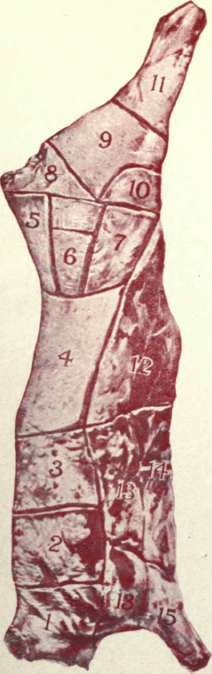
1 NECK
2 CHUCK RIB
3 PRIME RIB
4 SIRLOIN
5 BACK OF RUMP
6 MIDDLE OF RUMP
7 FACE OF RUMP
8 AITCH BONE
9 ROUND 10 VEIN
11 HIND SHIN
12 FLANK
13 RATTLE RAND
14 BRISKET
15 FORE SHIN
Plate B Boston Cuts
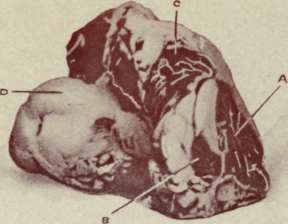
Sirloin Roast
A Sirloin B Tenderloin
C Flank D Kidney Su'ET
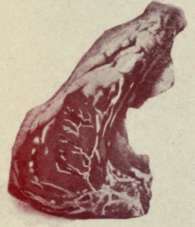
Tip Of Sirloin
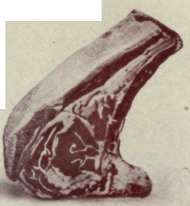
Rib Roast
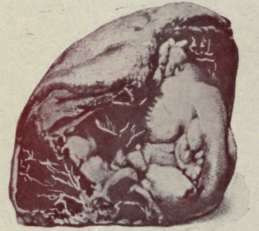
Middle Cut Of Sirloin
Plate C Boston Cuts
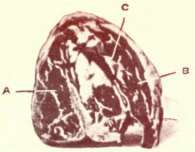
Sirloin Or Porterhouse Steak
A Sirloin B Tenderloin
C Flank
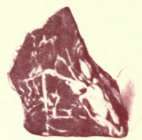
Aitch Bone
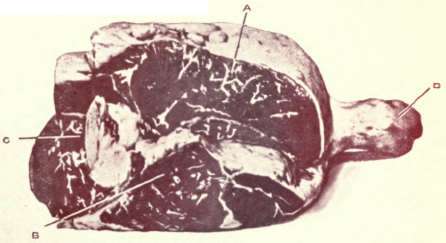
Round Of Beef
A Top Round B Bottom Round
C Vein D Shin
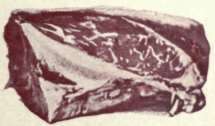
Back Of Rump
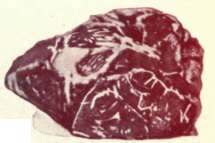
Face Of Rump
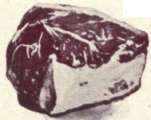
Middle Cut Of Rump
The side is cut across at right angles to the backbone, making "hind" and "fore" quarters. Here lies the first point of difference. In the Boston cut three ribs are left on the hind quarter, whereas in the New York cut all ribs are left on the fore quarter. This means that the first cut of the fore quarter in New York is the same piece of meat as the first cut on the hind quarter in Boston. A prime rib roast, the same ribs in both cases, is the first cut of the fore quarter in Boston and the second cut in New York.
Plates A and D show the "quarter" division line between sections (3) and (4). The pieces of the fore quarter are used for the same purposes in both methods: the ribs (3) for roasts; the chuck (2) for roasts and stews; the neck (1) for soup stock, stews, and beef-tea; the rattle rand (13) and brisket (14) of Plate A, and the plate (10), navel (11), and brisket (13) of Plate D, are used for corning; and the fore shin (15) is used for soup.
The greatest difference is in the way of cutting the hind quarter, and the confusion thus brought about is increased by using the same terms for different parts of the quarter. The loin (4) in both plates is cut in slices at right angles to the backbone for steaks or in larger pieces for roasts. The tenderloin is an oval-shaped muscle lying underneath the backbone in this section. It is sometimes removed whole for a roast called a "fillet of beef," but is more frequently sliced with the sirloin muscle to form steaks. The "Club" or "Delmonico" steak is the one in which only the tip of the tenderloin appears. A "Porterhouse" steak is one in which there is a cut of the tenderloin through its thickest part. This relation of tenderloin to sirloin muscle can be seen in the picture of a Porterhouse steak in Plate C. The terms "Club" and "Porterhouse" steaks are used alike in both the New York and Boston systems.
"Quarters "
The next section below the loin in the Boston cut is called the "rump" (5, 6, and 7 of Plate A). This part is cut out in a solid piece, and the bone removed. It is then divided into three pieces: the back, the middle cut, and the face. These are used for roasts, or cut in slices for steaks. The back makes the best roast, and is more economical than sir-loin roasts, as there is no waste. The other two rump cuts (6 and 7) are sometimes used for beef a la mode or pot roasts.
This section in New York (Plate D, 4) is still cut in slices like the loin to make the large sirloin steaks - the hip-bone, the flat-bone, and the round-bone sirloin steaks. These are not to be bought on the Boston market. The New York rump (Plate D, 5), used for stews and corning, is a cut which includes part of the Boston rump, the aitch bone, and part of the round (Plate A, 8 and 9).
Loin
Rump
Continue to:


My Books

