


Food And Food Economy
Description
This section is from the book "Eating To Live", by John Janvier Black. Also available from Amazon: Eating to Live.
Food And Food Economy
What has thus far been said about the ingredients of food and the ways they are used in the body may be briefly summarized in the following schematic manner:
Nutritive ingredients (or nutrients) of food
Edible portion.... e.g., flesh of meat, yolk and white of eggs, wheat flour, etc | |||
Food as pur-chased contains - | Nutrients | Proteids. | |
Fats. | |||
Carbohydrates. | |||
Mineral matters. | |||
Refuse: e.g. bones, entrails, shells, bran, etc. | |||
Uses of nutrients in the body
Proteids ..e.g., white (albumin) of eggs, curd (casein) of milk, lean meat, gluten of wheat, etc. | Form tissue.. | All serve as fuel to yield energy in the forms of heat and muscular power. |
Fats.................. e. g., fat of meat, butter, olive oil, oils of corn and wheat, etc | Are stored as fat.......... | |
Carbohydrates .... e. g., sugar, starch, etc. | Are transformed into fat.......... | |
Mineral matters (ash).. e- g., phosphates of lime, potash, soda, etc | Share in forming bone, assist in digestion, etc. | |
The views thus presented lead to the following definitions: (I) Food is that which, taken into the body, builds tissues or yields energy; (2) the most healthful food is that which is best fitted to the needs of the user; (3) the cheapest food is that which furnishes the largest amount of nutriment at the least cost; and (4) the best food is that which is both most healthful and cheapest.
We have, then, to consider the kinds and amounts of nutrients in different food materials, their digestibility, the kinds and amounts needed for nourishment by persons under different conditions of rest and work, and the nutritive value of different food products as compared with their cost.
Average Composition Of Common American Food Products
Food materials (as purchased). | Refuse. | Water. | Proteids. | Fat. | Carbohydrates. | Ash. | Fuel value per pound. |
ANIMAL POOD. | |||||||
Beef, fresh : | Percent. | Per cent. | Percent. | Per cent. | Percent. | Percent. | Calories. |
Chuck ribs.......... | 16.3 | 526 | 15. 5 | I5.0 | 0.8 | 910 | |
Flank......... | I0.2 | 54.0 | 17.0 | 19.0 | •7 | 1.105 | |
Lion....... | 133 | 52.5 | 16.1 | 17.5 | •9 | 1.025 | |
Proterhouse steak........ | I2.7 | 52.4 | 19.1 | 17.9 | .8 | I,IOO | |
Sirloin steak........... | 12.8 | 540 | 16.5 | 16.1 | •9 | 975 | |
Neck........... | 27.6 | 45.9 | 14.5 | II.9 | .7 | 1.165 | |
Ribs.......................... | 20.8 | 43.8 | 13.9 | 21.2 | .7 | 1.135 | |
Rib rolls...................... | 63.9 | 19.3 | 16.7 | .9 | 1.055 | ||
Round......... | 7.2 | 60.7 | 19.0 | 12.8 | 1.0 | 890 | |
Rump............. | 20.7 | 45.0 | 13.8 | 20.2 | .7 | 1.090 | |
Shank, fore.......... | 369 | 42.9 | 12.8 | 7.3 | .6 | 545 | |
Shoulder and cold......... | 16.4 | 56.8 | 16.4 | 9.8 | •9 | 715 | |
Fore quarter........... | 18.7 | 49.1 | 14.5 | I7.5 | .7 | 995 | |
Hind quater........ | 157 | 50.4 | 15.4 | 18.3 | .7 | 1.045 | |
Beef, corned, canned, pickled, and dried : Corned beef......... | 8.4 | 49.2 | 14.3 | 23.8 | 4.6 | 1.245 | |
Tongue, pickled............. | 6.0 | 58.9 | 11.9 | 19.2 | 4.3 | 1.010 | |
Dried, saled and smoked......... | 47 | 53.7 | 26.4 | 6.9 | 8.9 | 790 | |
Canned boiled beef......... | 51.8 | 25.5 | 22.5 | 1.3 | 1.410 | ||
Canned corned beef.......... | 51.8 | 26.3 | 18.7 | 4.0 | 1,270 |
Veal: | |||||||
Breast.......... | 21.3 | 52.0 | 15.4 | 11.0 | .8 | 745 | |
Leg.......................... | 14.2 | 60.1 | 15.5 | 79 | .9 | 625 | |
Leg cutlets........ | 34 | 68.3 | 20.1 | 7.5 | 1.0 | 695 | |
Fore quarter....... | 24.5 | 54.2 | 15.1 | 6.0 | 7 | 535 | |
Hind quarter........ | 20.7 | 56.2 | 16.2 | 6.6 | .8 | 580 | |
Mutton: | |||||||
Flank....... | 9.9 | 39.0 | 13.8 | 36.9 | .6 | 1,770 | |
Leg, hind....... | 18.4 | 51.2 | 15.1 | 14.7 | .8 | 890 | |
Lion chops......... | 16.0 | 42.0 | 13.5 | 28.3 | .7 | 1,415 | |
Fore quarter....... | 21.2 | 41.6 | 12.3 | 24.5 | .7 | 1,235 | |
Hind quarter, without tallow .. | 17.2 | 454 | 13.8 | 23.2 | .7 | 1.210 | |
Lamb: | |||||||
Breast........ | 19.1 | 45.5 | 15.4 | 19.1 | .8 | 1,075 | |
Leg, hind......... | 17.4 | 52.9 | 15.9 | 13.6 | •9 | 860 | |
Pork, fresh: | |||||||
Ham.......... | 10.7 | 48.0 | 13.5 | 25.9 | .8 | 1,320 | |
Lion chops......... | 19.7 | 41.8 | 13.4 | 24.2 | .8 | 1,245 | |
Shoulder.......... | 12.4 | 44.9 | 12.0 | 29.8 | .7 | 1,450 | |
Tendeloin....... | 66.5 | 18.9 | 13.0 | 1.0 | 895 | ||
Pork, salted, cured, and pickled: | |||||||
Ham, smoked......... | 13.6 | 34.8 | 14.2 | 33.4 | 4.2 | 1.635 | |
Shoulder, smoked........ | 18.2 | 36.8 | 13.0 | 26.6 | 5.5 | 1,335 | |
Salt pork.......... | 7.9 | 1.9 | 86.2 | 39 | 3,555 | ||
Bacon, smoked........ | 7.7 | 17.4 | 9.1 | 62.2 | 4.1 | 2,715 | |
Sausage: | |||||||
Bologna........ | 3.3 | 552 | 18.2 | 19.7 | 3.8 | 1,155 | |
Pork......................... | 39.8 | 13.0 | 44.2 | 1.1 | 2.2 | 2,075 | |
Frankfort.............. | 57.2 | 19.6 | 18.6 | 1.1 | 3.4 | 1,155 |
Pood materials (as purchased). | Refuse. | Water. | Protcids. | Fat. | Carbohydrates. | Ash. | Fuel value per pound. |
animal food - continued. | |||||||
Soups: | Percent. | Percent. | Per cent. | Percent. | Percent. | Per cent. | Calories. |
Celery, cream of........ | 88.6 | 2.1 | 2.8 | 5.0 | 1.5 | 235 | |
Beef......................... | 02.9 | 4.4 | .4 | I.I | 1.2 | I20 | |
Meat stew..... | 84.5 | 4.6 | 4.3 | 5.5 | I.I | 365 | |
Tomato.......... | 90.0 | 1.8 | I.I | 5.6 | 1.5 | 185 | |
Chicken, broilers........... | 41.6 | 43.7 | 12.8 | 1.4 | .7 | 305 | |
Fowls......... | 25.9 | 47.1 | 13.7 | 12.3 | .7 | 765 | |
Goose.......... | 17.6 | 38.5 | 13.4 | 29.8 | .7 | 1.475 | |
Turkey..... | 22.7 | 42.4 | 16.1 | 18.4 | .8 | 1,060 | |
Fish: | |||||||
Cod, dressed.......... | 29.9 | 58.5 | 11.1 | .2 | .8 | 220 | |
Halibut, steaks or sections .... | 17.7 | 61.9 | 15.3 | 4.4 | .9 | 475 | |
Mackerel, whole......... | 44.7 | 40.4 | 10.2 | 4.2 | .7 | 370 | |
Perch, yellow, dressed....... | 35.1 | 50.7 | 12.8 | •7 | .9 | 275 | |
Shad, whole....... | 50.1 | 35.2 | 9.4 | 4.8 | .7 | 380 | |
Shad, roe.................. | 71.2 | 20.9 | 3.8 | 2.6 | 1.5 | 600 | |
Fish, preserved: | |||||||
Cod, salt..................... | 24.9 | 40.2 | 16.0 | .4 | 18.5 | 325 | |
Herring, smoked......... | 444 | 19.2 | 20.5 | 8.8 | 7.4 | 755 | |
Fish, canned: | |||||||
Salmon............. | 63.5 | 21.8 | 12.1 | 2.6 | 915 | ||
Sardines............... | 15..0 | 53.6 | 23.7 | 12.1 | 53 | 950 |
Shellfish: | |||||||
Oysters. "solids"........... | 88.3 | 6.0 | z.3 | 3.3 | 1.1 | 225 | |
Clams......... | 80.8 | 10.6 | 1.1 | 5.2 | 2.3 | 340 | |
Crabs.......... | 52.4 | 36.7 | 7.9 | .9 | .6 | 1.5 | 200 |
Lobsters............. | 61.7 | 30.7 | 5.9 | .7 | .2 | .8 | 145 |
Eggs: Hens' eggs.......... | 211.2 | 65.5 | 13.1 | 93 | 0.9 | 635 | |
Dairy products, etc. | |||||||
Butter.......... | 11.0 | 1.0 | 85.0 | 3.0 | 3,410 | ||
Whole milk.................. | 87.0 | 3.3 | 4.0 | 5.0 | .7 | 310 | |
Skim milk........... | 90.5 | 3.4 | •3 | 5.x | .7 | 165 | |
Buttermilk.............. | 91.0 | 3.0 | •5 | 4.8 | .7 | 160 | |
Condensed milk........... | 26.9 | 8.8 | 8.3 | 54.1 | 1.9 | 1,430 | |
Cream............. | 74.0 | 2.5 | 18.5 | 4.5 | •5 | 865 | |
Cheese, Cheddar........ | 27.4 | 27.7 | 36.8 | 4.1 | 4.0 | 2,075 | |
Cheese, full cream......... | 34.2 | 25.9 | 337 | M | 3.8 | 1,885 | |
VEGETABLE FOOD. | |||||||
Flour, meal, etc.: | |||||||
Entire wheat flour.......... | 11.4 | 13.8 | 1.9 | 71.9 | 1.0 | 1.635 | |
Graham flour............. | 11.3 | 13.3 | 2.2 | 71.4 | x.8 | 1.645 | |
Wheat flour, patent roller process - High grade and medium.............. | 12.0 | 11.4 | 1.0 | 75.1 | 5 | 1,650 | |
Low grade.............. | 12.0 | 14.0 | 1.9 | 71.2 | 9 | 1.640 | |
Macroni, vermicelli, etc........... | 10.3 | 13.4 | •9 | 74.1 | 1.3 | 1.645 | |
Wheat breakfast food............... | 9.6 | 12.1 | 1.8 | 75.2 | 1.3 | 1,680 | |
Buckwheat flour............. | 13.6 | 6.4 | 1.2 | 779 | •9 | 1,605 |
1 Refuse, oil.
2 Refuse, shell.
Food materials (as purchased). | Refuse. | Water. | Proteids. | Fat. | Carbohydrates. | Ash. | Fuel value per pound. |
vegetable food - continued. | |||||||
Flour, meal, etc.: | Per cent. | Per cent. | Per cent. | Percent. | Percent. | Percent. | Calories. |
Rye flour............. | I2.9 | 6.8 | 0.9 | 78.7 | .7 | 1,620 | |
Corn meal.......... | 12.5 | 9.2 | 1.9 | 75.4 | 1.0 | 1,635 | |
Oat breakfast food.......... | 7.7 | 16.7 | 7.3 | 66.2 | 2.1 | I,8oo | |
Rice........... | 12.3 | 8.0 | •3 | 79.0 | .4 | 1,620 | |
Tapioca........... | IZ.4 | .4 | .1 | 88.0 | .1 | 1,650 | |
Starch............. | 90.0 | 1.675 | |||||
Bread, pastry, etc.: | |||||||
White bread............... | 35.3 | 9.2 | 1.3 | 53.1 | I.I | I,200 | |
Brown bread......... | 43.6 | 5.4 | 1.8 | 47.1 | 2.1 | 1,040 | |
Graham bread............. | 35.7 | 8.9 | 1.8 | 52.1 | 1.5 | 1,195 | |
Whole wheat bread.......... | 38.4 | 9.7 | •9 | 49.7 | 1.3 | 1,130 | |
Rye bread.......... | 357 | 9.0 | .6 | 53.2 | 1.5 | 1,170 | |
Cake........ | 19.9 | 6.3 | 9.0 | 63.3 | 1.5 | 1,630 | |
Cream crackers.......... | 6.8 | 9.7 | 12.1 | 69.7 | 1.7 | 1,925 | |
Oyster crackers.......... | 4.8 | 11.3 | zo.5 | 70.5 | 2.9 | I,910 | |
Soda crackers.......... | 59 | 9.8 | 9.1 | 73.1 | 2.1 | 1,875 | |
Sugars, etc.: | |||||||
Molasses..................... | 70.0 | 1,225 | |||||
Candy 1 ....... | 96.0 | 1,680 | |||||
Honey......... | 81.0 | 1,420 | |||||
Sugar, granulated......... | 100.0 | 1,750 | |||||
Maple syrup........... | 71.4 | 1,250 |
Vegetables: 2 Beans, dried........... | 12.6 | 22.5 | 1.8 | 59.6 | 3.5 | 1,520 | |
Beans, Lima, shelled........ | 68.5 | 7.1 | .7 | 22.0 | 1.7 | 540 | |
Beans, string.............. | 7.0 | 83.0 | 2.1 | •3 | 6.9 | .7 | 170 |
Beets.......... | 20.0 | 70.0 | 1.3 | .1 | 7.7 | .9 | 160 |
Cabbage........... | 15.0 | 777 | 1.4 | .2 | 4.8 | •9 | 115 |
Celery......... | 30.0 | 75.6 | .9 | .1 | 2.6 | .8 | 65 |
Corn, green (sweet), edible portion........... | 75.4 | 3.1 | 1.1 | 19.7 | .7 | 440 | |
Cucumbers........... | 15.0 | 81.1 | .7 | .2 | 2.6 | 4 | 65 |
Lettuce........... | 15.0 | 80.5 | 1.0 | .2 | 2.5 | .8 | 65 |
Mushrooms........... | 88.1 | 3.5 | .4 | 6.8 | 1.2 | 185 | |
Onions............. | 10.0 | 78.9 | 1.4 | .3 | 8.0 | •5 | 190 |
Parnips............. | 20.0 | 66.4 | 1.3 | .4 | 10.8 | 1.1 | 230 |
Peas (Pisum sativum), dried... | 9.5 | 24.6 | 1.0 | 62.0 | 2.9 | 1,565 | |
Peas (Pisum sativum), shelled . | 74.6 | 7.0 | 0.5 | 16.9 | 1.0 | 440 | |
Cowpeas, dried.............. | 13.0 | 21.4 | 1.4 | 60.8 | 3.4 | 1,505 | |
Potatoes............. | 20.0 | 62.6 | 1.8 | .1 | 14.7 | .8 | 295 |
Rhubarb........... | 40.0 | 56.6 | .4 | .4 | 2.2 | .4 | 60 |
Sweet potatoes........... | 20.0 | 55.2 | 1.4 | .6 | 21.9 | 9 | 440 |
Spinach......... | 92.3 | 2.1 | .3 | 3.2 | 2.1 | 95 | |
Squash............. | 50.0 | 44.2 | 7 | .2 | 4.5 | 4 | 100 |
Tomatoes.......... | 94.3 | .9 | .4 | 3.9 | 5 | 100 | |
Turnips................ | 30.0 | 62.7 | 9 | .1 | 57 | .6 | 120 |
1 Plain confectionery not containing nuts, fruit, or chocolate.
2Such vegetables as potatoes, squash. beets, etc., have a certain amount of inedible material, skin, seeds, etc. The amount varies with the method of preparing the vegetables, and cannot be accurately estimated. The figures given for refuse of vegetable], fruits, etc., are assumed to represent approximately the amount of refuse in these foods as ordinarily prepared.
Food materials (as purchased). | Refuse. | Water. | Proteids, | Fat | Carbohydrates. | Ash, | Fuel value per pound. |
vegetable food - continued. | |||||||
Vegetables, canned: | Percent. | Percent. | Percent. | Percent. | Percent. | Percent. | Calories. |
Baked beans....... | 68.0 | 6.0 | 2.5 | 10.6 | 2.1 | 555 | |
Peas (Pisum sativum), green .. | 85.3 | 3.6 | .2 | 9.8 | I.I | 235 | |
Corn, green......... | 76.I | 2.8 | 1.2 | I9.0 | •9 | 430 | |
Succotash.......... | 759 | 3.6 | 1.0 | l8.6 | ? | 425 | |
Tamotoes......... | 94.O | 1.2 | .2 | 4.0 | .6 | 95 | |
Fruits, berries, etc., fresh:l | |||||||
Apples......... | 25.0 | 63.3 | 0.3 | 0.3 | 10.8 | 0.3 | 190 |
Bananas........... | 35.0 | 48.9 | .8 | 4 | 14.3 | .6 | 260 |
Grapes............. | 25.0 | 58.0 | 1.0 | 1.2 | 14.4 | 4 | 295 |
Lemons........ | 30.0 | 62.5 | .7 | •5 | 59 | .4 | 125 |
Muskmelons......... | 50.0 | 44.8 | .3 | 4.6 | 3 | 80 | |
Oranges......... | 27.0 | 63.4 | .6 | .1 | 8.5 | .4 | 150 |
Pears............. | 10.0 | 76.0 | .5 | •4 | 12.7 | .4 | 230 |
Perisimmons, edible portion....... | 66.1 | .8 | .7 | 31.5 | .9 | 550 | |
Raspberries............. | 85.8 | 1.0 | 12.6 | .6 | 220 | ||
Strawberries........... | 50 | 85.9 | .9 | .6 | 7.0 | .6 | 150 |
Watermelons........ | 59.4 | 37.5 | .2 | .1 | 2.7 | .1 | 50 |
Fruits, dried: | |||||||
Apples....... | 28.1 | 1.6 | 2.2 | 66.1 | 2.0 | 1,185 | |
Apricots......... | 29.4 | 47 | 1.0 | 62.5 | 2.4 | 1,125 | |
Dates........ | 10.0 | 13.8 | 1.9 | 2.5 | 70.6 | 1.2 | 1,275 |
Figs......................... | 18.8 | 4.3 | 3 | 74.2 | 2.4 | 1,280 | |
Raisins.......... | 10.0 | 13.1 | 2.3 | 3.0 | 68.5 | 3.1 | 1,265 |
Nuts: Almonds.................... | 45.0 | 2.7 | 11.5 | 30.2 | 9.5 | 1.1 | 1,515 |
Brazil nuts........... | 49.6 | 2.6 | 8.6 | 33.7 | 3.5 | 2.0 | 1,485 |
Butternuts......... | 86.4 | .6 | 3.8 | 8.3 | 5 | •4 | 385 |
Chestnuts, fresh........ | 16.0 | 37.8 | 5.2 | 45 | 35.4 | 1.1 | 915 |
Chestnuts, dried....... | 24.0 | 45 | 8.1 | 53 | 56.4 | 1.7 | 1,385 |
Cocoanut.......... | '48.8 | 7.2 | 2.9 | 25.9 | 14.3 | •9 | 1,295 |
Cocoanut, prepared........ | 3.5 | 6.3 | 57.4 | 31.5 | 1.3 | 2,865 | |
Filberts......... | 52.1 | 1.8 | 7.5 | 31.3 | 6.2 | 1.1 | 1,430 |
Hickory nuts.......... | 62.2 | 1.4 | 5.8 | 25.5 | 43 | .8 | 1,145 |
Pecans, polished......... | 53.2 | 1.4 | 5.2 | 333 | 6.2 | .7 | 1,465 |
Peanuts............. | 24.5 | 6.9 | 19.5 | 29.1 | 18.5 | 1.5 | 1,775 |
Pinon (Pinus edulis)....... | 40.6 | 2.0 | 8.7 | 36.8 | 10.2 | 1.7 | 1,730 |
Walnuts, black.......... | 74.1 | .6 | 7.2 | 14.6 | 3.0 | .5 | 730 |
Walnuts, English..... | 58.1 | 1.0 | 6.9 | 26.6 | 6.8 | .6 | 1,250 |
Miscellaneous : Chocalate.... | 59 | 12.9 | 48.7 | 30.3 | 2.2 | 5,625 | |
Cocoa, powered........ | 4.0 | 21.6 | 28.9 | 37.7 | 7.2 | 2,160 | |
Cereal coffee, infusion (1 part boiled in 20 parts water)2 | 98.2 | .2 | 1.4 | .2 | 30 |
1 Fruits contain a certain proportion of inedible materials, as skin, seeds, etc.. which are properly classed as refuse. In some fruits, as oranges and prunes, the amount rejected in eating is practically the same as refuse. In others, as apples and pears, more or less of the edible material is ordinarily rejected with the skin and seeds, and other inedible portions. The edible material which is thus thrown away, and should properly be classed with the waste, is here classed with the refuse. The figures for refuse here given represent, as nearly as can be ascertained, the quantities ordinarily rejected.
2Milk and shell,
3The average of five analyses of cereal coffee grain is: Water, 6.2; proteids, 13.3; fat, 3.4; carbohydrates, 72.6, and ash, 4.5 per cent. Only a portion of the nutrients, however, enter into the infusion, The average in the table represents the available nutrients in the beverage. Infusions of genuine coffee and of tea like the above contain practically no nutrients.
Table II. Coefficients Of Digestibility And Fuel Values Per Pound Of Nutrients In Different Groups Of Food Materials
Kind of food. | Proteids. | Fat. | Carbohydrates. | |||
Digestibility. | Fuel value per pound. | Digestibility. | Fuel value per pound. | Digestibility. | Fuel value per pound. | |
Percent. | Calories. | Per cent. | Calories. | Percent. | Calories. | |
Meats and fish.......... | 97 | I.940 | 95 | 4,040 | 98 | 1,730 |
Eggs........ | 97 | 1,980 | 95 | 4.090 | 98 | 1,730 |
Dairy products......... | 97 | 1,940 | 95 | 3.990 | 98 | 1.730 |
Animal food (of mixed diet).... | % | 1,940 | 95 | 4,050 | 98 | 1,730 I,860 |
Cereals....... | 1,750 | 90 | 3.800 | 98 | ||
Legumes (dried)..... | 78 | 1,570 | 90 | 3.800 | 97 | 1,840 |
Sugars.......... | 98 | I,750 | ||||
Starches........... | 98 | I,86o | ||||
Vegetables........... | 83 | 1,410 | 90 | 3,80O | 95 | 1,800 |
Fruits............. | 85 | 1,520 | 90 | 3.8oo | 90 | 1,630 |
Vegetable foods (of mixed diet)... | 84 | 1,840 | 90 | 3,800 | 97 | 1,820 |
Total food (of mixed diet)........ | 92 | 1,820 | 95 | 4,050 | 97 | 1,820 |
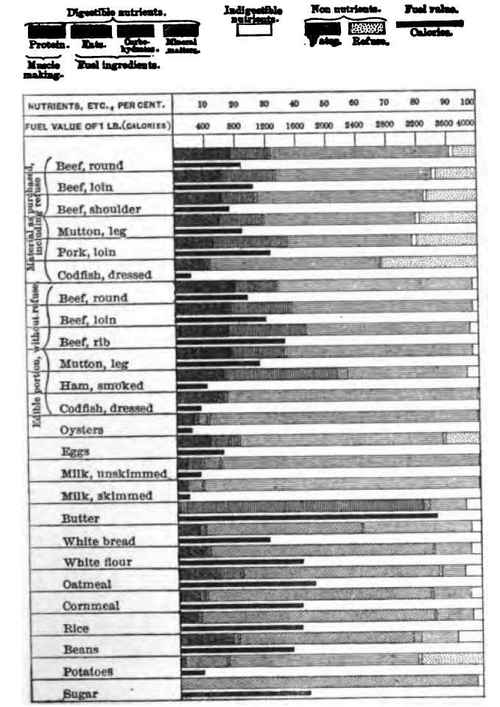
Chart I. - Composition Of Food Materials. Nutritive Ingredients, Refuse, And Fuel Values
Food Consumption Of Persons In Different Circumstances, And Proposed Dietary
[Quantities per man per day.]
Number of studies included in avenges. | Actually eaten. | Digestible. | |||||||
Proteids. | Fat. | Carbohydrates. | Proteids. | Pat. | Carbohydrates. | Fuel value. | Nutritive ratio. | ||
PERSONS WITH ACTIVE WORK. | Gms. | Gms. | Gms. | Gms. | Gms. | Gms. | Cal-ories. | r: | |
Rowing clubs in New England......... | 7 | 155 | 177 | 440 | 143 | 168 | 427 | 3,955 | 5.6 |
Bicyclists in New York.......... | 3 | 186 | x86 | 651 | I7X | 177 | 631 | 5.005 | 6 |
Football teams in Connecticut and California. | 2 | 226 | 354 | 634 | 208 | 336 | 615 | 6,590 | 6.6 |
Prussian machinist.......... | I | 139 | 113 | 677 | 128 | 107 | 657 | 4,270 | 7 |
Swedish mechanics......... | 5 | 189 | 110 | 714 | 174 | X04 | 693 | 4,590 | 53 |
PERSONS WITH ORDINARY WORK. | |||||||||
Farmers' families in eastern United States.... | 10 | 97 | X30 | 467 | 89 | 124 | 453 | 3,415 | 8.2 |
Mechanics' families in United States......... | 14 | 103 | 150 | 402 | 95 | 143 | 39° | 3,355 | 7.5 |
Laborers' families in large cities of the United States......... | 12 | 101 | 116 | 344 | 93 | 110 | 334 | 2,8l0 | 6.3 |
Laborers' families in United States (more comfortable circumstances)........... | 2 | 120 | 147 | 534 | 110 | 140 | 518 | 3,925 | 7.6 |
Russian peasants........ | 129 | 33 | 589 | 119 | 31 | 571 | 3.165 | 54 | |
Swedish mechanics....... | 6 | 134 | 79 | 523 | 123 | 75 | 507 | 3,330 | 5.5 |
PROFESSIONAL MEN. | |||||||||
Lawyers, teachers, etc., in United States........... | 14 | 104 | 125 | 423 | 96 | 119 | 410 | 3,220 | 7.1 |
College clubs in United States............. | 15 | 107 | 148 | 459 | 98 | 141 | 445 | 7.8 | |
German physicians.......... | 2 | 131 | 95 | 327 | 121 | 90 | 317 | 2,680 | 43 |
Japanese professor.......... | 1 | 123 | 21 | 416 | 113 | 19 | 403 | 2,345 | 4 |
MEN WITH LTTTLE OR NO EXERCISE. | |||||||||
Men (American) in respiration calorimeter... | 11 | 112 | 80 | 305 | 103 | 76 | 296 | 2,380 | 4.5 |
Men (German) in respiration apparatus...... | 5 | 127 | 80 | 302 | 117 | 76 | 293 | 2,430 | 4 |
PERSONS IN DESTITUTE CIRCUMSTANCES, | |||||||||
Poor families in New York City........ | 11 | S3 | 95 | 407 | 86 | 90 | 395 | 2,845 | 6.9 |
Laborers' families in Pittsburg, Pa....... | 2 | 80 | 95 | 308 | 74 | 90 | 29? | 2,400 | 6.8 |
German laborers' family ............. | 1 | 52 | 32 | 287 | 48 | 30 | 278 | 1,640 | 7.2 |
Italian mechanics........... | 5 | 76 | 38 | 396 | 70 | 36 | 384 | 2,225 | 6.6 |
MISCELLANEOUS. | |||||||||
Negro families in Alabama and Virginia..... | 39 | 86 | 145 | 440 | 79 | 138 | 427 | 3.395 | 93 |
Italian families in Chicago......... | 4 | 103 | 111 | 391 | 95 | 105 | 379 | 2,905 | 6.5 |
French Canadians in Chicago......... | 5 | 118 | 158 | 345 | 109 | 150 | 335 | 3,260 | 6.2 |
Bohemian families in Chicago....... | 8 | 115 | 101 | 360 | 106 | 96 | 349 | 2,800 | 5.3 |
Inhabitants Java village, Columbian Exposition, 1893......... | 1 | 66 | 19 | 254 | 61 | 18 | 246 | 1,450 | 4.7 |
Russian Jews in Chicago......... | 10 | 137 | 103 | 418 | 126 | 98 | 405 | 3,135 | 5 |
Mexican families in new Mexico........ | 4 | 94 | 71 | 613 | 86 | 67 | 595 | 3.46o | 8.7 |
Chinese dentist in California....... | 1 | 115 | 113 | 289 | 106 | 107 | 280 | 2,620 | 4.9 |
Chinese laundryman in California....... | 1 | 135 | 76 | 566 | 124 | 72 | 549 | 3,48o | 57 |
Chinese farm laborer in California........ | 1 | 144 | 95 | 640 | 132 | 90 | 621 | 3.98o | 6.2 |
United States army ration, peace......... | 120 | 161 | 454 | 110 | 153 | 440 | 3.730 | 7.1 | |
German army ration, peace........... | 114 | 39 | 480 | 105 | 37 | 466 | 2,725 | 5.2 |
Number of studies included in averages. | Actually eaten. | Digestible. | Fuel value. | Nutritive ratio. | |||||
Proteids. | Fat. | Carbohydrates. | Proteids. | Fat. | Carbohydrates. | ||||
DIETARY STANDARDS. | Gms. | Gms. | Gms. | Gms. | Gms. | Gms. | Cal-ories. | 1: | |
Man at hard work (Voit). ............ | 145 | 100 | 450 | 133 | 95 | 437 | 3,270 | 4.9 | |
Man at moderate work (Voit)........ | 118. | 56 | 500 | I09 | 53 | 485 | 2,965 | 55 | |
Man with very hard muscular work (Atwater) | 175 | (0 | (1) | l6l | (0 | (1) | 5,500 | 7.2 | |
Man with hard muscular work (Atwater} | I50 | (I) | (1) | 138 | (I) | (I) | 4,150 | 6.2 | |
Man with moderately active muscular work (Atwater).............................. | 125 | (I) | (I) | "5 | (I) (0 | (I) | 3,400 | 6.2 | |
Man with light to moderate muscular work (Atwater)......... | 112 | (I) | (I) | 103 | (I) | 3,050 | 6.1 | ||
Man at "sedentary" or woman with moderately active work (Atwater).......... | 100 | (I) | (0 | 92 | (I) | (1) | 2,7O0 | 6.x | |
Woman at light to moderate muscular work, or man without muscular exercise (Atwater) | 90 | (I) | (I) | 83 | (I) | (1) | 2,450 | 6.1 | |
(1) Pats and carbohydrates in sufficient amounts to furnish, together with the proteids, the indicated amount of energy.
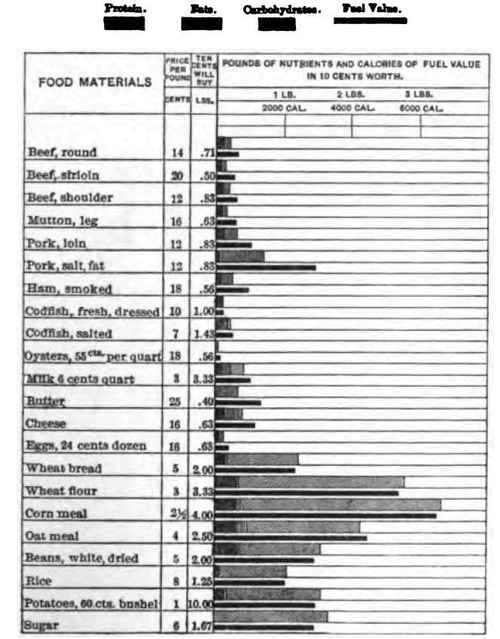
Chart II. Pecuniary Economy Of Food
Amounts of actually nutritive ingredients obtained in different food materials for 10 cents. (Amounts of nutrients in pounds; feel value in calorie*.)
Comparative Cost Of Digestible Nutrients And Energy In Different Food Materials At Average Prices
[It is estimated that a man at light to moderate muscular work requires about 0.23 pound of proteids and 3,050 calories of energy per day.]
Kind of food material. | Price per pound. | Cost of 1 pound pro-teids.1 | Cost of 1,000 calories energy.l | Amounts for 10 cents. | ||||
Total weight of food material. | Proteids. | Fat. | Carbohydrates. | Energy. | ||||
Cents. | Dollars. | Cents. | Pounds | Pound. | Pound. | Pounds. | Calorics. | |
Beef, sirloin......... | 25 | I.60 | 25 | 0.40 | 0.06 | O.06 | 410 | |
" " | 20 | 1.28 | 20 | .50 | .08 | .08 | 515 | |
" " | 15 | .96 | 15 | .67 | .10 | .11 | 685 | |
Beef, round......... | 16 | .87 | 18 | .63 | .11 | .08 | 560 | |
" " | 14 | .76 | 16 | .71 | .13 | .09 | 630 | |
" " | 12 | .65 | 13 | .83 | .15 | .10 | 740 | |
Beef, shoulder Cold....... | 12 | .75 | 17 | .83 | .13 | .08 | 595 | |
" " " | 9 | •57 | 13 | 1.11 | .18 | .10 | 795 | |
Beef, stew meat........ | 5 | .35 | 7 | 2 | .29 | .23 | 1,530 | |
Beef, dried, chipped....... | 25 | 32 | .40 | .10 | .03 | 315 | ||
Mutton chops, Ioin....... | 16 | 1.22 | 11 | .63 | .08 | .17 | 890 | |
Mutton leg.......... | 20 | 1.37 | 22 | .50 | .07 | .07 | 445 | |
" " ................ | 26 | 1.10 | 18 | .63 | •09 | •09 | 560 | |
Roast pork, loin......... | 12 | .92 | 10 | .83 | .IX | .19 | Il035 | |
Pork, smoked ham........ | 22 | 1.60 | 13 | .45 | .06 | .14 | 735 | |
" " " | 18 | 1.30 | II | .56 | .08 | .18 | 915 | |
Pork, fat salt....... | 12 | 6.67 | 3 | .83 | .02 | .68 | 2,950 | |
Codfish, dressed, fresh..... | 10 | •93 | 46 | 1 | .11 | 220 | ||
Halibut, fresh..... | 18 | 1.22 | 38 | .56 | .08 | .02 | 265 | |
Cod, salt........ | 7 | •45 | 22 | 1.43 | .22 | .01 | 465 | |
Macherel, salt, dressed........... | 10 | .74 | 9 | 1 | .13 | .20 | 1,135 | |
Salmon, canned.......... | 12 | .57 | 13 | .83 | .18 | .10 | 760 | |
Oysters, solids, 50 cents per quart.......... | 25 | 4.30 | 111 | .40 | .02 | .01 | 90 | |
Oysters, solids, 35 cents per quart......... | 18 | 3.10 | 80 | .56 | .03 | .01 | .02 | 125 |
Lobstar, canned......... | 18 | 1.02 | 46 | .56 | .10 | .01 | 225 | |
Butter........................ | 20 | 20.00 | 6 | .50 | .01 | .40 | 1,705 | |
" | 25 | 25.00 | 7 | .40 | .32 | 1,365 | ||
" | 30 | 30.00 | 9 | •33 | .27 | 1,125 | ||
Eggs, 36 cents per dozen........ | 24 | 2.09 | 39 | .42 | .05 | .04 | 260 | |
Eggs, 24 cents per dozen..... | 16 | 1.39 | 26 | .63 | .07 | .06 | 385 | |
Eggs, 12 cents per dozen... | 8 | .70 | 13 | 1.25 | .14 | .11 | 770 | |
Cheese......... | 16 | .64 | 8 | .63 | .16 | .20 | .02 | 1,185 |
Milk, 7 cents per quart..... | 3 1/2 | 1.09 | 11 | 2.85 | .09 | .11 | .14 | 885 |
Milk, 6 cents per quart.... | 3 | •94 | 10 | 3.33 | .11 | .!3 | .17 | 1,030 |
Wheat flour....... | 3 | .31 | 2 | 3.33 | .32 | .03 | 2.45 | 5,440 |
1 The cost of 1 pound of proteids means the cost of enough of the given material to furnish 1 pound of proteids, without regard to the amount of the oilier nutrients present. Likewise the cost of energy means the cost of enough material to furnish 1,000 calories without reference to the kinds and proportions of nutrients in which the energy is supplied. These estimates of the cost of proteids and energy are thus Incorrect in that neither gives credit for the value of the other.
Kind of food material. | Price per pound. | Cost of x pound pro-teids.1 | Cost of 1,000 calories energy.1 | Amounts for 10 cents. | ||||
Total weight of food material. | Proteids. | Fat. | Carbohydrates. | Energy. | ||||
Cents. | Dollars. | Cents. | Pounds | Pound. | Pound. | Pounds. | Calories. | |
Wheat flour........... | 2 1/2 | .26 | 2 | 4 | .39 | .04 | 2.94 | 6,540 |
Corn meal, granular......... | 2 1/2 | .32 | 2 | 4 | .31 | .07 | 2.96 | 6,540 |
Wheat breakfast food......... | 7 1/2 | .73 | 4 | 1.33 | .13 | .02 | .98 | 2,235 |
Oat breakfast food......... | 7 1/2 | .53 | 4 | 1.33 | .19 | .09 | .86 | 2,395 |
Oat meal......... | 4 | .20 | 2 | 2.50 | .34 | .16 | 1.66 | 4,500 |
Rice......... | 8 | 1.18 | 5 | 1.25 | .08 | .97 | 2,025 | |
Wheat bread......... | 6 | .77 | 5 | 1.67 | .13 | .02 | .87 | 2,000 |
" "......... | 5 | .64 | 4 | 2 | .16 | .02 | 1.04 | 2,400 |
" " .............. | 4 | .51 | 3 | 2.50 | .20 | .03 | 1.30 | 3,000 |
Rye bread....... | 5 | .65 | 4 | 2 | .15 | .01 | 1.04 | 2,340 |
Beans, white, dried..... | 5 | .20 | 3 | 2 | .35 | .03 | 1.16 | 3.040 |
Cabbage......... | 2 1/2 | 2.08 | 22 | 4 | .05 | .01 | .18 | 460 |
Celery.............. | 5 | 6.65 | 77 | 2 | .02 | .05 | 130 | |
Corn, canned............... | 10 | 4.21 | 23 | 1 | .02 | .01 | .18 | 430 |
Potatoes, 90 cents per bushel.. | 1.00 | 5 | 6.67 | .10 | .01 | .93 | 1,970 | |
Potatoes, 60 cents per bushel.. | 1 | .67 | 3 | 10 | .15 | .01 | 1.40 | 2.950 |
Potatoes, 45 cents per bushel.. | 3/2 | .50 | 3 | 13.33 | .20 | .01 | 1.87 | 3.935 |
Turnips.................... | I | 1.33 | 8 | 10 | .08 | .01 | .54 | 1,200 |
Apples..................... | 1 1/2 | 5.00 | 8 | 6.67 | .02 | .02 | .65 | 1,270 |
Bananas.................... | 7 | 10.00 | 27 | 1.43 | .01 | .01 | .18 | 370 |
Oranges.................... | 6 | 12.00 | 40 | 1.67 | .01 | .13 | 250 | |
Strawberries................ | 7 | 8.75 | 47 | 1.43 | .01 | .01 | .09 | 215 |
Sugar...................... | 6 | 3 | 1.67 | 1.67 | 2,020 |
1 See note on page 29.
According to Dr. Atwater, a man at hard muscular work requires 1.2 the food of a man at moderately active muscular work. A man with light muscular work and a boy sixteen years old require 0.9 the food of a man at moderately active muscular work. A man at a sedentary occupation, a woman at moderately active work, a boy fourteen years old, and a girl sixteen years old, require 0.8 the food of a man at moderately active muscular work. A woman at light work, a boy twelve years old, and a girl fourteen years old, require 0.7 the food of a man at moderately active muscular work. A boy eleven years old and a girl twelve years old require 0.6 the food of a man at moderately active muscular work. A child from six to nine years old requires 0.5 the food of a man at moderately active muscular work. A child from two to five years old requires 0.4 the food of a man at moderately active muscular work. A child under two years old requires 0.3 the food of a man at moderately active muscular work.
Again quoting from Atwater, all persons must get from their food a proper amount of proteids for building and keeping in repair the bodily machine and fuel for warmth and work; but individuals differ in the amounts they require, and even among those in good health many must avoid certain kinds of food. One man cannot eat fish, another cannot eat mutton, another cannot eat eggs, and so on; while some have weak digestion, naturally or acquired, and these must have special diets. These are cases for the physician to study and set right The point is to get what agrees with these people, and yet get a diet that will afford the proper amount of nourishment. Here the dyspeptic needs proper advice and guiding.
If we take more food than is needed, or improper food, we overtax the digestive organs; injury follows and energy is wasted. If a man is a glutton, in the end he must suffer. Usually we eat three meals in twenty-four hours. Custom has much to do with this. Every one should regulate this matter according to his needs and habits. It is never well to eat to repletion at any one meal. Do not confine yourself to a one-sided diet. Poverty may make such a course somewhat necessary, as instanced by the bread-and-tea diet of many poor women especially. On the other hand, do not live on meat alone, or vegetables alone. A properly proportioned and properly mixed diet is the diet of election for man. Of course special diets are for special cases. The question of diet should be more studied by all. Eating and drinking, especially among the idle and well-to-do, is made an amusement in many cases. They eat for social enjoyment and merely to pass away time. This is in evidence in travelling and in city life. Take a Pullman buffet car for a journey. People are constantly eating and drinking here, and at the regular meal-time pass into the dining car for the three regular meals, and thus keep up the constant tickling of their gustatory senses. In city life we see the same tampering with our digestive machinery. Among those holding the ordinary positions of business life we behold the horrors of the quick lunch, where all the laws of health as to digestion are violated. To those better equipped with this world's goods we see errors of diet in the rich heavy lunch, often with spirits, wine, or beer. Women are great sinners at this mid-day lunch. The horrors of the sweets and the ices, and such, only their stomachs and often their general wretchedness can reveal. The full late dinner and the heavy supper after the opera complete the gastronomic dissipation. Few can withstand this round of eating and drinking and live beyond fifty years of age. We are getting to know better. Caterers are learning more how to serve people. Dinners, luncheons, and such are lighter and served more in accordance with proper rules governing health than they formerly were; but even as this care in serving increases, people must learn and grow more cautious in eating and drinking, and thus preserve their own health, the stability of the coming man, and the general good of the entire human race.
Continue to:


My Books

