


Ham
Description
This section is from the book "Hand-Book Of Practical Cookery", by Pierre Blot. Also available from Amazon: Hand-Book of Practical Cookery, for Ladies and Professional Cooks.
Ham
To Boil
Sugar-cured are preferred to others.
Scrape off the outside gently, soak in cold water for from six to twenty-four hours, take off and wipe dry.
Envelop it in a towel and tie it. Place it in a kettle large enough to hold it without bending it; cover with cold water; season with six small onions, two carrots, four cloves, two bay-leaves, a handful or two plants of parsley, two or three stalks of thyme, two of celery, two cloves of garlic (a handful of hay and half a bottle of white wine, if handy would improve the taste); boil gently for four or five hours, according to the size (four hours for a ten-pound one, five for a fifteen-pound one). Pay no attention to the old saying that "it takes half an hour to every pound."
Take from the fire, remove the towel, break off and remove the small bone at the larger end of it, and without tearing the meat. Remove the rind also, leaving only about two inches of it near the smaller end, cutting it so that it will be dentilated.
To Decorate
It is decorated in several ways, according to taste and fancy. If the fat is not white after having removed the rind, spread a very thin coat of lard over it, place the ham on a dish, the fatty side up. Cut carrots, turnips, and beets, boiled tender, in fancy shapes, with paste-cutters or with a knife; place them tastefully all over the ham; place also all over it some parsley, capers, and olives. Chop some meat-jelly and put it all around the dish, and serve. In carving it, scrape back the lard and vegetables, slice, and serve.
Another
When boiled, trimmed, and the rind removed, put it in the oven for about twenty minutes, basting the while with a Madeira sauce. Serve with the sauce. Any kind of puree may be served with it.
Another
When trimmed and soaked in water as directed, boil it with half wine and half water: the same seasonings as when boiled in water. Use either Catawba, Sauterne, or Rhine wine. It makes it more expensive, but it is excellent. It is served as when boiled in water.
Another
Boil it in claret wine, and when trimmed and decorated, serve it with a mushroom or a truffle sauce.
Another
Boil, trim, and cut off the rind as described in the above cases; place the frill, and serve with spinach au beurre.
Another
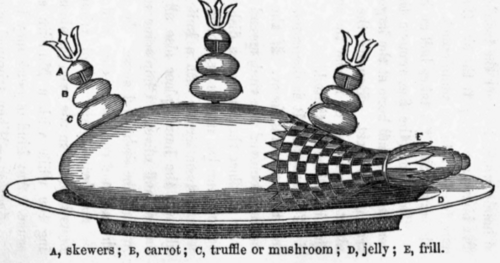
Boil and trim the ham as above, cut the rind in the same way. What is left of the rind is cut as seen in the cut opposite: that is, some small square pieces are cut off, from place to place, so that it resembles a checkerboard; stick two or more skewers in it, glaze it with essence of beef or with sugar, and serve either on a tomato-sauce or on peas a l'An-glaise.
Ham English Fash-Ion
Soak it in water and trim it as directed. Make some paste with water and flour only; spread a coat of thi3 paste all over the ham, and then envelop it in buttered or oiled paper. Put it on the spit and baste with fat while it is roasting. Roast it for three or three and a half hours, according to size ; remove the paper about two hours after it has been taken from the fire; cut a hole in the paste about an inch in diameter and on the lean side; pour into it, little by little, half a pint of good Madeira wine, cover the hole with some paste, placing a band of paper on it to prevent it from falling; put the ham back on the spit for about twenty minutes, and serve whole with Madeira sauce. We mean, by serving whole, with the paste around it, but not the paper.
Besides the sauce, some green vegetables, boiled only, are served on separate dishes, but eaten with the ham.
It is also served like game, with currant-jelly, applesauce, etc.
Champagne Sauce
Proceed as for the above in every particular, except that you use Champagne instead of Madeira wine, and when done serve it with a Champagne sauce.
Another
It may be boiled as directed above, and served with a Champagne sauce also.
Another
When soaked and dry, put it in a crockery vessel; put on and all around it four onions chopped fine, two bay-leaves, two sprigs of thyme, a piece of nutmeg, and pour on the whole a bottle of white wine; cover the vessel as nearly air-tight as possible, leave it thus for about twenty-four hours, turning it over two or three times, so as to let every side take the seasonings. Place the ham on the spit before a good fire, baste often with the seasonings from the crockery vessel, and when done take it off", dust it with fine raspings of bread, place it fifteen minutes in a slow oven, strain the drippings, boil them till reduced to a proper thickness, dish the ham, pour the drippings on it, and serve.
Continue to:


My Books

