


Recipes For Timbales. Part 14
Description
This section is from the book "The Epicurean", by Charles Ranhofer. Also available from Amazon: The Epicurean, a Complete Treatise of Analytical and Practical Studies on the Culinary Art.
Recipes For Timbales. Part 14
(2605). Timbale Of Pheasants With Truffles (Timbale De Faisans Aux Truffes)
Remove the meat from the breast of two raw pheasants. Chop up the fleshy part of the legs with one fillet and the carcass parings, and with it mix an equal quantity of fat pork, a few raw truffles and fragments of foies-gras; pound well and pass through a sieve. Cut into large squaresthe remaining breast meats and lay them in a vessel with as much cut-up raw foies-gras; season highly and pour over a few spoonfuls of Madeira wine; keep this in a cool place for two hours. Butter a large dome-shaped mold, broader than it is high; line it with cold pie paste (No. 144) and cover with a layer of the forcemeat, filling the empty space with the contents of the vessel; cover the top with a thick, well-rounded layer of the same, and then lay several slices of fat pork on all; close up the aperture of the mold with a flat of the same paste, fastening it to the edges, and in the center bore a small opening. Now lay the timbale on a small-sized baking sheet and let it cook for about an hour and a half in a slack oven; after it has been removed for a quarter of an hour pour into the hole two or three gills of brown chaudfroid ( No. 594), reduced with pheasant fumet (No. 397) and Madeira wine, and let it cool for twenty-four hours before unmolding.
When read} to serve invert it on the table, lift off the mold and cut from the bottom a slice about an inch thick, then begin cutting the dome into even slices, not too thick, from the top to the bottom; restore these to their original shape on the piece cut from the bottom. Dress the timbale on a wooden foundation attached to a dish and covered with white paper; have small holes perforated atequal distances around the edges of this foundation and into these stick a dozen small hatelets, each one being garnished with two peeled truffles, one largerthan the other. On the summit of the dome insert another hatelet garnished with large truffles; surround the foundation either with handsome jelly croutons (No. 2442), or else with slices of pie cooked in a cradle mold.
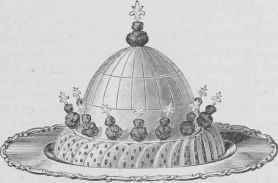
Fig. 532.
(2987). Timbale Of Gnocquis, A La Choiseul (Timbale De Gnocquis A La Choiseul)
Prepare a paste with a pint of milk boiled with a quarter of a pound of butter; remove it at the first boil and put in a half pound of sifted flour; prepare as a pate-a-chou (No. 132); boil for a few momenta on the fire, then incorporate Fourteen eggs, salt and four ounces of grated parmesan. Turn this paste over on the table and finish with sufficient flour to have it firm and solid, then roll it out into thin strings a quarter of an inch in width, and divide these into quarter-inch lengths; roll each one to the shape of a ball and plunge them into boiling water to poach for three minutes, then drain and lay them in a saucepan with grated Swiss cheese and bechamel sauce (No. 409). Line a timbale mold with thin foundation paste (No. 135), pour in the gnoquis and wet the inside upper edge; cover the timbale with a flat of the same paste, attach the edges solidly together and cook for one hour in a medium oven, remove, unmold and serve at once, dressed on a dish, with a little buttered veloute sauce (No. 415) served separately.
Continue to:


My Books

