


Recipes For Mutton (Mouton)
Description
This section is from the book "The Epicurean", by Charles Ranhofer. Also available from Amazon: The Epicurean, a Complete Treatise of Analytical and Practical Studies on the Culinary Art.
Recipes For Mutton (Mouton)
(1605). Double Baron Or Saddle, Roasted (Double Baron Ou Selle Rotis')
The double of mutton is the back hip part with the leg on which the saddle with about seven of the ribs is left adhering (Fig. 340). Select a good sheep not too large, but young and fat, remove the skin and suppress the fat; cut several incisions on the fat to facilitate and equalize the cooking, then lay it in a copper pan and cook in a moderate oven; the meat must be left rare, then salt it over. Dress and decorate the leg bone with paper frills (No. 10), pouring a clear gravy (No. 404), on the bottom of the dish. The baron and saddle are to be cooked the same way and served the same; they differ only in cut. The baron is taken from the loin end as far as the first rib (Fig. 340). The saddle is the whole hind part of the mutton without the legs.
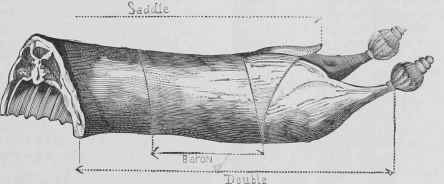
Fig. 340.
(1606). Sheep's Ears A La Westphalian (Oreilles De Mouton A La Westphalienne)
Blanch and braise some sheep's ears after having thoroughly cleansed them in a mirepoix stock (No. 419); when cooked put them in a vessel with the stock strained ever, and let get cold. Cut out the inside of the ears with a column tube, then reheat them in the braise stock. Dress on a baking dish and till the interiors with veal quenelle forcemeat (No. 92), to which add chopped truffles and some veloute sauce ( No. 415), thickened with egg-yolks; dredge over some bread-crumbs and grated parmesan cheese; sprinkle over a little melted butter and place in the oven to color slightly. Dress them in a circle and (ill the center with thin slices of ham fried in butter over a brisk tire: dilute the glaze in the pan with white wine and brown sauce (No. 414), reduce and pour it over the ham; sprinkle chopped parsley over the whole.
(1607). Epigrammes Of Mutton A La Jardinlere (Epigrammes De Mouton A La Jardiniere)
Have eight mutton cutlets prepared as for plain (No. 1590), season, dip in eggs and breadcrumbs, equalize the bread-crumbs and fry in clarified butter or if preferred omit the breading and simply saute the cutlets plain. Braise some breast of mutton the same as for plain (No. 1585), then put them under a weight and when cold pare them into half hearts; dip these in Villeroi sauce | No. 560), and after this is cold dip them in eggs, then in bread-crumbs, immerse them in plenty of hot frying fat; when of a nice color, drain. Decorate the top of a hollow border mold with all kinds of cut up vegetables, fill the inside with quenelle forcemeat (No. 92), poach, unmold on hot dishes. Range the breasts and cutlets alternately in a circle on top of this and fill the empty center with a jardiniere (No. 677); serve an espagnole sauce (No. 414) separately after it has been reduced with the braise stock which has been strained and freed from fat, and some mushroom essence (No. 392).
(1608). Mutton Fillets A L'Alexandre (Filets De Mouton A L'Alexandre)
Pare the mutton fillets, cut them up into thin slices a quarter of an inch thick and cover each one with a cooked fine herb preparation (No. 385), seasoning first with salt and pepper, dip in beaten eggs, roll in fine bread-crumbs, giving each a horseshoe-shape and fry in clarified butter. Slice six mutton kidneys, as many raw mushrooms and half as many truffles, fry the kidneys in butter, add to them the mushrooms and truffles, drain off the butter and replace it by a little espagnole sauce ( No. 414), lemon juice and fresh butter, pour this stew into a dish and dress the cooked fillets over in straight rows, one overlapping the other.
Continue to:


My Books

