


Recipes For Beef (Boeuf)
Description
This section is from the book "The Epicurean", by Charles Ranhofer. Also available from Amazon: The Epicurean, a Complete Treatise of Analytical and Practical Studies on the Culinary Art.
Recipes For Beef (Boeuf)
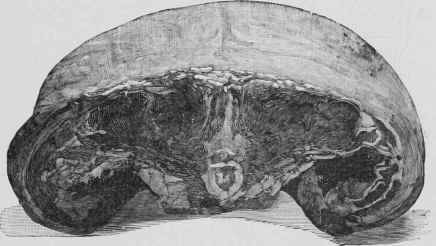
(1313). Baron Of Beef A La St. George (Selle De Boeuf A La St. George)
The baron of beef weighs about one hundred and fifty pounds. It is the saddle of beef cut from the hip of a young and tender ox as far down as the second rib, this being pared and the thinnest part covered with slices of fat so as to have the meat of uniform thickness and cooked alike throughout. It takes about five hours to cook a baron of beef in a baker's brick oven, the best to use for large pieces of this description, after being cooked they should be put in a heater or warm place, for about two hours, to finish cooking slowly. When cooked arrange it on a large dish, garnishing on the edges with shavings of horseradish (No. 98) and the ends with Yorkshire pudding (No. 770). Serve thickened gravy (No. 405) well skimmed and strained through a fine sieve, in a separate sauce-boat, also some baked potatoes.
(1314). Breast or Brisket Of Beef A La Florence (Poitrine Ou Bavette De Boeuf A La Florence)
The name of brisket is applied to the part of the beef adjoining the cross ribs, and the neck. If the beef be of a good quality, the plate or brisket makes an excellent and economical boil, the meat being juicy and interlarded with fat giving it a very good flavor.
Put a quarter of a pound of butter in a saucepan, and when warm, add half a pound of lean bacon and half a pound of ham cut into squares of a half of an inch. When the bacon and ham are well browned, add four ounces of onions cut into an eighth of an inch squares, and two pounds of brisket of beef well freed from fat, boned and cut into one inch squares. Add a bunch of parsley, also thyme, bay leaf and a small clove of garlic, two cloves, two celery heads cut in quarters and trimmed and some stewed tomatoes. Moisten with a little broth (No. 194a). cook for two hours and a half, adding a little more broth at times, and serve on a dish garnished around with gastronome potatoes (No. 2789).
(1315). Corned Breast Of Beef With Cabbage (Poitrine De Boeuf Sale Aux Choux)
Lay a breast of beef in a brine of half salt, and set it in a cold room, leaving it for twelve days. Unsalt it for two hours, then put the meat in a saucepan with cold water. Let it boil, skimming it occasionally, and place it on one side of the fire to simmer for several hours, or until the meat be thoroughly cooked. Blanch two or three cabbages, cut them in quarters, remove the hard centers, called the core, and two hours before serving put the cabbage in with the beef. When the meat is done properly, dram, and arrange it on a dish, garnishing it round with the cabbage, put some boiled potatoes at either end, and serve a little good gravy separately.
Beef, American Cuts (Boeuf Coupe A L'Americaine)
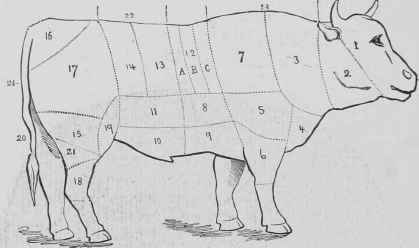
(Fig. 302.).
1. Head.
2. Beef jowl.
3. Neck.
4. Brisket.
5. Cross ribs.
6. Shin.
7. Chuck ribs.
8. Plates.
9. Navel.
10. Inside flank.
11. Thick flank.
12. Six Prime ribs, A first cut, B second cut, C third.
13. Short loin.
14. Hip.
15. Round.
16. Aitchbone rump.
17. Round bottom.
18. Leg of beef.
19. Butt.
20. Oxtail.
81. Horseshoe legs.
22. Hip and loin.
23. Whole chuck.
24. Round top.
Continue to:


My Books

