


(2909). Recipes For Eggs On A Dish (Oeufs Sur Le Plat)
Description
This section is from the book "The Epicurean", by Charles Ranhofer. Also available from Amazon: The Epicurean, a Complete Treatise of Analytical and Practical Studies on the Culinary Art.
(2909). Recipes For Eggs On A Dish (Oeufs Sur Le Plat)
There is very little difference between eggs on a dish or miroir eggs, for they are both cooked the same way, the only difference being that the first ones are served on the same dish they are cooked in, while the miroir eggs are basted with boiling butter while cooking and cut in rounds as soon as done with a two and a half inch pastry cutter; take them up with a palette and serve on a plate or dish.
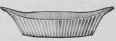
Fig. 566.
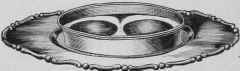
Fig. 567.
How To Prepare Eggs On A Dish
These eggs should be conked in china egg dishes (Fig. 567): to do them properly first butter the dish with fresh or unsalted butter, break the eggs into the dish, and salt over the whites but not the yolks so as not to discolor them: set the dish on a thick, cold baking sheet and push it at once into the oven so that they receive more heat from the top than bottom; as soon as the yolks are glossy remove the dish from the oven and. if necessary. finish cooking on top, being careful not to have the whites done too much. Eggs cooked in this way are generally served on the same dish, with or without a garnishing.
(2910). Eggs On A Dish, Bercy (Oeufs Sur Le Plat A La Bercy)
Fry in a pan two or three sausages; pour the fat into a small egg dish (Fig. 567), leaving the sausages in the pan, then break four eggs into the dish. Pour over some melted butter, salt over the whites and cook in the range oven, leaving them in till they are glossy. Skin the sausages, cut them up and dress around the eggs, serving with a half-glaze sauce (No. 413) and tomato sauce (No. 549), reduced together and strained through a fine sieve.
(2911). Eggs On A Dish, Bienvenue (Oeufs Sur Le Plat A La Bienvenue)
Lay through a pocket on the inside edge of the basin of a dish a border made of potato croquette preparation (No. 2782) softened with an egg; fill the center of this border with a bed of duxelle or cooked fine herbs (No. 385); break over some raw eggs without injuring the yolks. season with salt and-pepper, and put in the center of the yolks; dredge with grated Swiss cheese, pour on some butter and cook the eggs in a hot oven. Serve as soon as removed.
(2912). Eggs On A Dish, Conde (Oeufs Sur Le Plat A La Conde)
Through a pocket provided with a channeled socket form a border of chicken quenelle forcemeat (No. 89) and baking forcemeat (No. 81), well mixed together, laying it in the inside of the basin of the dish. Butter the bottom of this dish, season with salt and pepper, and break in a sufficiency of eggs without disturbing the yolks: strew the whites with duck's liver cut in one-eighth of an inch squares, and over the whole scatter grated parmesan cheese; pour on some butter and cook in a hot oven. Garnish around with three-quarters of an inch round chicken croquettes.
(2913). Eggs On A Dish, Creole Style (Oeufs Sur Le Plat A La Creole)
Fry colorless in oil one tablespoonful of chopped onions, as much finely cut-up hot pepper, a quarter of a clove of crushed garlic and a peeled tomato cut in two, pressed out, then divided into small squares; simmer, reduce, and when of a sufficient (consistency add two tablespoonfuls of cooked rice, salt and cayenne pepper. With this preparation cover the bottom of a dish fit for the oven; break over the eggs carefully, keeping the yolks entire, pour on melted butter, season with salt on the white of the eggs, and in the center of the yolk put a little pepper, and cook in a moderate oven.
Continue to:


My Books

