


True Love-Stories Of Famous. King George III. And Hannah Lightfoot. Part 2
Description
This section is from "Every Woman's Encyclopaedia". Also available from Amazon: Every Woman's Encyclopaedia.
True Love-Stories Of Famous. King George III. And Hannah Lightfoot. Part 2
The Disappearance Of The Bride
But what really did become of her ? That on April 17, 1759, she went through some form of marriage with the Prince of Wales may be accepted as tolerably authentic. But as to what happened in the meanwhile one can only conjecture.
The Prince, it would seem, after he had successfully eluded Master Axford, drove her to some safe place of refuge, either at Kew or Richmond - perhaps ultimately he took her to the house of his old friend, Mr.perryn, of Knightsbridge - where he could continue his rudely interrupted wooing without further danger, while making definite arrangement for the future.
Something of the sort must have happened, and for a while Hannah continued to communicate regularly with her mother. These letters are still in existence, but unfortunately it is not permissible to reproduce them here in print. It may be said, however, that they make frequent reference to " a Person," ' a certain Person," " the Person."
Who could he have been ? Obviously not Axford; there was no occasion to allude to him in such guarded terms. Then the Prince ? Surely. And in these letters Hannah makes it quite clear that she loved him dearly, and had reposed implicit trust in him. At this time, therefore, George must have had free and easy access to her.
What Did The Quakers Know?
But then, quite suddenly, all traces of Hannah vanished. It is impossible to say what happened to her. Even legend is silent. Someone, it would seem, must have betrayed the lovers. Perhaps - this is the most likely theory - Bute or the Prince's mother for a second time surprised their secret, and forthwith took steps - possibly again with Elizabeth Chudleigh's connivance - to whisk the girl away to some place where George could not even hope to find her.
Be this as it may, in some way the secret leaked out, or something happened which made it necessary for the lovers, temporarily, at any rate, to separate. And it is a significant fact that at about the same time the Society of Friends should solemnly have expelled Hannah from their order. It would be ridiculous to maintain that so severe a
4069 love step was taken simply because she married Isaac Axford. He was an eminently respectable young man, quite eligible, and, although not himself a Quaker, certainly came of a Quaker family. Moreover, although the Society of Friends discussed the affairs of Hannah Lightfoot at several meetings, not once is her husband mentioned by name in the minute-book.
Surely, therefore, it was not to her marriage that the good Quakers took exception, but to her subsequent entanglement with the Prince. Clearly they knew something - something which they dared not voice in public or in that plain-spoken language which is the pride of their order.
But George was far too ardent a young wooer to allow himself to be baffled by so small an obstacle as the disappearance of his lady love, however mysterious the circumstances. And eventually he found her. Where or when is not on record. All that can be said is that he found her, and that on April 17, 1759, he married her. But how could he marry her ? Was she not already wedded to Isaac Axford ? *
These questions raise several very interesting points. In the first place, although the Act for Preventing Clandestine Marriages did not come into force until Lady Day, 1754, it was passed by Parliament in June, 1753, six months prior to the Axford-lightfoot wedding.
Now, in the eyes of the new Act, this wedding certainly would have been invalid.
From its provisions, moreover, Jews, Quakers (both sects had strict ceremonials of their own), and members of the Royal Family, were deliberately excluded. It might have been passed, therefore, directly to suit the convenience of George and Hannah, for Axford, being neither Jew nor Quaker, was bound down by its provisions, whilst marriage, and. after Hannah Lightfoots death, insisted on being re-married to him privately at Kew
From the painting by Francis Cotes, R.a., in the possession of the Duke of Northumberland
Hannah, being a Quaker, and George a member of the Royal Family, were left free to marry as they liked. The Society of Friends alone could take exception to Hannah's actions, and they had taken exception already, and emphatically.
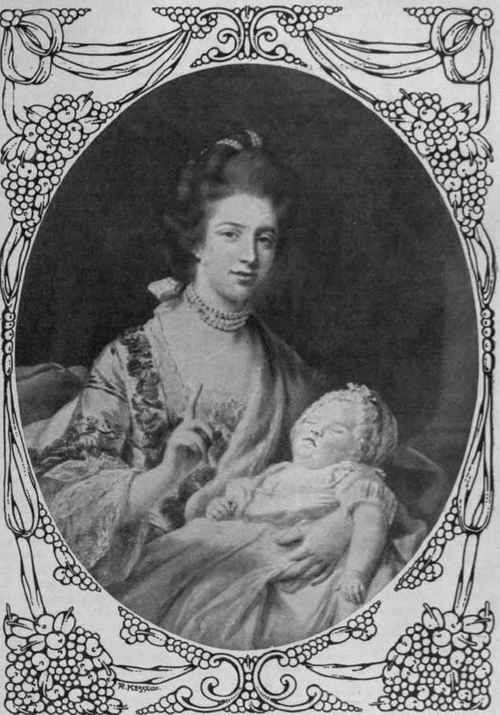
Queen Charlotte and the Princess Royal. The Queen truly believed in the story of her husband's former
Eventually, moreover, even the conscientious Master Axford took the law into his own hands, and, without having his
* According to one theory, the Prince really was married to Hannah Lightfoot at Keith's Chapel on December 11, 1753, Axford acting merely as proxy at the ceremony. This is an ingenious belief and by no means unromantic. Nor does it disprove the story as narrated in these pages. On the contrary, it merely makes it necessary to regard the subsequent elopement as a splendid piece of bluff magnificently stage-managed, perfectly acted. And this perhaps is not at all improbable.
former marriage rescinded, led another woman to the altar - this time the lady of his choice, a certain Mary Bartlett.
Before taking this step, it is true, he waited patiently for six long years and left no stone unturned which might reveal a clue to Hannah Lightfoot's whereabouts. So perhaps he was justified. Besides, he had but little to fear. A charge of bigamy against him was most improbable, for obviously an inquiry into his affairs would lead to undesirable disclosures.
Hannah's Marriage Certificate
And then he married Mary Bartlett in the summer "of 1759. This surely is more than a coincidence, for George is alleged to have married Hannah in the April of that same year. Yes, Axford certainly knew what he was doing. He must have heard something; enough, at any rate, to make him feel safe in following his future monarch's lead.
Continue to:


My Books

