


The Charm Of Applique Velvet
Description
This section is from "Every Woman's Encyclopaedia". Also available from Amazon: Every Woman's Encyclopaedia.
The Charm Of Applique Velvet
A New Idea for a Dress Trimming - The Pansy in Velvet - How to Cut Out and Arrange the Design - An Arrangement of the Vine with Leaves and Grapes - A Classical Effect - Suggestions for the Use of Velvet Applique Work
One of the most delightful ideas for the glorification of our clothes is the application of various coloured velvets cut in pretty shapes to decorate our gowns, scarfs, muffs, and evening cloaks.
Not only is the result of this work quite charming, but the work itself is an amusing hobby. Velvet flowers and leaves are cut out neatly with a sharp pair of scissors, and then these shapes are placed on the chosen fabric and secured in position with a liquid adhesive to be bought in small tubes.
Suitable Models
First of all, we must consider what flowers will give the happiest results, for we want to represent a flower that has for its chief beauty and characteristic velvety petals.
Immediately our thoughts wander to one of our most beautiful flowers - the flower which signifies "heartsease" - the gentle, old-fashioned pansy. This flower is quite one of the loveliest for applique velvet work. Velvet pansies would look exquisite on a pale blue chiffon scarf or gown. The flowers are not expensive to make, as two half-yards of silk velvet, a dark and light mauve, would make quite a number of flowers - indeed, if a simple design for a panel or corsage is required two quarters of a yard of velvet would most likely be quite sufficient.
Designing
A very easy method of obtaining a good shaped pansy is to procure some good postcards with pansy designs. Postcards are truly invaluable treasures to the woman who wants to work out a floral design of the applique velvet description. Study the postcard and pick out the most perfect specimens of the pansy you can find. If possible, get a replica of the same card, for one of the cards will be mutilated by your sharp scissors. Cut out the finest pansy, then cut out the petals. Most likely you will decide to have light petals on the top and dark petals below. Pin each card petal on to the velvet and cut it accurately to shape.
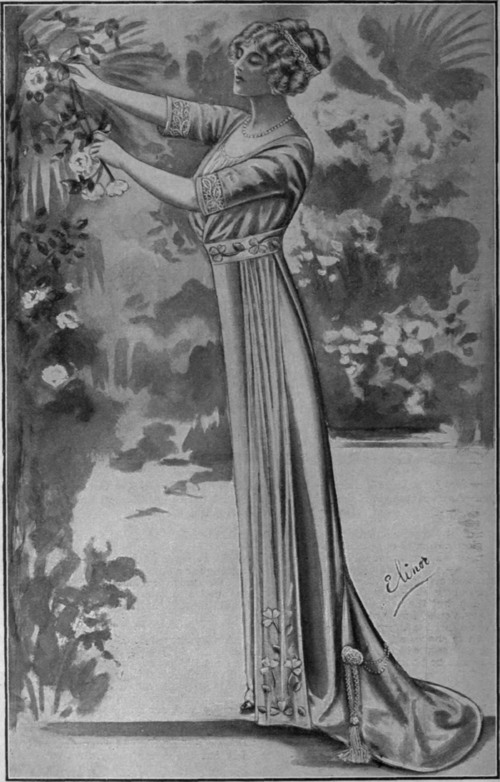
Garnitures in applique velvet are particularly lovely on evening gowns. A charming waist-belt and side panel are shown in the sketch above
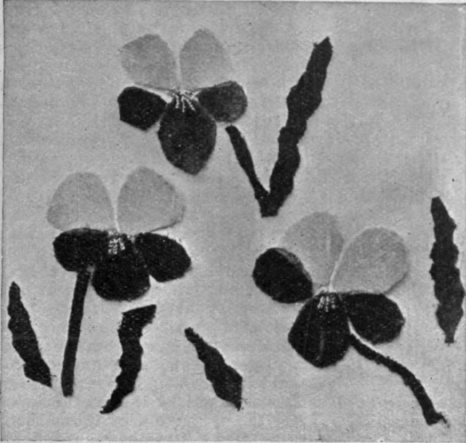
The pansy is an effective flower when carried out in applique velvet work. The shadings can range from the lightest to the darkest tones
Take some soft green velvet - a quarter of a yard will go a long way - and cut out some stems and leaves.
Pin the pale blue chiffon firmly down on a board and then study the uncut postcard, and you will be able to see how the petals are placed. Take your adhesive and spread it lightly over the back of each velvet petal - finishing one at a time - and place it in the desired position on the chiffon.
The pansies may be carelessly scattered over the chiffon for a tunic with good effect, or they could form a border to a tunic. They would also look charming at the end of a chiffon scarf. As the flowers are laid on the chiffon they are pressed down gently with a white cloth. When you have placed your flowers to your satisfaction, the stem and leaves are arranged into position. The centres of the flowers look most effective finished off with gold beads.
Be very careful not to put too much adhesive on to your petal, or it will not have a pleasing appearance. It is quite an art to find out just how much is required to secure each petal firmly to the chiffon.
Virginia creeper, carried out in soft reds and browns, would also lend itself admirably to this fascinating form of dress embellishment.
Bunches of purple grapes look very beautiful on pale blue satin. These grapes will make an exquisite adornment for a scarf, also for a muff for theatre use, and for the wide lapels of an evening cloak. The vine also looks delightful on chiffon, which is afterwards mounted on pale blue satin.
We will now consider a grape design, which would look well on an evening gown - either for a crossover piece for the bodice or for the side panel of a skirt. A panel is decidedly smart if it is of the triangular persuasion. Choose some very soft shades of mauve and purple velvet, one shade for the dark purple grapes, and the lighter shade will prove an excellent foil to this darker colour. Cut out a vine leaf, much smaller than the size of the growing vine leaf - and also the size of the grapes must greatly depend on the figure and physique of the wearer. The grape design would not be out of place on a small woman if carried out proportionately to suit her height. Small bunches of grapes look delightful. Pin the satin on to a drawing-board, and cover the leaf with the adhesive. Place it lightly in the position you desire on to your satin.
For the grape design a stem will be required. This is cut out in a soft shade of brown velvet. Place this on the satin so that it has one of the vine leaves growing from it. One or two more leaves can be placed above and below it according to the artistic ideas of the worker.
We now come to the bunch of grapes. Cut a small piece of brown velvet for the stem upon which the grapes hang; place it carefully into position. Cut rounds of velvet in the dark and light shades of velvet. They can be the size of a sixpence, or, if quite small grapes are desired, the circles or rounds of velvet to represent the grapes could be the size of a threepenny-piece. Each little round must be gummed carefully before it is placed on the satin. Arrange the velvet circles to form a pretty shaped bunch, placing each grape fairly near to the last one secured in position. Choose some dark grapes, then some light ones until the effect is procured.

The stately iris is specially adapted for a design in applique velvet for the woman who favours classical and statuesque effects
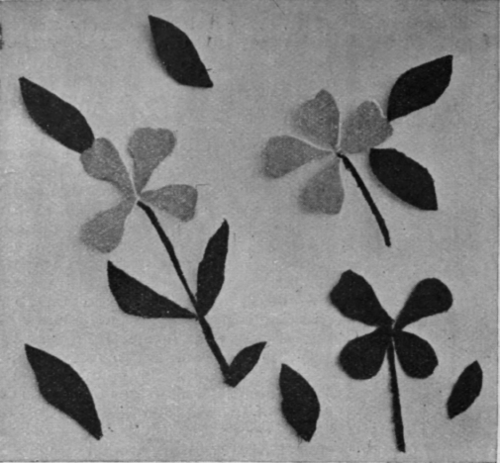
Purple and mauve clematis are exquisite posed on white chiffon
It is a fascinating design, and extremely beautiful. An edging of swansdown looks perfect on an evening cloak which is adorned with the applique velvet grapes.
Purple and mauve clematis looks exquisite on white chiffon. The flowers are cut out in two shades of mauve velvet, and the leaves in a soft shade of green. A chiffon apron tunic would look quite lovely adorned with these flowers. The little apron of chiffon should be fastened to your board securely, and the flowers of the clematis and the leaves are arranged carelessly over the ethereal surface. It will be found that sometimes the adhesive will go straight through on to the board when such a fabric as chiffon is used, and may be inclined to stick to the board. The following rule may be observed for all fabrics. Directly the applique work is completed, remove the fabric very carefully from the board, and pin it up as straight as possible in a warm place to dry. If any of the flowers or foliage seem to be insecure, put the back of the left hand behind the flower for a support, and with the fingers of the right hand press them into position.
One of the most glorious flowers for this applique work is the gorgeous and classical iris, which would make a lovely design for a gown for the woman who favours classical and statuesque effects. The flowers are arranged in a dignified manner. They make a charming panel, or they would look amazingly beautiful each end of a white chiffon scarf, or on one of crepe-de-chine which is edged with swansdown. What more exquisite theatre wrap could woman desire? The flowers could also be arranged on chiffon, and the scarf could be lined with wool-backed satin, so that the wrap would not only be a thing of glory, but delightfully warm.
A particularly rich effect in velvet applique can be obtained in the colours ranging from the palest yellows up to rich orange and golden browns. The nasturtium flower would be a suitable choice for the expression of these shadings, and would not be a difficult bloom to represent. The foundation might be palest yellow, or a dark shade of brown would throw up the rich colours of the flowers to perfection. Any of these ideas could be used for the embellishment of curtains, cushions, and screens. But the exquisite beauty of the applique velvet flowers must first of all appeal to women who love chic and dainty dress accessories, and once they have found this charm they will be at no loss to adapt the work to their individual needs.
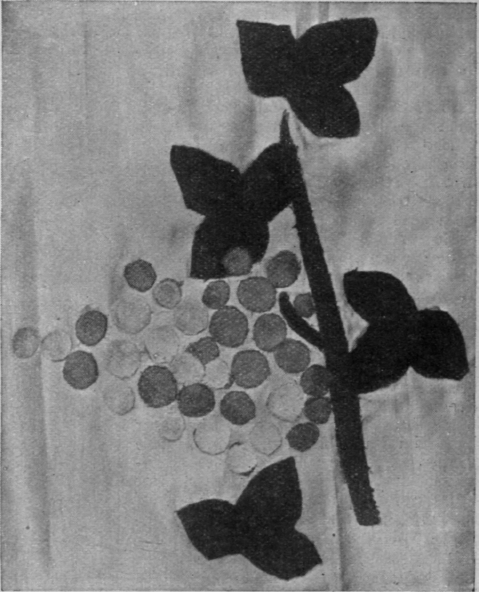
Grapes and their leaves form a fascinating design, and give ample scope to the artistic taste of the worker
Continue to:


My Books

