


Invalid Cookery
Description
This section is from "Every Woman's Encyclopaedia". Also available from Amazon: Every Woman's Encyclopaedia.
Invalid Cookery

The Importance of Invalid Cookery - Foods Suitable and Unsuitable - How to Serve Invalid Meals
Daintily - Some Useful Recipes
The manner in which food for invalids is cooked and served is a matter of such vast importance that it claims special and earnest attention.
While disease is acute the actual cooking required for the patient's food is reduced to a minimum, but even then practical knowledge, science, and care are required, or the apparently simple nourishment may do harm instead of good.
Doctors tell us over and over again that they frequently experience the greatest difficulty in obtaining perfectly made beef-tea, chicken jelly, and such-like sick-room fare, even in houses where the cook is accustomed to serve elaborate dinners.
Such ignorance often renders the physician's skill unavailing. At all events, his efforts are hampered unfairly, and the patient's recovery retarded owing to the lack of wisely selected dishes, correctly cooked and temptingly served. To quote a writer on culinary matters:
' A woman may be excused if she cannot make a cake, but it should be regarded as a social crime if she is unable to prepare a cup of good beef-tea or some simple dish that will further, not retard, the invalid's recovery."
The most critical time for the patient, and the period when the temper, tact, and skill of the nurse and cook are most severely taxed, is when the crisis is over and the "feeding-up" stage is reached, for the appetite of the convalescent is fickle.
Rules To Remember
1. The digestion of the invalid is very feeble. Therefore give foods so prepared that the digestive organs have as little work to do as possible.
2. Foods suitable for the healthy are often worse than useless for invalids, for their digestions are too weak to be able to prepare them for absorption into the blood.
3. Avoid giving invalids veal, pork, kidneys, liver, salmon, mackerel, eels, or any shell-fish (except oysters). Nor must rich cakes, pastry, rich soups or sauces and highly-spiced dishes be permitted.
4. Give strong, clear soups, broths, light dishes of eggs, sole, whiting, oysters, chicken, and mutton, if meat is allowed.
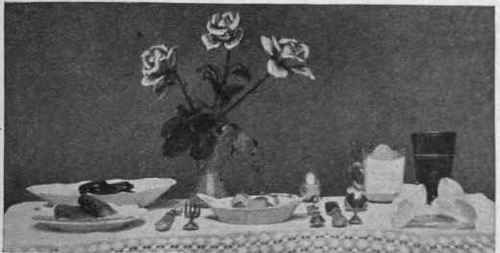
An attractively served meal for an invalid. The wisely selected dishes are not only correctly cooked, but also temptingly served
Quail, turkey, and pheasant are also | missible, if not the least high. Asparagus, spinach, and mashed potatoes are whole-some, and jellies, custards, milk puddings, and stewed fruits, freed from skin and stones, are all useful.
5. Do not ask the patient what he will like; let the menu be a pleasant little surprise.
6. Offer all possible variety, even if only by varying the wearisome eggs and milk by novel touches of colour, mode of serving. and so forth.
7. Offer small quantities of food at regular, short intervals; this is far better than imagining a good round meal should be eaten at the orthodox hours.
8. Serve less than the patient will probably require; never overload the plate in over-anxiety to "feed-up," or the result will generally be that the whole portion will be refused. Be ready, however, to offer a second helping.
9. Jellies, blancmanges, puddings, etc., are all best made in tiny cups or moulds just sufficient for one meal. The appearance is more tempting, and there is no risk of the cut surface becoming dry and discoloured.
10. Make a strict rule that no food is left in the patient's room. Not only does the constant sight of food remove ail desire for it, but the food deteriorates. It is specially harmful for milk, or preparations of milk.
11. Absolute cleanliness of all saucepans and culinary apparatus is most essential, otherwise the characteristically del* flavours of invalid food will be spoilt.
Continue to:


My Books

