


Amateur Leatherwork. Continued
Description
This section is from "Every Woman's Encyclopaedia". Also available from Amazon: Every Woman's Encyclopaedia.
Amateur Leatherwork. Continued
In using velvet hide, after the design has been traced on it, the worker proceeds at once to pressing down the edges and modelling. With this leather, too, a variation can be made by
"pressing-in" the design, leaving the surrounding background standing out. The novice should, however, learn to work on ordinary leather first, as it teaches the use of more tools and is a better lesson.
It should be remembered that the leather is always easier to work if not allowed to get dry. The only part that is better done on dry leather is the background, as it would be impossible to punch evenly over a large area if it were damped.
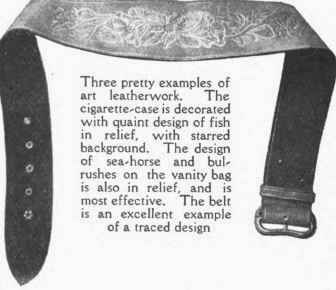
In choosing designs, experience only can teach which should prove suitable and effective; but, roughly speaking, any design intended for woodcarving in relief, or metalwork, can be used equally well for leather. Patterns intended for needlework or on tiles, wallpapers, or furniture can often be worked in with advantage. It is impossible for amateurs to make up their own leatherwork in a really satisfactory manner, as special machines and tools are required, if the finished article is to have the workmanlike appearance that the material demands. There are people who make a speciality of making up work, but the local saddler is often equal to the task, and willing to carry out original suggestions.



A Fascinating Hobby - Materials Required - How to Do the Work - Suitable Objects upon which to Work, and other Practical Suggestions
Many women nowadays are at a loss to find congenial and remunerative employment, but floral mosaicon is a hobby with which even the most fastidious cannot find fault.
The chief materials needed for this fascinating work are the special paper, liquid glue, a pair of nippers, and, of course, the card, frame, box, or other object to which the particular decoration is to be fixed or attached. To carry out the work satisfactorily, nimble fingers, good taste, an eye for colour, and perseverance are essential. The latter may seem to imply that the work is really difficult. This is not so. But no hobby or accomplishment can be mastered fully in a day. The " mosaicon " - a material is made specially for the purpose - is sold, in strips of about 12 inches long and 1/8 inch wide, in every imaginable colour and shade, and some with silver or gilt edges.
How The Work Is Done
Having secured a varied selection of strips, the operator must decide on a design to carry out. The beginner will be wise to begin with a simple one, and, when she can roll the paper deftly, then to attempt more elaborate schemes. Each petal of the flower selected has to be formed by rolling the strips between the first finger and the thumb, and then the round balls of rolled paper are shaped by pressure. When a sufficient number of petals and leaves are completed, they must then be fixed with,glue to the article for which the design is wanted. Only a very little glue should be used, and care must be taken to see that it does not ooze or show beyond the flower or foliage. The glue should be applied with a very fine brush, and the nippers used for picking up the different parts and then placing the flower in its proper position and pressing it down until it is firmly fixed.
The stalks are formed of the strips in their natural form, and, if thick stalks are wanted, two or more of the strips can be used together.
In plate No. 1 a forget-me-not design is carried out, a facsimile of which was purchased by Queen Mary. The frame was a well-made one, in khaki - coloured chamois leather, on which the pretty blue flowers with their light green foliage, the two sprays meeting at the top and finished off with a pink bow, showed a charming piece of handiwork. Anyone who can accomplish such a result will find it a most engrossing occupation, and the outlay necessary is very small. A great feature and advantage of this particular work is that it is nearly everlasting. It does not fade, tarnish, or fall to pieces when once it has been securely fixed. When preferred, the frames can be covered with glass like a photograph. This arrangement adds but little to the cost, and helps greatly to preserve the work against injury, dust, and so forth.

1. Forget-me'not design
Plate 2 shows a frame of rather large dimensions, composed of white watered silk with gilt rim, and an ornamentation at the top. On the silk in each corner is a design of scarlet pimpernel, the bow being of silk mosaicon. A similar frame was recently purchased at a bazaar by Miss Marion Terry. There is a great field for the display and sale of this particular kind of work.
Another pretty design was a frame purchased by Queen Alexandra, composed of white forget-me-nots worked on a pink linen foundation.
Then there is the " Empire " frame, with a chaplet of bay-leaves, connected at the base by what appears to be a jewelled true-lover's knot. Not only are frames used for this special work, but also large or small screens of plain white wood. The stained green or brown, and even polished screens, can be decorated with some bold designs, such as long-stemmed annunciation lilies or sunflowers, both of which look charming on a greyish blue background. Branches of red rowan-berries or barberries would be equally effective. In fact, the variety of schemes is almost endless.
Decorating Bridge-boxes, Blotters, etc.
Bridge and other card-game boxes, match-boxes (either of wood or leather), hat or hairpin boxes, cigar, cigarette, or stamp boxes, clock-stands, easels, mirrors, stationery-boxes, blotters, etc., and the usual appointments of the writing-table, moreover, can be decorated in this way, whilst menu-stands and guest-cards for the dinner-table can be made to look most attractive.

2. A frame worked with scarlet pimpernel design
Continue to:


My Books

