


Tea. III
Description
This section is from the book "Drinks Of The World", by James Mew. Also available from Amazon: Drinks of the world,.
Tea. III
Pepys and Tea - First English Poem on Tea - Price of Tea temp Queen Anne - Scandal over the Tea Cup - Jonas Hanway and Dr. Johnson on Tea - Love of the latter for this Beverage - How to make Good Tea.
By Garway's Advertisement we get at one fact, that the use of tea had not been brought into popular use before 1657: a fact which is borne out by that old quid nunc Pepys, who would surely have noticed it, as, indeed, he did as soon as it was brought under his ken. He mentions it in his diary under date 25th Sept., 1661, as being then a novelty, at all events to him. "I did send for a Cup of Tee, a China Drink of which I never drank before." And again, 28th June, 1667, "Home, and there find my wife making of Tee, a drink which Mr. Pelling the Potti-cary tells her is good for her cold and defluxions." So that even then it was not a common drink with people well to do, as we know Pepys was. The old English custom of drinking beer at breakfast died very hard -nay, it is not yet dead - surviving in farm houses in many places in the country, notably in Somersetshire; and when tea became cheap enough to be drank by the middle classes, those beneath them in the social scale indulged in sage tea, and infusions of other home off own herbs.
As it increased in popularity, the poets got hold of it, and numerous were the laudatory verses in Latin respecting its virtues. But, as far as I can find, the earliest English poem about it was by Waller, as under:"Of Tea
Commended by Her Majesty.1
"Venus her Myrtle, Phoebus has his bays; Tea both excels, which she vouchsafes to praise. The best of queens,1 and best of herbs, we owe To that bold nation 2 which the way did shew To the fair region where the Sun does rise, Whose rich productions we so justly prize. The Muses' friend, Tea does our fancy aid, Repress those vapours which the head invade, And keeps that palace of the soul serene, Fit on her birthday to salute the Queen."
As years went on, its popularity became greater, and it is satisfactory to find by the following extract from Lord Clarendon's diary, 10th Feb., 1688, that the tea imported was good, and that it was treated properly. "Le Pere Couplet supped with me; he is a man of very good conversation. After supper we had tea, which he said was as good as any he had drank in China. The Chinese, who came over with him and Mr. Fraser, supped likewise with us."
With time, the consumption of tea increased, and its price was much lower; but still, taking the money value in the time of Queen Anne, in relation to our own it was excessively dear, and its value fluctuated much. Black tea varied in 1704 from 12s. to 16s. per pound; in 1706, 145. to 16s.; in 1707, which seems to have been an exceptionally dear year, 16s., 20s., 22s., 24s., 30s., and 32s. In 1709 it was from 14s. to 28s.; and in 1710, 12s. to 28s. Green tea in 1705 was 13s. 6d.; in 1707, 20s., 22s., 26s.; in 1709, 10s. to 15s.; and in 1710, 10s. to 16s. The difference between new and old is given once; the new tea is 14s., and the old 12s. and 10s.
1 Catharine of Braganza, wife of Charles II.
2 Portugal.
The margins in price are not only accounted for by difference in age, but it was well known that old leaves were re-dried and used in the cheaper sorts; indeed, there is a very curious advertisement in the advertising portion of the Tatler, Aug. 26th, 1710: "Bohea Tea, made of the same Materials that Foreign Bohea is made of, 16s. a Pound. Sold by R. Fary only, at the Bell in Grace Church Street, Druggist. Note. The Natural Pecko Tea will remain, after Infusion, of a light grey colour. All other Bohea Tea, tho' there be White in it will Change Colour, and is artificial."
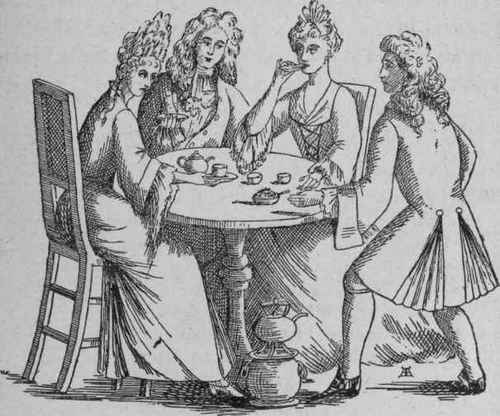
Tea was now "in Society," and was made the medium of pleasant little reunions. The accompanying illustration gives a Tea-party, temp. Queen Anne, by which it appears that the cups had no handles at that time, and were of veritable oriental porcelain, and that it was not considered a breach of good manners to drink tea out of saucers.
But even this Eden had its serpent, in the shape of scandal, from which the tea table seemed no freer in the time of Good Queen Anne than our own.1 "Thus they take a sip of Tea, then for a draught or two of Scandal to digest it, next let it be Ratifia, or any other Favourite Liquor, Scandal must be the after draught to make it sit easie on their Stomach, till the half hour's past, and they have disburthen'd themselves of their Secrets, and take Coach for some other place, to collect new matter for Defamation."
An anonymous poet of that time sings thus of the tea table:
"Here we see Scandal, (for our sex too base), Seat in dread Empire in the Female Race, 'mong Beaus and Women, Fans and Mechlin Lace,
Chief seat of Slander, Ever there we see
Thick Scandal circulate with right Bohea.
1 The Works of Thomas Brown, ed. 1708, vol. iii., p. 86.
There, source of black'ning Falsehood's Mint of Lies,
Each Dame th' Improvement of her Talent tries,
And at each Sip a Lady's Honour dies;
Truth rare as Silence, or a Negro Swan,
Appears among those Daughters of the Fan."
Peter Motteux, in the same reign (1712), wrote "A Poem in Praise of Tea;" but his theme may, after all, only have been taken to advertise his East India Warehouse in Leadenhall Street. He says:
"From boist'rous Wine I fled to gentle Tea; For, Calms compose us after Storms at Sea. In vain wou'd Coffee boast an equal Good; The Chrystal Stream transcends the flowing Mud. Tea, ev'n the Ills from Coffee sprung, repairs, Disclaims its Vices, and its Vertue shares.
To bless me with the Juice two Foes conspire, The clearest Water with the purest Fire, Wine's Essence in a Lamp to Fewel turns, Exhales its Soul, and for a Rival burns. The Leaf is mov'd, and the diffusive Good, Thus urg'd, resigns its Spirits in the Flood.
Continue to:


My Books

