


Champagne Wines. Part 2
Description
This section is from the book "Drinks Of The World", by James Mew. Also available from Amazon: Drinks of the world,.
Champagne Wines. Part 2
The next process is corking, and, as we all know, champagne corks are not as other corks. They are made larger than the vent of the bottle, and are soaked in water, and very often steamed. They are somewhat expensive, the best corks used costing about threepence each; but it is a very false economy to use common corks, for the gas would escape. The pliant cork is placed in a machine which pinches it and compresses it to the size of the aperture of the bottle, and holds it there till a twenty-pound weight is let drop, on the principle of a pile-driving hammer, and drives the cork in firmly. The powerful leverage used to bring down the edge of the cork for wiring and stringing, imparts the round-shaped top peculiar to champagne corks. The bottles, after being corked and wired, are allowed to rest for two or three months, in order that the wine and the liqueur may properly amalgamate, and are then tinselled and labelled, ready for the consumer; but some of the best wines are kept for years to mature, and are, of course, of far higher value.
A sweet Champagne may be made of any wine, but a dry Champagne must be a good wine, as, if it is not sound, its acidity is detected at once; but this defect would be hidden by the liqueur necessary to make it sweet.
At Epernay, the bulk of the wine is not so good as that coming from Reims, and sells at a lower price; but there are firms there of world-wide note, such as Moet & Chandon, Perrier, Joliet & Co., Mennier Freres, Wachter & Co., etc.
Bordeaux or Claret.
In England we generally call the wines coming from Bordeaux, Clarets, the derivation of which cognomen is somewhat obscure; but it seems almost universally accepted that it comes from the French word Clairet, which is used even at the present time as a generic term for the vins ordinaires of a light and thin quality, grown in the south of France, and was in use from a very early date. The old French poet,
Olivier Basselin (who died 1418 or 1419), sings:
"Beau nez, dont les rubis ont coute mainte pipe De vin blanc et clairet . . ."
There was, however, another Claret, a compounded wine, resembling hypocras, which Giraldus Cambrensis, who lived in the twelfth century, classes thus: "Clare-turn, mustum, et medonem" (Claret, must, and mead). And the venerable Franciscan, Bartholomew Glan-ville,1 says: "Claretum, ex vino et melle et speciebus aromaticis est confec'tum" (Claret is made from wine, honey, and aromatic spices). It makes a marked feature in a curious tenure.2 "John de Roches holds the Manor of Winterslew, in the county of Wilts, by the Service, that when our Lord the King should abide at Clarendon, he should come to the Palace of the King there, and go into the Butlery, and draw out of any vessel he should find in the said Butlery at his choice, as much Wine as should be needful for making (pro factura) a Pitcher of Claret (unius Picheri Claretti), which he should make at the King's charge, and that he should serve the King with a Cup, and should have the vessel from whence he took the Wine, with all the Remainder of the Wine left in the Vessel, together with the Cup from whence the King should drink that Claret." This refers to a roll of 50 Ed. III., or 1376.
But this is not the Claret of our days, which is the wine produced in the countries watered by the rivers Dordogne and Garonne and the Gironde, at least it should be so; but, in truth, owing to the good railway communication, wine comes to Bordeaux from every part of France, large quantities owing their birth to the banks of the Rhone, from the Herault, Roussillon, etc.; and a judicious blending at Bordeaux, and its being shipped thence, is a very good title to its being grown in the Medoc; but the quantity shipped to all parts of the world, compared with the acreage of growth, entirely precludes the supposition that it possibly could have been the production of that district.
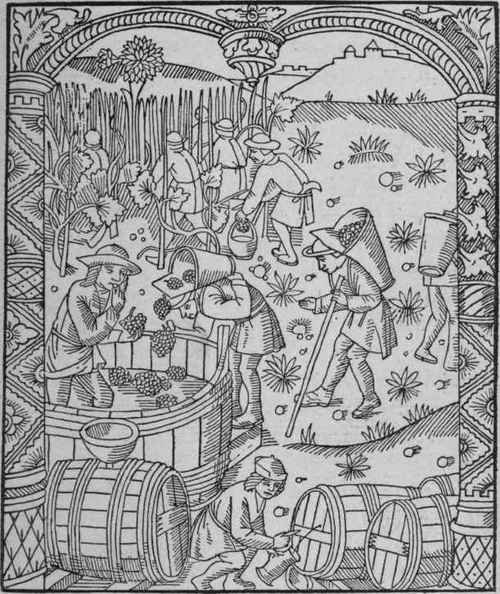
From The "Compost Et Kalendrier Des Bergeres," I499
1 De Proprietatibus Rerum. Argent. 1485, lib. xix., cap. 56.
2 Blount's Fragmenta ! Antiquitatis. Sec. "Grand Serjeantry," No. IV.
The nobility of the Médoc wines is small. There are only four premiers crûs, but they are magnificent. They are Château Lafitte, Château Latour, Château Margaux, and Château Haut-brion; and ail these, especially the Latour, have a flavour and seductive bouquet ail their own, which is believed to arise from an extremely volatile oil contained in the grape skins, which, like all ethers, requires time to evolve and mature. But the soil, undoubtedly, has most to do with it, and this must be in a very large degree composed of fragments of rock, small and large, while the smooth round pebbles reflect the rays of the sun and throw them upwards, so as almost to surround the grapes with light and heat. Again, these stones absorbing the sun's rays during the day, give out warmth after sunset, whilst they keep the roots of the vines cool, and prevent to a great degree the evapora-tion of the natural and necessary moisture of the earth.
But these premiers crûs are not always good; for instance, in 1869, Messrs. Fulcher & Baines, wine brokers, sold by auction a very large parcel of Château Margaux for about 30s. per dozen. There was no doubt but that it was genuine wine, bottled at the Château, for the cases and corks were all properly branded; but of such low quality was it, or it deteriorated so rapidly, that when sold again in 1871 the same wine only averaged 18s. per dozen.
The 2nd Growths are:
Mouton, | coming from | Pauillac. |
Rauzan-Segla, | " | Margaux. |
Rauzan- Gassies, | " | " |
Léoville-Las Cases, | " | St. Julien. |
Léoville- Poyféré, | " | " |
Léoville-Barton, | " | " |
Durfort-Vivens, | " | Margaux. |
Lascombes, | " | " |
Gruard-La rose-sarg, | " | St. Julien. |
Gruard-La rose, | " | " |
Braune-Cantenac, | " | Cantenac. |
Pichon- Longueville, | " | Pauillac. |
Pichon- Longueville- Lalande, | " | " |
Ducru-Beaucaillou, | " | 6V. Julien. |
Cos-Destournel, | " | St. Estephe. |
Montrose, | " | " |
3rd Growths. | ||
Kirwan, | coming from | Cantenac. |
Château-d'issau, | " | " |
Lagrange, | " | St. Julien. |
Langoa, | " | " |
Château-Giscours, | " | Labarde. |
Malescot-St. Exupéry, | " | Margaux. |
Cantenac- Brown, | " | Cantenac. |
Palmer, | " | " |
La Lagune, | " | Ludon. |
Desmirail, | " | Margaux. |
Calon-Ségur, | " | St. Estèphe. |
Ferrière, | " | Margaux. |
M. d'alesmeis Becker, | " | " |
4th Growths.
St. Pierre, | coming from | St. Julien. |
Branaire-Duluc, | " | " |
Talbot, | " | " |
Duhart-Milon, | " | Pauillac. |
Poujet, | " | Cantenac. |
La Tour-carnet, | " | St. Laurent. |
Rochet, | " | St. Estèphe. |
Château- Beychevelle, | " | St. Julien, |
La Prieuré, | " | Cantenac. |
Marquis de Therme, | " | Margaux. |
5th Growths. | ||
Pontet-Canet, | coming from | Pauillac. |
Batailley, | " | " |
Grand- Puy- Lacoste, | " | " |
Ducasse-Grand-Puy, | " | Pauillac. |
Lynch-Bages, | " | " |
Lynch-Moussas, | " | " |
Dauzac, | " | Labarde. |
Moulton d'armailhacq- | " | Pauillac. |
Le Tertre, | " | Arsac. |
Haut-Bages, | " | Pauillac. |
Pédesclaux, | " | " |
Belgrave, | " | St. Laurent. |
Camensac, | " | " |
Cos-Labory, | " | St. Estèphe. |
Clerc-Milon, | " | Pauillac. |
Croizet-Bages, | " | " |
Cantemerle, | " | Macau. |
These are only some of the wines of the Médoc, so that I may be excused from recapitulating the names of the different growths of the Graves, the Pays de Sauternes, the Côtes, the Palus, and those of Entredeux Mers - their name is legion, and it would answer no good purpose. Cocks, in his Bordeaux and its Wines, gives a list of 1,900 of the principal growths, so that we can have a good choice of names from which to christen our "Shilling Gladstone."
Continue to:


My Books

