


Gathering The Grapes
Description
This section is from the book "Beverages And Their Adulteration Origin, Composition, Manufacture, Natural, Artificial, Fermented, Distilled, Alkaloidal And Fruit Juices", by Harvey W. Wiley. Also available from Amazon: Beverages And Their Adulteration.
Gathering The Grapes
The mode of gathering the grapes is almost the same throughout the whole of the Douro valley. Of course in some instances greater care is exercised by some growers than by others. In the typical Port vineyard every detail of the harvest is carefully directed and superintended by an experienced master vintager. The grapes are gathered in large baskets. When these are full they are carried off on the shoulders of the laborers, some times 20 or 30 altogether. The illustration shows the laborers carrying the full baskets. Usually the leaders of this procession improvise a kind of a band. The instruments employed are usually a drum, an accordion and a triangle. The mountain sides are so steep that even if it were advisable the grapes could not be transported in wagons. Handling the Grapes.
When the grapes arrive at the winery they are placed in large square depressions, about three feet deep, and in them they are pressed. The grapes are pressed entirely by the feet of the workmen. This is a period of great festivity, the workmen singing and shouting continually for 6 solid hours, when they are allowed to rest until their turn comes again after 4 or 6 hours of sleep. After the juice is expressed it is subjected to fermentation, the progress of which is determined by experience and by a spindle which determines the density of the juice. As the sugar ferments the juice grows lighter and lighter until at the end it is probably no heavier than water. The expressed juice, after the first fermentation is over, is run into cisterns, some of which are very large, holding as high as 14,000 gallons. The harvest having taken place in October, the fermented juice is allowed to remain undisturbed in these cisterns until the following January. A careful examination is then made of the wine, in order to determine its degree of excellence and maturity. After the first fermentation is over it is usually transferred to other cellars and placed in smaller containers for the continuation of the ripening process.
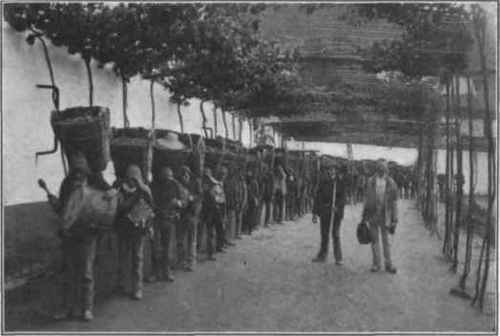
Fig. 37. Carrying grapes to the Lagar for pressing. (From Challoner.)
The varieties of grapes which are most generally employed in the manufacture of genuine Port wines are the following:
Red Wine Grapes
Malvazia Vermelha
Alvarilhao
Bastardo
Bocca de Mina (most delicious)
Cornifesto
Douzellinho do Castello
Mourisco preto
Souzao (deepest color)
Tinta amarella
Tinta bastardeira
Tinta de Castello
Tinta Cao (very good)
Touriga (the finest)
Tinta Francisca (very good)
Rabo de Ovelha
White Wine Grapes
Agudelho
Alvaraca
Arinto
Douzellinho
Gouveio
Malvazia Mourisco Branco Muscatel Promissao Rabigato
Table Grapes
Dedo de Dama Muscatel de Jesus
Ferral (rose color) All the Chasselas
The Tinta Coa, Touriga and Tinta Francisca are very fine grapes, but as they yield less juice than others they are not much used by the smaller growers.
Continue to:


My Books

