


Composition Of Water
Description
This section is from the book "Beverages And Their Adulteration Origin, Composition, Manufacture, Natural, Artificial, Fermented, Distilled, Alkaloidal And Fruit Juices", by Harvey W. Wiley. Also available from Amazon: Beverages And Their Adulteration.
Composition Of Water
Chemically pure water is composed of only two substances, hydrogen and oxygen. These materials in the free state exist only in a gaseous condition. Oxygen forms practically one-fifth of the volume of the atmosphere. Hydrogen does not exist very largely in a free state, though its occurrence in nature as hydrogen is sometimes observed. In nine pounds of pure water in round numbers eight pounds are oxygen and one pound hydrogen. If the composition of water is referred back to the gaseous state of its two components, it is found that two volumes of hydrogen combine with one volume of oxygen to form water. The union takes place on the application of a flame, with tremendous violence. The strongest containers of mixtures of hydrogen and oxygen in proportions to form water are ruptured with the greatest violence if the combination takes place. The composition of water may be shown very beautifully and very easily by an experiment which produces its decomposition. If water containing an electrolyte such as diluted sulphuric acid is subjected to the action of the electric current hydrogen will be given off at the negative pole and oxygen at the positive pole of the electrical apparatus. If the negative pole be placed in one arm of a bent tube and the positive pole in the other, the gases may be collected separately. This is illustrated in the simple apparatus shown in the figure. The positive pole is marked + and is found to be giving off oxygen; the negative pole is marked - and is found to be giving off hydrogen. The gases rise in the tube and are collected. It will be seen that the volume of the hydrogen collected is just double that of the oxygen. This form of simple apparatus is called by chemists an eudiometer. If pure water with an electrolyte which cannot be decomposed is used the resulting gases will be pure. Pure water is so poor a conductor of electricity that no decomposition will take place in the apparatus described because of the inability of the current to pass through the connecting arm filled with pure water between the positive and negative poles. The addition of a few drops of sulphuric acid enables the current to pass, while at the same time the acid is not in danger of being acted upon appreciably by the electric current itself. The result is that nothing is decomposed except pure water, so that pure hydrogen will be found in one arm of the apparatus and pure oxygen in the other. If the operation be conducted over an inverted tube in which both poles are in the same tube, the oxygen and hydrogen will escape together gradually forcing the liquid out at the bottom of the tube.
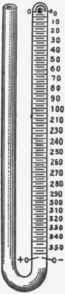
Fig. 1. Eudiometer.
Continue to:


My Books

