


Poppy Family. Greater Celandine. Chelidonium Majus
Description
This section is from the book "Our Early Wild Flowers", by Harriet Louise Keeler. See also: Newcomb's Wildflower Guide.
Poppy Family. Greater Celandine. Chelidonium Majus
From chelidon, a swallow, because it appeared at the time the swallows came.
Perennial. Naturalized from Europe. Dry waste land, roadsides, near dwellings. Throughout New England and the Middle West. Frequent in northern Ohio. April-September.
Stem
Weak, one to two feet high, branching, slightly hairy, containing bright-orange, acrid, juice.
Leaves
Thin, four to eight inches long, deeply cleft into five, irregular, oval lobes, the terminal one the largest.
Flowers
Lusterless yellow, one-half an inch across, on slender pedicels, in a small, umbel-like cluster.
Sepals
Two, falling early.
Petals
Four, rounded.
Stamens
Many, yellow.
Pistil
One, maturing into a long capsule tipped with style and stigma.
The Celandine is a loose, branching herb sprawling along roadsides and waste places, and on the site of old buildings. The pale-green stalk has a whitish bloom and grows from one to two feet high. It is weak and brittle and filled with copious, orange-colored, acrid juice that stains everything it touches. The flowers are half an inch or more across, and are borne in small, loose clusters on slender stems. The four petals are pure yellow and without lustre. The buds nod, though the flower stands erect; two yellowish sepals fall as the flower opens. The leaf is compound, deeply cleft into five or more leaflets; the under-surface has a whitish bloom, is strongly ribbed and veined.
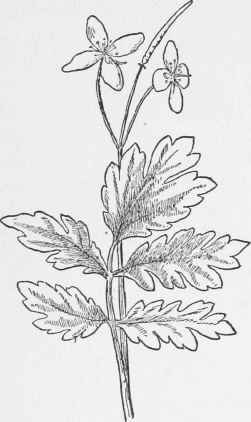
Celandine. Chelidonium majus
The seed-pod is slender and often two inches long; it is two-parted and splits upward from the bottom when ripe.
Continue to:


My Books

