


Menyanthaceae - Buckbean Family. Buckbean. Marsh-Trefoil. Menyanthes Trifoliata
Description
This section is from the book "Our Early Wild Flowers", by Harriet Louise Keeler. See also: Newcomb's Wildflower Guide.
Menyanthaceae - Buckbean Family. Buckbean. Marsh-Trefoil. Menyanthes Trifoliata
The ancient name probably from men, month, and anthos, flower; some say from the length of its flowering period, which is about a month.
A perennial swamp herb, bearing in early spring sprays of beautiful white flowers and three-parted leaves. New England, Pennsylvania, and farther north and west. Not reported in Ohio. May.
Rootstock
Thick, creeping, running horizontally a considerable distance.
Leaves
Ternately divided, on long petioles which are sheathed at the base; leaflets oval or oblong.
Flowers
White or slightly reddish bells, borne in a raceme on a naked scape a foot high.
Calyx
Five-parted, shorter than the corolla.
Corolla
Short, funnel-form, bearded within with white hairs, the border five-cleft and spreading.
Pistil
Ovary, one-celled; style exserted, persistent; stigma two-lobed.
Fruit
Many-seeded capsule.
Professor William W. Bailey, writing of New England flowers, reports as follows:
"A very beautiful flower, common to both hemispheres, is in the month of May often found in our swamps. It is the Buckbean or Menyanthes, a member of the gentian family. It has long, subaqueous rootstocks, from which spring the long-petioled compound leaves of three leaflets. The racemed flowers are borne on naked scapes and are white or externally Menyanthes trifoliata tinged with pink; within, the divisions of the corolla are closely bearded with exquisite hairs.
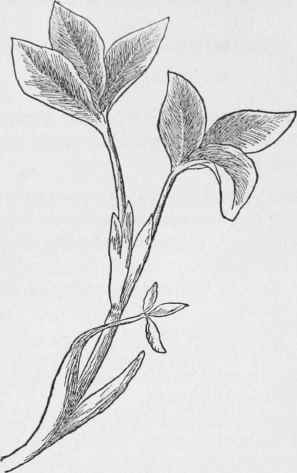
Buckbean.
"The Menyanthes is apt to grow provokingly out of one's reach from the shore. If one has high rubber boots, it is delightful to wade in after it and to stand waist-deep amidst its waving plumes. Like some Lorelei, it has tempted many an adventurer into the water."
Continue to:


My Books

