


Euphorbiaceae - Spurge Family. Cypress-Spurge. Euphorbia Cyparissias
Description
This section is from the book "Our Early Wild Flowers", by Harriet Louise Keeler. See also: Newcomb's Wildflower Guide.
Euphorbiaceae - Spurge Family. Cypress-Spurge. Euphorbia Cyparissias
Euphorbia, an ancient name, in honor of Euphorbus, King Juba's physician.
Perennial. Naturalized from Europe and escaped from gardens and old graveyards; grows in patches. Throughout northeastern United States and west to Kansas. Common in northern Ohio. April, May.
Rootstock
Horizontal, creeping.
Stems
Clustered in large patches, five to twelve inches high, somewhat branching, topped by many-rayed umbels of greenish-yellow flowers, very leafy, milky.
Leaves
Many and crowded, pale green, linear; margins strengthened; half to three-fourths of an inch long, irregularly alternate upon the stem.
Flower Cluster
Umbel, greenish yellow, flat-dome-shaped.
Flowers
Insignificant; the involucre of two bracts more conspicuous than the group of pistillate and stam-inate florets within.
Fruit
Capsule, globose; seeds oblong. Pollinated by bees and butterflies.
The Cypress-Spurge usually marks the site of an old garden or has crossed the enclosure of a country churchyard. It is easily recognized as a patch of yellowish green, consisting of many upright stems, very leafy, with short narrow leaves, and in May topped by small, roundish clusters of greenish-yellow blossoms.
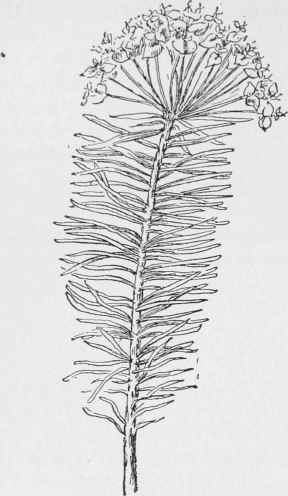
Cypress-Spurge. Euphorbia cyparissias
The structure of these blossoms, like all the Euphorbias, is difficult to explain and quite as difficult to understand, but the cluster itself is ornamental, and that is not difficult to understand. The plant is equipped to be a weed, but does not seem to have gone very far in that direction.
Continue to:


My Books

