


78. Flaveria Juss.; Gmelin, Syst. 1269. 1791
Description
This section is from the book "An Illustrated Flora Of The Northern United States, Canada And The British Possessions Vol3", by Nathaniel Lord Britton, Addison Brown. Also available from Amazon: An Illustrated Flora of the Northern United States, Canada and the British Possessions. 3 Volume Set..
78. Flaveria Juss.; Gmelin, Syst. 1269. 1791
Glabrous or minutely puberulent, light-green, mostly annual herbs, with opposite sessile entire or serrate leaves, and small 1-several-flowered, usually sessile, oblong and densely cymose-capitate heads of tubular, or both tubular and radiate yellow or yellowish flowers. Involucre of 2-5 narrow, nearly equal, appressed bracts, sometimes with 1 or 2 additional small exterior ones. Receptacle small, naked or setose. Ray-flower commonly only 1, pistillate, fertile, sometimes wanting. Disk-flowers 1-15, perfect, fertile, their corollas 5-toothed. Anthers entire at the base. Style-branches of the disk-flowers truncate. Achenes oblong or linear-oblong, 8-10-ribbed. Pappus none. [Latin, flavus, yellow, from its dyeing properties.]
About 7 species, natives of the warmer parts of America. In addition to the following, 3 others occur in the southern United States. Type species: Flaveria chilensis Gmelin.
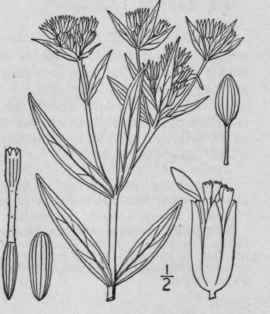
1. Flaveria Campestris Johnston. Plains Flaveria
Fig. 4528
Flaveria campestris Johnston, Proc. Am. Acad. 39: 287. 1903.
Annual, glabrous, erect, 1°-2° high, little branched. Leaves linear or lanceolate, serrulate or entire, 3-nerved, acuminate or acute at the apex, sessile by a broad and somewhat clasping base, 1'- 2 1/2' long, 2"- 4" wide; heads about 3" high, closely sessile in terminal glomerules or these pedunculate from the upper axils; involucre of 3 oblong-lanceolate bracts, 2-5-flowered; ray equalling or longer than the breadth of the disk; achenes linear, glabrous, about 1 1/2 " long.
In alkaline soil, Missouri to Colorado, Texas and Mexico. Aug.-Oct. In our first edition included in the Mexican F. angustifolia (Cav.) Pers.
Continue to:


My Books

