


7. Kuhnia L. Sp. Pl. Ed. 2, 1662. 1763
Description
This section is from the book "An Illustrated Flora Of The Northern United States, Canada And The British Possessions Vol3", by Nathaniel Lord Britton, Addison Brown. Also available from Amazon: An Illustrated Flora of the Northern United States, Canada and the British Possessions. 3 Volume Set..
7. Kuhnia L. Sp. Pl. Ed. 2, 1662. 1763
derennial herbs, with alternate punctate resinous-dotted leaves, and discoid heads of white or purplish flowers in terminal cymose corymbs. Involucre turbinate-campanulate, its bracts striate, imbricated in several series, the outer shorter. Corolla regular, the tube slender, the limb 5-lobed. Anthers obtuse and entire at the base, nearly or quite separate. Style-branches slender, obtusish. Achenes 10-striate. Pappus a single row of numerous iery plumose bristles. [Named for Dr. Adam Kuhn, of Philadelphia, a pupil of Linnaeus.]
About 8 species, native of North America and Mexico. Type species: Kuhnia eupatorioides L. Puberulent: leaves sparingly dentate, or entire: heads loosely clustered, 4"-s" high.
1. K. eupatorioides.
Pubescent or tomentulose; leaves sharply serrate; heads densely clustered, 6-8 high.
2. K. glutinosa.
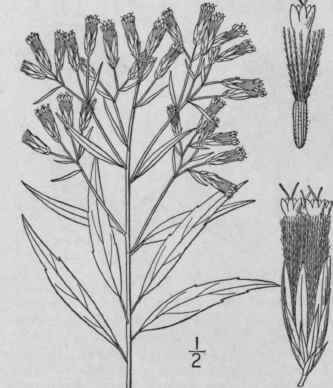
1. Kuhnia Eupatorioides L. False Boneset
Fig. 4175
Kuhnia eupatorioides L. Sp. Pl. Ed. 2, 1662. 1763.
Eupatorium alternifolium Ard. Spec. Bot. 2: 40. pl. 20. 1764.
Erect, puberulent and resinous, 1°-3° high, branched above. Leaves lanceolate or linear-lanceolate, acute or obtusish at the apex, narrowed at the base, sparingly dentate, or entire, the upper sessile, the lower usually short-petioled; heads several or numerous, peduncled, 4"-5" high, loosely clustered; outer bracts of the involucre lanceolate or ovate-lanceolate, acuminate, the inner much longer, linear, cuspidate; pappus tawny, or sometimes nearly white.
In dry soil, New Jersey to Georgia, Ohio, Minnesota, West Virginia and Texas. Ascends to 3300 ft. in West Virginia. Aug.-Sept.
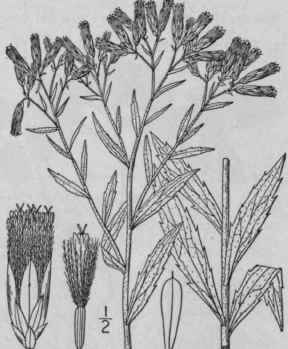
2. Kuhnia Glutinosa Ell. Prairie False Boneset
Fig. 4176
Kuhnia glutinosa Ell. Bot. S. C. & Ga. 2: 292. 1821-24. Kuhnia suaveolens Fresen. Ind. Sem. Francf. 1838. Kuhnia eupatorioides var. corymbulosa T. & G. Fl. N. A. 2: 78. 1841.
Stouter and often taller than the preceding species, corymbosely or paniculately branched, pubescent or tomentulose, somewhat viscid. Leaves all sessile, lanceolate to ovate-lanceolate, usually sharply serrate with distinct teeth, veiny, 1'-3' long, 3"-10" wide, or those of the branches linear-lanceolate and entire; heads numerous, 6"-8" high, densely clustered in the cymes, their peduncles mostly short; inner bracts of the involucre lanceolate, acuminate; pappus tawny or brown.
In dry soil, Illinois to North Dakota, Colorado, Alabama and Texas. Perhaps a race of the preceding species. Aug.-Oct.
Kuhnia Hitchcockii A. Nelson, a little known species of Kansas, differs by having very small linear leaves, at least on the upper part of the plant.
Continue to:


My Books

