


66. Helianthus [Vaill.] L. Sp. Pl. 904. 1753. Part 9
Description
This section is from the book "An Illustrated Flora Of The Northern United States, Canada And The British Possessions Vol3", by Nathaniel Lord Britton, Addison Brown. Also available from Amazon: An Illustrated Flora of the Northern United States, Canada and the British Possessions. 3 Volume Set..
66. Helianthus [Vaill.] L. Sp. Pl. 904. 1753. Part 9
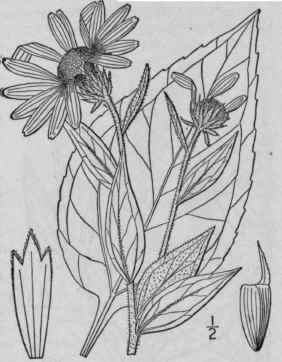
24. Helianthus Laetiflorus Pers. Showy Sunflower
Fig. 4484
Helianthus laetiflorus Pers. Syn. 2: 476. 1807.
Perennial; stem scabrous or hispid, leafy, 4°-8° high. Leaves oval-lanceolate or ovate-lanceolate, short-peti-oled, 3-nerved, rough on both sides, narrrowed at the base, acute or acuminate at the apex, serrate or serrulate, 4-10' long, 1/2'-1 1/2' wide, the upper often alternate; heads usually several, 2-4' broad, mostly short-peduncled; bracts of the hemispheric involucre ovate-lanceolate, or oblong-lanceolate, imbricated in only 2 or 3 series, ciliate, otherwise nearly glabrous, appressed or but little spreading, shorter than or equalling the yellow disk; rays 15-25, showy; chaff of the receptacle entire, or sometimes 3-toothed.
On prairies and barrens, Pennsylvania to Minnesota. Recorded as adventive in Massachusetts. Aug.-Sept.
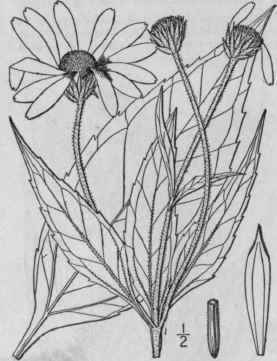
25. Helianthus Tomentosus Michx. Woolly Sunflower
Fig. 4485
H. tomentosus Michx. Fl. Bor. Am. 2: 141. 1803.
Perennial; stem stout, hirsute or hispid, especially above, branched, 4°-10° high. Leaves rather thin, ovate, or the lower oblong, mostly alternate, 3-ribbed above the base, gradually or abruptly contracted into margined petioles, rough above, softly villous-pubes-cent beneath, sparingly serrate, the lower often 1° long and 4' wide; heads commonly several or numerous, 3'-4' broad; involucre hemispheric, its bracts imbricated in many series, linear-lanceolate, long-acuminate, squarrose, densely hirsute and ciliate, usually longer than the broad yellowish disk; chaff of the receptacle and lobes of the disk corolla pubescent; pappus of 2 subulate awns.
In dry soil, Virginia to Georgia and Alabama. Reported from Illinois, probably erroneously. Aug.-Oct.
26. Helianthus Tuberosus L. Jerusalem Artichoke. Earth Apple
Fig. 4486
Helianthus tuberosus L. Sp. Pl. 905. 1753. Helianthus tuberosus subcanescens A. Gray, Syn. Fl. 1: Part 2, 280. 1884.
Perennial by fleshy thickened rootstocks, bearing tubers; stems hirsute or pubescent, branched above, 6°-12° high. Leaves ovate or ovate-oblong, rarely ovate-lanceolate, firm, 3-nerved near the base, narrowed, or the lower rounded, truncate or subcordate at the base, acuminate at the apex, rather long-petioled, scabrous above, finely pubescent or canes-cent beneath, serrate, 4'-8' long, 1 1/2'-3' wide, the upper alternate, the lower opposite; heads several or numerous, 2'-31/2' broad; involucre hemispheric, its bracts lanceolate, acuminate, hirsute or ciliate, squarrose; disk yellow; rays 12-20; chaff of the receptacle acute and pubescent at the summit; achenes pubescent.
In moist soil, Nova Scotia and Ontario to Manitoba, Georgia and Arkansas and Kansas. Often occurs along roadsides in the east, a relic of cultivation by the aborigines. Now extensively grown for its edible tubers. Canada potato. Girasole. Topinambour. Sept.-Oct.
Continue to:


My Books

