


6. Lonicera L. Sp. Pl. 173. 1753. Part 5
Description
This section is from the book "An Illustrated Flora Of The Northern United States, Canada And The British Possessions Vol3", by Nathaniel Lord Britton, Addison Brown. Also available from Amazon: An Illustrated Flora of the Northern United States, Canada and the British Possessions. 3 Volume Set..
6. Lonicera L. Sp. Pl. 173. 1753. Part 5
12. Lonicera Xylosteum L. Fly-Honeysuckle
Fig. 3990
Lonicera Xylosteum L. Sp. Pl. 174. 1753.
A shrub, 3°-7° high, the foliage densely ap-pressed-pubescent when young. Leaves ovate, oval, or obovate, entire, short-petioled, rather pale green, obtuse, or the upper acute at the apex, obtuse, subcordate or narrowed at the base, glabrous above when mature, persistently pubescent beneath, 1'-3' long; petioles 2"-4" long; peduncles axillary, 2-flowered, 4"-8" long, about as long as the flowers, or longer; flowers yellowish white; bracts linear-subulate; berries scarlet.
Escaped from cultivation, Rhode Island, New York and New Jersey. Native of Europe and Asia. May-June.
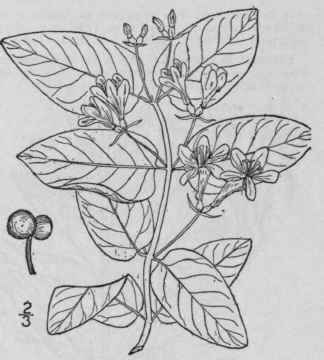
13. Lonicera Tatarica L. Tartarian Bush-Honeysuckle
Fig. 3991
Lonicera tatarica L. Sp. Pl. 173. 1753.
A glabrous shrub, 5°-10° high. Leaves ovate, rather thin, not conspicuously reticulate-veined, 1'-3' long, acute or obtusish at the apex, cordate at the base, not ciliate; flowers in pairs on slender axillary peduncles; corolla pink to white, 7"-8" long, the tube gibbous at the base, the limb irregularly and deeply 5-lobed, somewhat 2-lipped; peduncles 1' long; bracts linear, sometimes as long as the corolla-tube; stamens and style scarcely exserted; berries separate, red.
Escaped from cultivation, Ontario, Maine and Vermont to southern New York, New Jersey and Kentucky. May. Native of Asia. Garden fly-honeysuckle.
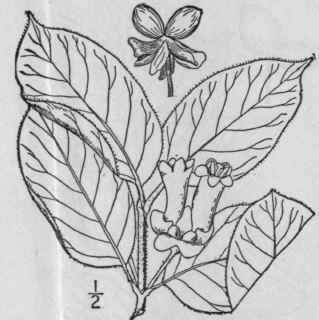
14. Lonicera Involucrata (Richards.) Banks. Involucred Fly-Honeysuckle
Fig. 3992
Xylosteum involucratum Richards. App. Frank.
Journ. Ed. 2, 6. 1823. Lonicera involucrata Banks; Richards, loc. cit.
1823. Distegia involucrata Rydb. Bull. Torr. Club 33:
152. 1906.
A glabrate or pubescent shrub, 3°-10° high. Leaves short-petioled, ovate, oval, or obovate, 2'-6' long, acute or acuminate at the apex, narrowed or rounded at the base, more or less pubescent, at least when young; peduncles axillary, 1'-2' long, 2-3-flowered; bracts foliaceous, ovate or oval, often cordate; bractlets also large, at length surrounding the fruit; flowers yellow; corolla pubescent, funnel form, the limb nearly equally 5-lobed; lobes short, little spreading; stamens and style slightly exserted; berries separate, globose, or oval, nearly black, about 4" in diameter.
In woodlands, New Brunswick and Quebec to western Ontario and Michigan, west to British Columbia and Alaska, south to Arizona, Utah and California. June-July.
Continue to:


My Books

