


45. Gnaphalium L. Sp. Pl. 850. 1753. Part 2
Description
This section is from the book "An Illustrated Flora Of The Northern United States, Canada And The British Possessions Vol3", by Nathaniel Lord Britton, Addison Brown. Also available from Amazon: An Illustrated Flora of the Northern United States, Canada and the British Possessions. 3 Volume Set..
45. Gnaphalium L. Sp. Pl. 850. 1753. Part 2
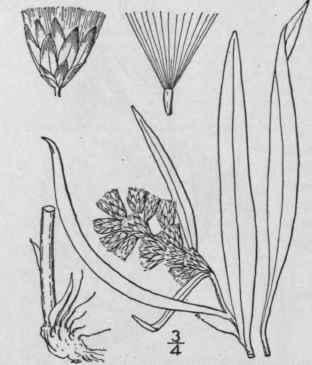
3. Gnaphalium Decurrens Ives. Clammy Everlasting. Winged Cudweed
Fig. 4408
Gnaphalium decurrens Ives, Am. Journ. Sci. 1: 380. pl. 1. 1819.
Annual or biennial, similar to the two preceding species, fragrant; stem very leafy, glandular-viscid, corymbosely branched above, 2°-3° high. Leaves lanceolate or broadly linear, acutish at the apex, densely white-woolly beneath, glabrate or loosely woolly above, sessile and decurrent on the stem at the base, 1'-3' long, 2"-3" wide, or the lowest shorter and slightly spatulate; heads in several or numerous corymbose glomerules of 2-6, about 3" high; bracts of the involucre yellowish-white or brownish, ovate, acutish or the inner lanceolate and acute, the outer woolly at base; pappus-bristles distinct; achenes glabrous.
In open, moist or dry places, Nova Scotia to Pennsylvania, West Virginia ?, Ontario, British Columbia, Michigan, south in the Rocky Mountains to Arizona. Sweet balsam. Balsam-weed. July-Sept.
4. Gnaphalium Palustre Nutt. Western Marsh Cudweed
Fig. 4409
Gnaphalium palustre Nutt. Trans. Am. Phil. Soc. (II) 7: 403. 1841.
Annual; diffusely branched from the base, densely but loosely floccose-woolly all over, 2'-%' high. Leaves sessile, oblong, linear-oblong, or the lower spatulate, obtuse or acutish, 6"-12" long, 1 1/2"-3" wide; heads about 2" high, several together in leafy-bracted glom-erules; involucre more or less woolly, its bracts linear or lanceolate, acute, white or pale yellow; pappus-bristles distinct, separately deciduous.
In moist wet soil, Saskatchewan to Montana, western Nebraska and New Mexico, west to British Columbia and California. May-Aug.


5. Gnaphalium Uliginosum L. Low Or Marsh Cudweed. Wartwort. Mouse-Ear
Fig. 4410
Gnaphalium uliginosum L. Sp. Pl. 856. 1753.
Annual; diffusely branched from the base, or the stems sometimes erect or ascending, ap-pressed-woolly all over, 2'-8' high. Leaves sessile, spatulate-linear, linear, or the lower oblanceolate or spatulate and narrowed into petioles, all obtuse or obtusish, generally mucronulate, 1'-1 1/2' long; heads about 2" high, numerous in dense leafy-bracted terminal glomerules; bracts of the involucre oblong or oblong-lanceolate, brown, the outer obtuse or obtusish and more or less woolly, the inner acute; pappus-bristles distinct, separately deciduous.
In damp soil, Newfoundland to Virginia, west to western Ontario, Saskatchewan, British Columbia and Oregon, and Indiana. Also in Europe. July-Sept.
6. Gnaphalium Supinum L. Dwarf Cudweed
Fig. 4411
Gnaphalium supinum L. Syst. Ed. 2, 234. 1767- Perennial, white-woolly, much tufted; stems simple, l'-31/2' high. Leaves mainly basal, linear, acute, narrowed at the base, sessile, 6"-12" long, 1"-2" wide; heads few or several, capitate or short-spicate, about 3" high; flowers yellowish; bracts of the involucre brown, glabrous, lanceolate or oblong-lanceolate, acute; pappus-bristles distinct, separately deciduous.
Alpine summit of the White Mountains of New Hampshire, and of Mt. Katahdin, Maine; Labrador and Greenland, and on high mountains in Europe and Asia. Called also mountain-cudweed. July-Aug.

Continue to:


My Books

