
![previous page: 34. Euphrasia [Tourn.] L. Sp. Pl. 604. 1753](../../../images/nav/page_prev.gif)


35. Bartsia L. Sp. Pl. 602. 1753
Description
This section is from the book "An Illustrated Flora Of The Northern United States, Canada And The British Possessions Vol3", by Nathaniel Lord Britton, Addison Brown. Also available from Amazon: An Illustrated Flora of the Northern United States, Canada and the British Possessions. 3 Volume Set..
35. Bartsia L. Sp. Pl. 602. 1753
Annual or perennial herbs, partly parasitic on the roots of other plants, with opposite leaves, and purple pink red or yellow flowers, in terminal leafy-bracted spikes. Calyx cam-panulate or tubular, 4-toothed or 4-cleft. Corolla very irregular, the tube straight or recurved, the limb 2- lipped; upper lip erect, concave, entire, the margins not recurved; lower lip spreading, 3- lobed. Stamens 4, didynamous, ascending under the upper lip of the corolla; anther-sacs similar, parallel. Capsule globose, oblong, or ovoid, loculicidally dehiscent, several-many-seeded. Seeds horizontal, striate, or ribbed. [Named for John Bartsch, a Prussian botanist, died 1738.]
About 6 species of the northern hemisphere. Only the following is known to occur in North America. Type species: Bartsia viscdsa L.
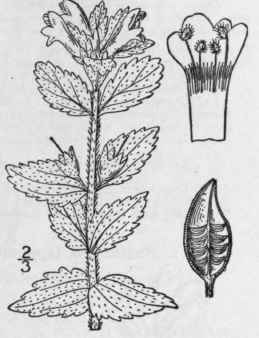
1. Bartsia Alpina L. Alpine Bartsia
Fig. 3844
Bartsia alpina L. Sp. Pl. 602. 1753.
Perennial by short rootstocks, pubescent; stem erect, leafy, simple, or rarely with 1 or 2 short branches, 4'-10' high. Leaves sessile, ovate, or ovate-oblong, crenate-dentate, obtuse or acutish, rounded and sometimes slightly clasping at the base, 1/2'-1' long; bracts similar, smaller, mostly shorter than the flowers; spike l'-2' long; flowers 8"-10" long, sometimes borne also in the upper axils; calyx 4-cleft nearly to the middle; corolla purple, its tube much longer than the calyx; anthers pubescent, at least on the back; capsule ovoid-oblong, equalling or longer than the calyx.
Labrador to Greenland and the Arctic Sea. Also in Europe. Summer.
Continue to:


My Books

