


31. Aster L. Sp. Pl. 872. 1753. Part 5
Description
This section is from the book "An Illustrated Flora Of The Northern United States, Canada And The British Possessions Vol3", by Nathaniel Lord Britton, Addison Brown. Also available from Amazon: An Illustrated Flora of the Northern United States, Canada and the British Possessions. 3 Volume Set..
31. Aster L. Sp. Pl. 872. 1753. Part 5
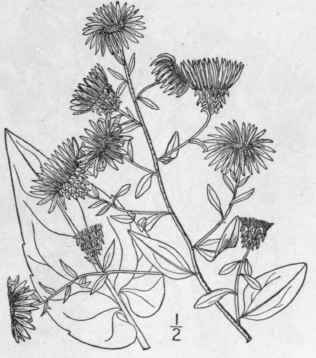
12. Aster Violaris Burgess. Violet-Leaf Aster
Fig. 4293
Aster violaris Burgess; Britt. & Brown, III. Fl. 3: 361. 1898.
Caudex thick, fleshy; plant glabrate, bluish green, minutely glandular; stem slender, erect, or assur-gent, 2° high, or less. Basal and lower leaves broadly reniform, abruptly acuminate or apiculate, often 3' long by 4' wide, their slender petioles 6'-8' long, the sinus very broad and shallow; middle stem leaves similar, not cordate; the upper numerous, long-elliptic, chiefly with narrowed bases, all thin, firm, rough above; inflorescence leafy, small, loose, rather narrow and high, paniculate-corymbose, nearly level-topped, its slender branches with nearly opposite, oblong leaves; heads 6" high, or more; rays 12-15, pale violet, narrow.
In shaded moist places, sometimes in leaf-mold among rocks, New York from the Hudson to Lake Erie. Sept-Oct.
13. Aster Multiformis Burgess. Various-Leaved Aster
Fig. 4294
Aster multiformis Burgess; Britt. & Brown, III. Fl. 3: 361. 1898.
Deep green, minutely glandular; stem erect, slender, 1°-2° high, angular-striate in drying. Basal leaves usually 2, large, thick, cordate-oblong, often accompanied by later smaller oblong ones; stem leaves very thin, sharply serrate, rough above, minutely puberulent beneath, the lower ovate, acuminate, usually with a narrow sinus, the upper oval to ovate-lanceolate, petioled, the uppermost elliptic-lanceolate, serrulate, sessile or nearly so; inflorescence small, its branches upwardly curved; heads about 7" high; rays about 13, rounded and retuse at the apex; bracts green, glands few, almost hidden by the minutely strigose pubescence of the peduncles.
In moist shaded places, Maine to western New York, Pennsylvania and Maryland. July-Aug.


14. Aster Nobilis Burgess. Stately Aste
Fig. 4295
Aster nobilis Burgess; Britt. & Brown, III. Fl. 3: 361. 1898.
Tall, minutely glandular above; stem shining, bright green, 4°-5° high. Leaves thin, but firm, smooth in growth, roughened in drying, minutely puberulent beneath, dark green, basal and lower leaves large, the blade often 9' long by 6' wide, about as long as the stout petiole, sharply toothed, the sinus deep, broad, or the lobes overlapping; stem leaves similar, the upper oblong-lanceolate, sessile; inflorescence irregularly cy-mose-paniculate, with small subulate recurved leaves; bracts long, acute, green; heads 6" high, or less; rays 13-15, violet-blue or pale violet; disk-flowers not numerous, their corollas funnel-form with a long capillary tube.
In leaf-mold, Lake Champlain to Lake Erie. Aug.
15. Aster Anomalus Engelm. Many-Rayed Aster
Fig. 4296
Aster anomalus Engelm.; T. & G. Fl. N. A. 2: 503. 1843.
Stem rough, rather stout, branched above, 1°-3° high. Leaves thin, the lower and basal ones deeply cordate, ovate, or ovate-lanceolate, entire or slightly repand, rough-pubescent on both surfaces, acute or acuminate at the apex, 3'-4' long, 1'-2' wide, on slender naked petioles; upper leaves short-petioled or sessile, lanceolate, oblong, or linear, much smaller; heads few, 4"-6" high, I2"-I5" broad; receptacle hemispheric, its bracts lanceolate, acute, or acuminate, hirsute, imbricated in several series, their foliaceous tips spreading or re-flexed; rays 30-45, 5"-6" long, bright violet-blue; pappus whitish.
On limestone cliffs, Illinois to Missouri and Arkansas. Sept.

Continue to:


My Books

