


25. Aphanostephus Dc. Prodr. 5: 310. 1836
Description
This section is from the book "An Illustrated Flora Of The Northern United States, Canada And The British Possessions Vol3", by Nathaniel Lord Britton, Addison Brown. Also available from Amazon: An Illustrated Flora of the Northern United States, Canada and the British Possessions. 3 Volume Set..
25. Aphanostephus Dc. Prodr. 5: 310. 1836
Erect or ascending canescent branching herbs, with alternate leaves, and rather large heads of both tubular and radiate flowers, solitary at the ends of the branches. Involucre hemispheric, its bracts lanceolate or linear, scarious-margined, imbricated in a few series, the outer smaller. Receptacle convex or conic, naked. Ray-flowers pistillate, white or purplish.
Disk-flowers perfect, yellow, their corollas tubular, the limb expanded above, 5-dentate.
Anthers obtuse and entire at the base. Style-branches flattened, their appendages short, obtuse. Achenes many-ribbed. Pappus a short dentate crown. [Greek, faint-crown.]
About 5 species, natives of the southwestern United States and Mexico. Type species: Aphanostephus ramosissimus DC.
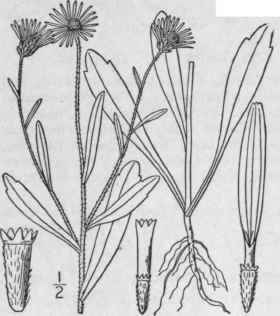
1. Aphanostephus Skirrobasis (Dc.) Tre-Lease. Aphanostephus
Fig. 4269
Keerlia skirrobasis DC. Prodr. 5: 310. 1836.
Leucopsidium arkansanum DC. Prodr. 6: 43. 1837.
Aphanostephus arkansanus A. Gray, Pl. Wright. 1: 93. 1852.
Aphanostephus skirrobasis Trelease; Coville & Bran-ner, Rep. Geol. Surv. Ark. 1884: Part 4, 191. 1891.
Erect, or diffusely branched, densely canescent, 6'-2° high. Basal and lower leaves spatulate, obtuse, 1'- 4' long, somewhat dentate, laciniate or entire, narrowed into margined petioles; upper leaves lanceolate, oblong or oblanceolate, obtuse or acute, mostly sessile, smaller; heads 8"-12" broad, 3"-5" high; rays numerous, narrow, entire; achenes ribbed and angled; pappus a lobed or dentate crown.
In dry soil, Kansas to Texas and Chihuahua, east to Florida. May-Aug.
Continue to:


My Books

