


2. Orobanche [Tourn.] L. Sp. Pl. 632. 1753
Description
This section is from the book "An Illustrated Flora Of The Northern United States, Canada And The British Possessions Vol3", by Nathaniel Lord Britton, Addison Brown. Also available from Amazon: An Illustrated Flora of the Northern United States, Canada and the British Possessions. 3 Volume Set..
2. Orobanche [Tourn.] L. Sp. Pl. 632. 1753
Glandular-pubescent, erect simple or branched, reddish yellowish violet or nearly white herbs, parasitic on the roots of various plants, with scattered scales, and spicate or racemose, complete and perfect, bracted and sometimes bracteolate flowers. Calyx split both above and below, nearly or quite to the base, the divisions 2-cleft or rarely entire, or more or less unequally 2-5-toothed. Corolla oblique, strongly 2-lipped; upper lip erect, emarginate or 2-lobed; lower lip spreading, 3-lobed. Stamens included; anther-sacs mostly mucronate at the base. Placentae equidistant, or approximate in pairs. Style slender, commonly persistent until after the dehiscence of the capsule; stigma peltate to funnelform, entire, or laterally 2-lamellate. [Greek, Choke-vetch.]
About 90 species, natives of the Old World and western America. Besides the following some 6 others occur in the western parts of North America. Type species: Orobanche major L.
Calyx 4-toothed; stems mostly branched.
1. O. ramosa.
Calyx split on both sides; stem simple.
2. O. minor.
Calyx 5-cleft; stem simple.
3. O. ludoviciana.
1. Orobanche Ramosa L. Hemp Or Branched Broom-Rape
Fig. 3878
Orobanche ramosa L. Sp. Pl. 633. 1753.
Plant yellowish; stem rather slender, branched, or rarely simple, 3'-15' high, the scales few and distant, 2"-5" long. Spike loosely many-flowered, denser above than below, the lowest flowers short-pedi-celled; bracts usually 3, the longest about equalling the calyx; calyx 4-toothed, the teeth triangular-ovate, acute, or acuminate, about as long as the tube; corolla s"-9" long, the tube yellow, slightly constricted above the ovary, the limb bluish.
Parasitic on the roots of tomato, hemp and tobacco, New Jersey, Illinois, Kentucky. Adventive or naturalized from Europe. Summer. Strangle-tare.
Orobanche purpurea Jacq., another European species, with violet flowers and a 5-toothed calyx, is recorded as found on Achillea in lawns a: Wingham, Ontario.

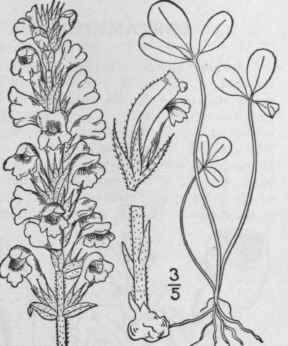
2. Orobanche Minor J. E. Smith. Lesser Or Clover Broom-Rape. Herb-Bane
Fig. 3879
O. minor J. E. Smith, Engl. Bot. pl. 422. 1797.
Plant yellowish-brown; stem rather stout, simple, 4'-2o' high; lower scales numerous, ovate-oblong, the upper lanceolate, acute, scattered, 3"-10" long. Spike dense, or the lower flowers separated, 3's' long; bracts 1 or 2, lanceolate, equalling or longer than the flowers; flowers 5"-9" long; calyx split both above and below, each of the lateral segments 2-cleft, the teeth lanceolate-subulate; corolla-tube yellowish, scarcely constricted above the ovary, the limb bluish.
Parasitic on the roots of clover, New Jersey to Virginia. Naturalized from Europe. Called also devil's-root and hell-root. Strangle-tare. May-July.

3. Orobanche Ludoviciana Nutt. Louisiana Broom-Rape
Fig. 3880
Orobanche ludoviciana Nutt. Gen. 2: 58. 1818. Aphyllon ludovicianum A. Gray, Bot. Cal. 1: 585. 1876. Mysorrhisa ludoviciana Rydb.; Small, Fl. SE. U. S.
1093. 1903.
Stems stout, simple, solitary or clustered, viscid-puberulent, 4'-12' high, scaly. Flowers 6"-8" long, very numerous in dense terminal spikes, 1-2-bracteo-late under the calyx; calyx 5-cleft, the lobes somewhat unequal, linear-lanceolate, acuminate, longer than the corolla-tube, or shorter; corolla 2-lipped, purplish, its tube narrow, about twice as long as the limb, the teeth of its lips acute; anthers woolly; capsule ovoid-oblong, shorter than the calyx.
In sandy soil, Illinois to South Dakota, Saskatchewan, Nebraska, Texas, Arizona and California. Strangle tare. June-Aug.
Continue to:


My Books

